Human females are the only mammals on Earth that routinely live decades beyond their reproductive years. In nearly every other species, females remain capable of reproduction until close to death, because evolution typically stops investing in an individual once it can no longer produce offspring. Yet human women routinely live 30, 40, or even 50 years past menopause, remaining healthy, active, and cognitively sharp. Evolution, which is notoriously efficient, does not pay biological costs without a return.
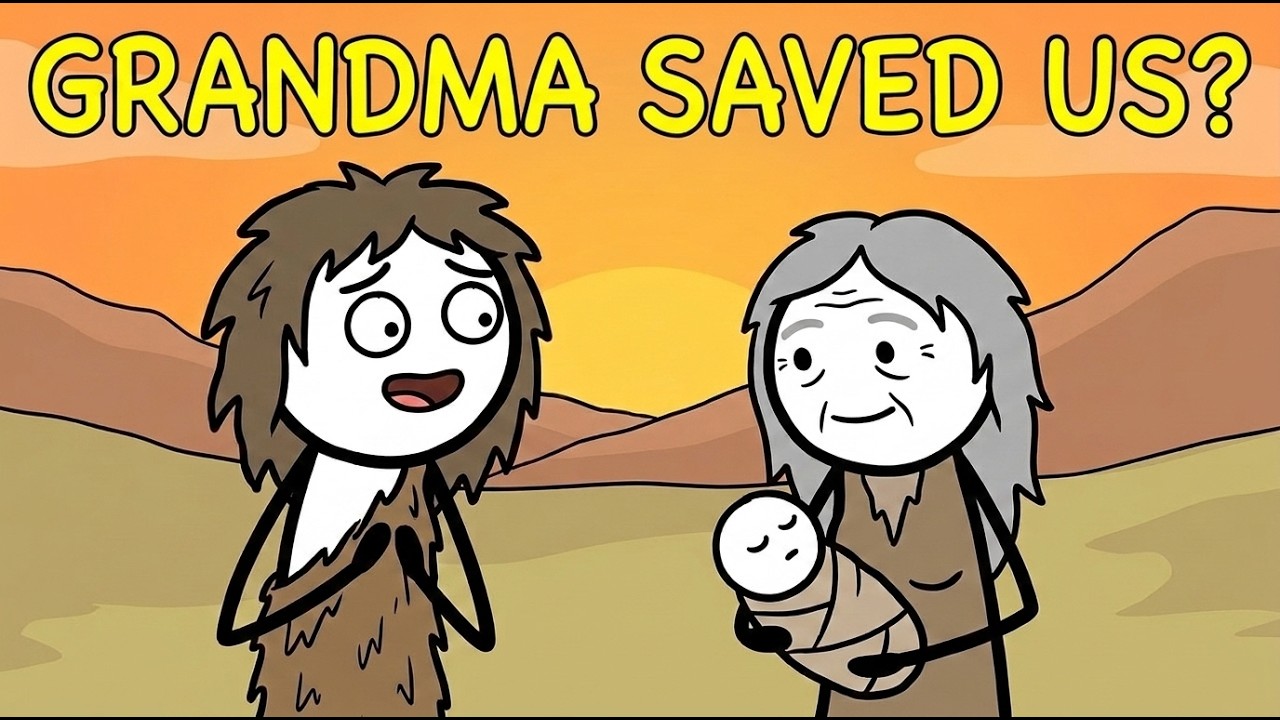
The question of what that return is has produced one of the most counterintuitive findings in evolutionary biology: the grandmother hypothesis. In 1966, biologist George Williams first identified what is known as the menopause puzzle. Natural selection appeared to preserve female longevity past the point of reproduction, which seemed to serve no evolutionary purpose. Williams tentatively proposed that post-reproductive females might improve the survival chances of their grandchildren, allowing their own genes to propagate more effectively through their grandchildren than through additional pregnancies at an advanced age.
The idea remained largely dormant for decades. In the 1990s, anthropologist Kristen Hawkes traveled to Tanzania to study the Hadza, one of the last remaining hunter-gatherer populations on Earth, whose lifestyle closely approximates ancestral human patterns. She went to study hunters but ended up discovering grandmothers. Hawkes observed that when Hadza mothers weaned a child and became pregnant again, the newly weaned child’s nutritional intake dropped significantly.
Young children in hunter-gatherer groups cannot forage effectively on their own, lacking the strength, knowledge, and fine motor skills to process adult foods. A pregnant or nursing mother has limited capacity to provision both a new infant and a newly weaned child simultaneously. The newly weaned children did not starve, however. Their nutrition held up remarkably well, and Hawkes found the same explanation repeated across families and seasons: grandmothers were feeding them.
Hadza grandmothers spent more time foraging than any other demographic group, including young adult women. They were more efficient foragers than their daughters, drawing on decades of accumulated knowledge about where food was located, how to process it, and which sources were most reliable in each season. They directed most of what they gathered not toward themselves but toward their grandchildren. Children with active, present grandmothers were measurably better nourished, grew faster, and survived at higher rates than children without them.
The grandmother was not a passive elder receiving care from the group. She was a high-productivity economic contributor whose output was specifically directed toward the survival of the next generation. This finding triggered three decades of research that has filled in extraordinary details. Knowledge transfer is one of the most dramatic dimensions.
A grandmother in a hunter-gatherer group typically held more than 40 years of accumulated environmental knowledge: where food sources were located across seasonal cycles, which plants were edible at which stages, which water sources remained reliable in dry years, how to read weather signs, how to process foods requiring complex preparation, and what to do when children became sick. This knowledge existed only in the minds of those who had lived long enough to accumulate it. Losing a grandmother meant losing a specific, irreplaceable archive of survival-critical information. The grandmother hypothesis also has a parallel on the male side.
Older men in hunter-gatherer contexts typically contributed differently but significantly. While men’s reproductive capacity declines more gradually than women’s, older men continued to contribute substantially to group productivity long past their peak physical strength. Older men were often the most skilled hunters, not because they were strongest or fastest, but because hunting success correlates more strongly with knowledge, patience, and strategic thinking than with raw physical capacity. Studies of Hadza hunters consistently find that hunting returns peak in men in their 40s and remain high into their 50s and 60s.
A 55-year-old Hadza man is typically a more productive hunter than a 20-year-old, because his knowledge and judgment advantage overwhelms any physical disadvantage. Older men also typically held the primary knowledge of intergroup relationships: which neighboring groups were allies or threats, the history of conflicts and cooperations, and the complex obligations governing exchange. The grandmother hypothesis makes a specific, testable prediction: if grandmothers substantially increase grandchild survival, then the presence of a living maternal grandmother should produce a detectable difference in child mortality. This has been tested across historical population records from pre-industrial Finland, 18th-century Quebec, Gambian villages, and historical Japanese census data.
The results are consistent: children with a living, proximate maternal grandmother show measurably lower mortality rates than those without. The effect is specific to maternal grandmothers, which makes biological sense, as maternal grandmothers are genetically certain relatives. Paternal grandmothers face a small genetic uncertainty through the father. The effect size varies across studies, but the direction is consistent.
Living grandmothers are statistically protective for child survival; dead or distant ones are not. The grandmother hypothesis implies that human longevity itself was partly driven by the fitness benefits of accumulated knowledge and intergenerational care. The long human lifespan is not simply a byproduct of large brains or medical advancement. It is at least partly an adaptation to the value of accumulated wisdom in a species dependent on cultural knowledge rather than instinct.
The grandmother hypothesis adds a profound complication to the standard evolutionary view of aging as entropy that natural selection cannot see. If post-reproductive individuals provide substantial fitness benefits to relatives, selection can see them indirectly. Selection on genes keeping grandmothers healthy and cognitively sharp simultaneously improves grandchild survival. The human pattern of relatively slow cognitive decline and preserved physical capacity into the 60s and 70s may partly reflect selection on post-reproductive fitness effects.
Grandmothers were healthy because evolution needed them to be. The grandmother hypothesis also implies a specific social organization for ancient human groups, one that was multigenerational, with the oldest generation economically active and socially central. Knowledge flowed from older to younger as a primary mechanism of cultural transmission, and child care was genuinely distributed across generations rather than concentrated in parents alone. Anthropologists call any individual other than the mother who contributes to infant care an allomother, and this is a universal feature of human societies in a way that is unusual among primates.
Human infants are more dependent for longer than any other primate infant, requiring more calories, care, teaching, and protection for a longer period than any other species. The grandmother was not supplementing a self-sufficient parenting system; she was a structural component of a parenting system designed around her presence. One of the most consequential grandparental contributions may have been the management of conflict within the group. Ancient human groups were small, dense, and under continuous resource pressure, conditions that produce interpersonal conflict over food, mates, status, and sleeping spots.
Unresolved conflict is dangerous; groups that fracture lose the cooperative advantages that keep them alive. Studies of modern hunter-gatherer and traditional societies consistently identify older adults, particularly older women, as the primary agents of conflict resolution within the group. Their social memory, who owes what to whom, what agreements were made, and what precedents exist, provided workable solutions. A grandmother keeping the group together was doing something as important as feeding grandchildren: preserving the social infrastructure that made everything else possible.
Storytelling and language transmission were equally vital. In pre-literate society, the oldest members held the deepest story libraries and had the most time to tell them. Grandmothers were often the most available adults, remaining at camp with young children while parents foraged or hunted. The stories they told were not entertainment but knowledge delivery systems: how food was found in the drought year two decades ago, what happened when the group met strangers, why certain behaviors were dangerous.
The grandmother’s story was her foraging knowledge delivered in a form a child’s developing brain could absorb and retain. Children over-imitate adults with unusual fidelity, copying not just functional actions but apparently irrelevant details, because their brains cannot yet distinguish which details matter. This mechanism allows cultural knowledge to transmit with high fidelity across generations. Extending this logic across multiple generations reveals that a grandmother who lived to 70 was a living archive of rare events: droughts, floods, disease outbreaks, conflicts, and resource failures spanning five or six decades.
The specific knowledge of how to handle a situation occurring once every 30 years exists only in those who were alive and paying attention the last time it happened. Losing the oldest people means the next rare event becomes the first rare event again, with all the mortality that implies. The grandmother was insurance against catastrophes the group had never seen because she had seen them before. The grandmother hypothesis also lands directly on how we organize our lives today.
The modern world has systematically dismantled the conditions under which the grandmother effect operates. Nuclear families live in separate dwellings, often geographically dispersed from extended family, and elderly individuals are frequently placed in institutional settings that separate them from grandchildren. For the vast majority of human history, grandmothers were present nearby and actively involved in the care and education of grandchildren. The modern arrangement, in which grandparents are optional supplements rather than structural components of the child care system, is a deviation from the ancestral pattern so recent that evolution has had no time to respond.
Studies of modern families consistently find that children with involved, proximate grandparents show measurable benefits in academic outcomes, emotional regulation, and social competence, while involved grandparents show better cognitive outcomes and lower mortality than those socially isolated. Ancient humans needed grandparents to survive because the human system of child rearing, the longest, most expensive, most knowledge-intensive developmental period of any species, was never designed to run on parental effort alone. It was designed to run on a distributed network of care, knowledge, and provisioning in which the oldest generation played the central role. The grandmother’s presence made shorter birth intervals possible, kept newly weaned children fed, transmitted decades of survival-critical knowledge, resolved internal conflicts that would have fractured the group, and maintained the intergenerational memory that made human culture cumulative rather than perpetually reinvented.
Every human being alive today is a product of that system working. The extended human lifespan exists because of grandmothers. Human culture exists because of grandmothers.
The depth of knowledge transmission separating human civilization from every other species exists because evolution found a way to make old women indispensable after reproduction.