Somewhere inside your head, a voice is reading these words to you right now. You did not consciously start it, and you cannot easily stop it. That voice is so automatic, so deeply wired into human cognition, that it feels impossible to separate from thought itself. But the question of how that voice first came to exist—how any human being ever spoke a meaningful word—is one of the most contested puzzles in science.
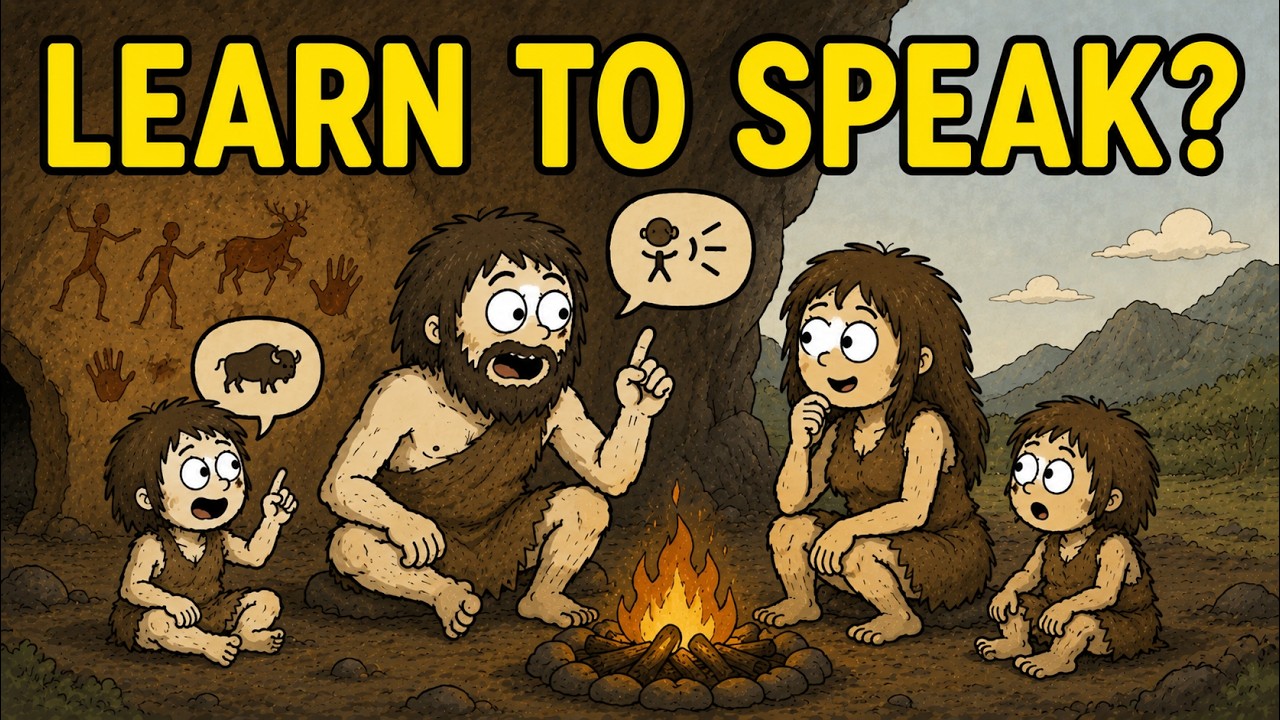
The problem is stark: speech leaves no physical trace. You cannot dig up a word or carbon date a sentence. Unlike a stone tool or a fossilized bone, language vanished into the air the moment it was uttered. Yet the greatest transformation in human history happened precisely through this invisible medium, and scientists have been piecing together its origins from bones, genes, animal behavior, infant development, and ancient campsites.
The story that emerges is far more intricate than a single moment of genius. Language did not begin when one person decided to invent it. It grew gradually and collectively, shaped by millions of years of evolution in social situations that increasingly rewarded the ability to share precise information. By around 300,000 years ago, anatomically modern humans—Homo sapiens—had appeared on Earth.
They had the round skull, the flat face, the chin. But physically modern does not mean behaviorally modern. The archaeological record from that period shows stone tools of designs used for hundreds of thousands of years, but little evidence of symbolic thinking. Beads, engraved patterns, and deliberate burials appear much later, roughly 50,000 to 100,000 years ago, a timing that remains deeply controversial.
Some researchers believe language arose recently, around 70,000 to 100,000 years ago, as part of a broader cognitive revolution. Others argue it evolved far more gradually, stretching back hundreds of thousands of years. Neither camp has conclusively won. To understand what language required, scientists look at what came before.
Animal communication systems are genuinely sophisticated. Birds learn songs from others. Wolves coordinate through synchronized howling. Elephants use low-frequency rumbles that carry specific social information for miles.
Dolphins maintain identity through signature whistles. Within the primate lineage, the most striking example comes from vervet monkeys in East Africa. In the early 1980s, researchers Robert Seyfarth and Dorothy Cheney conducted experiments in Amboseli, Kenya that reshaped the field. They showed that vervet monkeys produce acoustically distinct alarm calls for different predators.
The call for a leopard sends monkeys up into trees. The eagle call makes them look skyward and dive into dense vegetation. The python call makes them stand upright and scan the ground. Crucially, when the researchers played back recorded calls through hidden speakers with no predator present, the troop responded appropriately every time.
The sound itself carried specific information about the world. But vervet alarm calls are not language. They are a closed set. Vervets cannot combine calls to produce new meanings or talk about events from yesterday or tomorrow.
The system is rigid, genetically constrained, and emotionally driven. The transition from this kind of communication to human language required something categorically new. The body had to change first. A chimpanzee’s larynx sits high in the throat, limiting the range of sounds it can produce.
You cannot teach a chimpanzee to speak, not from a failure of intelligence, but because the physical machinery is not there. In humans, the larynx descended lower, creating a longer pharynx that allows the tongue to move in two dimensions. This enables the enormous range of distinct vowel sounds that make spoken language possible. Fossils of earlier human relatives like Homo heidelbergensis show evidence of a transitional vocal tract.
One of the most informative bones in this story is the hyoid, a small horseshoe-shaped bone that anchors the muscles of the tongue and larynx. In 1989, researchers excavating Kebara Cave in Israel discovered a remarkably preserved Neanderthal hyoid from roughly 60,000 years ago. Its shape was nearly identical to modern humans, and three-dimensional imaging showed internal architecture consistent with how we use our hyoids during speech. This suggested Neanderthals had at least some of the physical apparatus for speech.
Breath control matters just as much. Producing fluent speech requires precise control of the muscles between the ribs and the abdomen. In modern humans, the spinal canal in the chest region is noticeably wider, allowing a denser nerve supply to the breathing muscles. This feature appears in the fossil record around 600,000 years ago.
Together, the descended larynx, flexible tongue, expanded nerve supply, and modern hyoid made spoken language physically possible. But they did not create it. A parrot can produce complex sounds, but it is not composing sentences. The hardware was necessary but not sufficient.
In 2001, scientists studying a British family known as the KE family discovered something extraordinary. Roughly half of this 30-person family had a striking speech and language impairment inherited across three generations. They struggled to coordinate precise mouth, tongue, and lip movements, a condition called verbal dyspraxia, and showed deficits in understanding grammatical rules. The cause was a mutation in a single gene, FOXP2.
The media immediately dubbed it the language gene, but the reality is more interesting. FOXP2 does not encode grammar or vocabulary. It regulates the development of brain circuits connecting the cortex to deeper structures involved in learning and coordinating movement sequences. The human version of FOXP2 differs from the chimpanzee version at two positions.
Initially, researchers believed these changes appeared recently, perhaps 200,000 years ago. Then ancient DNA research changed the picture. Neanderthals carried the same two changes, pushing the appearance back to before the split between our species and theirs, around 300,000 to 400,000 years ago. More recent genomic analysis suggests the changes may go back roughly 1.
8 to 1. 9 million years, around the time the genus Homo first appeared. Language did not spring from a single recent mutation. The genomic architecture supporting speech was assembled over an enormous stretch of time.
The human brain weighs about 3 pounds and contains around 86 billion neurons. Yet other animals with impressive brains never developed anything remotely resembling language. Dolphins have highly folded brains and sophisticated social relationships, but they do not have grammar. New Caledonian crows manufacture tools and remember individual human faces across years, but their calls carry nothing like structural complexity.
A chimpanzee named Kanzi, the subject of decades of research, demonstrated understanding of spoken English beyond expectations, but never spontaneously invented symbols, asked questions, or produced anything resembling the recursive sentences human children produce naturally by age four. The difference is not simply intelligence. It is about specific cognitive mechanisms. One is joint attention, the ability to deliberately direct another’s attention to something in the shared environment.
When a human infant points at a dog, they are making a social bid: look at the same thing I am looking at. When the caregiver responds with the word dog, the infant knows the word refers to the shared object. This triangular relationship—self, other, shared object—is the basic architecture on which word learning is built. Joint attention is much more limited in other great apes.
A second mechanism is recursion, the ability to embed structures within structures, producing sentences of unlimited complexity from a finite set of elements. Whether any other animal possesses this capacity in anything like the human form remains intensely debated. The control of fire did not just keep early humans warm. It restructured time.
Before fire, darkness meant danger and stillness. Fire created a safe illuminated space in the dark. Robin Dunbar, an anthropologist at the University of Oxford, argued that the hours around a campfire represented a genuinely new category of human time, hours that could not be used for foraging but were safe and social. Research on contemporary hunter-gatherer communities like the Hadza of Tanzania documents a striking shift: daytime talk is practical, but evening campfire conversation is dominated by storytelling, discussions of relationships, distant people, past events, and imaginings about the future.
Polly Wiessner, an anthropologist who worked with the ! Kung San of the Kalahari, published research in 2014 in the Proceedings of the National Academy of Sciences documenting this pattern. Content that requires displacement, talking about things not present, flourished around fire. Fire also enabled cooking, which changed diet and digestion.
Cooked food is softer, and over generations this contributed to a reduction in jaw size. A smaller, less muscular jaw is more mobile, better suited to the precise articulatory movements clear speech requires. Ecological pressure also played a role. The large herbivores of the African Pleistocene were not easy prey.
A single hunter facing one was at serious risk, but groups working together could succeed. Coordination requires communication. Setting an ambush requires assigning roles. Driving prey toward a cliff or a river requires a shared plan that exists before the hunt begins.
Responding to unexpected developments in real time requires rapid, specific communication about direction and timing. Voice carries further than gesture and works when people cannot see each other. Groups that could coordinate hunting through more precise vocal communication would have had a measurable survival advantage. Over many generations, natural selection would have favored the features that made precise vocal communication easier.
This is a central argument researchers like Steven Pinker have made for language as a biological adaptation. There is a competing view that the hands came first. Great apes in the wild use gestures in highly flexible, intentional ways, strikingly different from the largely involuntary nature of their vocalizations. Neurological evidence supports this: in the primate brain, a region in the premotor cortex contains mirror neurons that fire both when the animal performs an action and when it observes the same action.
In humans, the corresponding region is Broca’s area, one of the main language regions. The most powerful evidence is sign languages. They are fully developed linguistic systems with their own syntax and recursive construction. They arise spontaneously.
The Nicaraguan sign language, which emerged in the 1980s when deaf children were brought together in schools, developed from simple home signs into a complex grammatical system within a single generation, with later children creating a richer version than their predecessors. Watch a human infant over the first two years and you see a compressed replay of something that took the species enormous time. Newborns prefer their mother’s voice within hours, having heard it through the uterine wall for months. By 3 months, they engage in proto-conversations, taking turns and matching their caregiver’s timing and emotional tone.
By 9 months, they begin to follow gaze and direct it through pointing. The first recognizable words appear between 10 and 14 months, usually for things in the shared field of attention. The vocabulary explosion that follows is driven by fast mapping, attaching a new word to a new meaning after a single exposure. Grammar emerges gradually.
By age two, children combine words. By age four or five, they use relative clauses and construct narratives, without formal instruction. Children extract regularities from the language around them and apply them to new forms. Words without grammar are a collection of things.
Grammar transforms that collection into a system capable of describing anything. Consider the difference between “the lion followed the hunter” and “the hunter followed the lion. ” The words are identical; the meaning is not. In the context of the African Pleistocene, the difference could be fatal.
Grammar encodes which animal is the agent and which is acted upon. Or consider “I found water” versus “I would have found water if. ” Grammar enables displacement, talking about times, places, and events that are not present, requiring systems that mark tense, modality, and conditionality. The evolutionary origin of grammar is one of the deepest unsolved problems.
One hypothesis, developed by Noam Chomsky and collaborators, proposes that the key innovation was a mental operation called merge, the ability to take two elements and combine them into a larger unit that can itself be combined. Applied recursively, this generates infinite sentence structures. Whether merge evolved all at once or gradually is fiercely debated. What is not debated is that grammar transformed what language could do.
For perhaps a hundred thousand years, Homo sapiens shared Europe and Western Asia with Neanderthals. These were not primitive creatures. They had brains at least as large as ours, made complex tools, controlled fire, and buried their dead. The fossil record includes perforated eagle talons and shells with pigment traces.
Their hyoid bones were anatomically similar to ours. Their auditory anatomy was tuned to frequencies overlapping the range most important for human speech. They carried the same FOXP2 variants. All this suggests they had the physical capacity for spoken communication.
Whether it reached the grammatical complexity of modern human language is unknown. What we know is that by roughly 40,000 years ago, they were gone, though genomic analysis shows they interbred with modern humans, and most people outside sub-Saharan Africa carry between 1 and 4% Neanderthal DNA. Their extinction had multiple causes. But some researchers propose that differences in the efficiency of language could have contributed to an adaptive gap, that modern humans’ ability to coordinate larger groups and accumulate knowledge across generations gave a compounding advantage.
This hypothesis is impossible to confirm, but not implausible. Before language, knowledge died with the person who held it. A technique could only travel as far as direct observation allowed. Language changed this completely.
With words, a technique could be described, an event narrated, a warning issued about a danger the listener had never encountered. This shift from knowledge stored in individual minds to knowledge stored in shared language was the beginning of what we now call culture. Every technology, institution, and scientific finding today is part of a chain of cultural transmission tens of thousands of years long. No other animal has anything comparable at scale.
Chimpanzees transmit some behaviors culturally, but the fidelity, complexity, and cumulative nature of human transmission is categorically different, and language is the reason. Modern linguistics has documented over 7,000 distinct languages spoken on Earth. Beneath the surface diversity are patterns that appear universal: all languages have nouns and verbs or equivalents, ways of asking questions, marking time, and expressing negation. All use a small set of sounds, typically 15 to 50 phonemes, combined in rule-governed ways.
These universals suggest all human languages are built on the same underlying cognitive architecture. The diversity comes from isolation and time. As populations migrated out of Africa beginning around 70,000 years ago, separated groups developed languages independently. Historical linguistics has identified large families like Indo-European and Niger-Congo, traceable back to single ancestor languages.
But beyond about 8,000 to 10,000 years, the signal of shared ancestry becomes too weak to detect. The deepest part of language’s history stretches into a past that linguistic methods cannot reach. The first true word—a sound used deliberately with shared understanding, capable of referring to something not immediately present—is unknown and unknowable. Language leaves no direct physical trace.
We have the bones of the people who spoke, the tools they made, the pigments they mixed. We do not have a single syllable of what they said. Every word spoken before the invention of writing, approximately 5,000 years ago, has been absorbed by the air and dispersed. What remains is a reconstruction, a careful, probabilistic, evidence-constrained story.
We can say with confidence that the physical prerequisites for speech were in place by several hundred thousand years ago, that social and ecological conditions favoring more complex communication were present even earlier, and that the cognitive capacities required for language appear specifically human in their developed form. By the time humans produced symbolic art tens of thousands of years ago, they almost certainly possessed language capable of supporting it. But the first word, the specific sound in a specific moment by a specific person that crossed the threshold from signal to symbol, is lost. A thought experiment clarifies what language does.
Without it, human cognitive life does not disappear. Perception, emotion, spatial reasoning, social awareness would remain. What disappears is the ability to share the contents of one mind with another in arbitrary detail. There would be no formal education, no written or oral history, no science, no law, no large-scale cooperation among strangers.
The compounding accumulation of knowledge that produced the modern world would not have occurred. Intelligence alone, without the ability to share and transmit it, produces local solutions that die with the individual. Language is not just a communication tool. It is the substrate on which human civilization was built.
The question assumes language was invented the way a specific individual invents a specific device. But language was not invented. It was evolved biologically over millions of years and culturally over hundreds of thousands of years through countless interactions among countless individuals who were not trying to invent anything. The biology provided the capacity; the culture provided the content.
The first meaningful sound was probably not recognized as an invention by anyone who heard it. It was just a sound that worked, carrying information others could use. It got repeated and imitated and refined.
And out of that unremarkable beginning, across a time span almost impossible to comprehend, came every word in every language ever spoken by every human being who has ever lived.