Modern humans spend billions of dollars trying to solve a problem that ancient humans never had. Gyms, fitness trackers, high-tech running shoes, and workout supplements all exist to motivate physical exertion. But for ancient humans, the very idea of exercise as a separate activity would have been completely foreign. The key distinction is that physical activity and exercise are not the same thing.
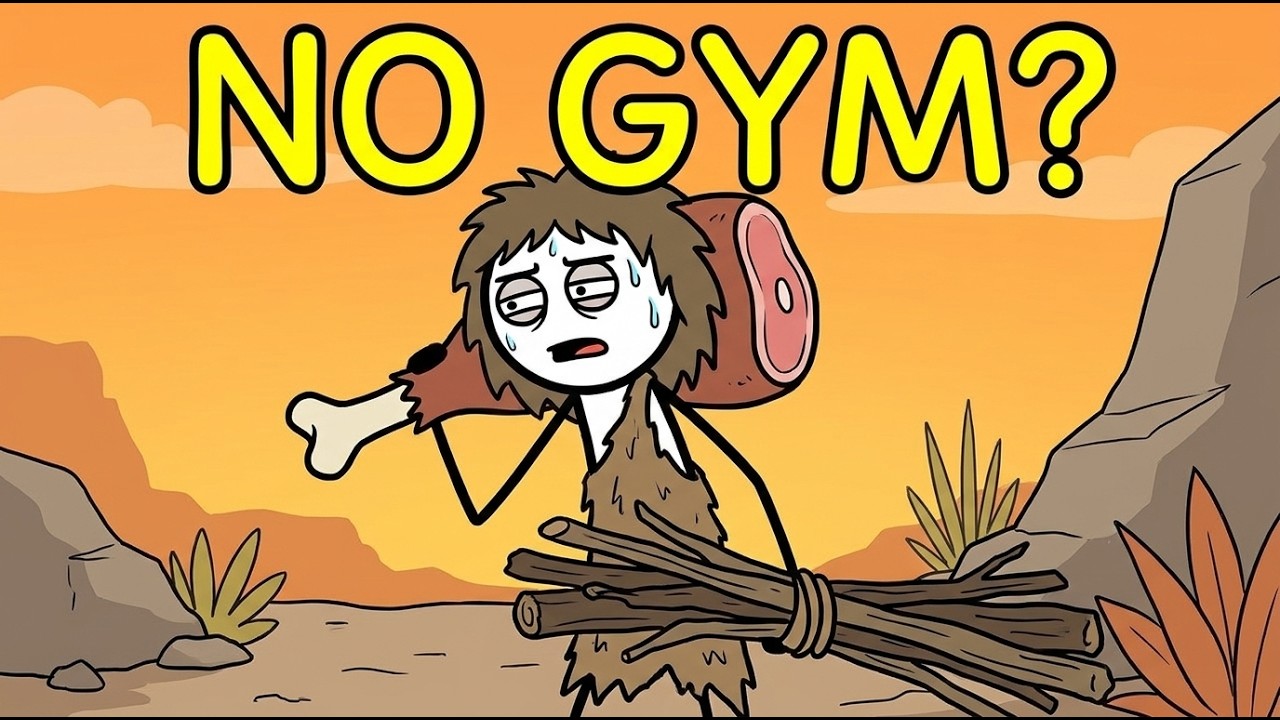
Physical activity is movement with an external purpose—walking, carrying, climbing, or digging. Exercise is movement done purely for its own sake, where the run goes nowhere and the weight is lifted only to be put back down. Ancient humans were extraordinarily active, but they were not exercising. The movement in their daily lives was obligatory, not optional.
They moved because survival demanded it. The crucial difference is that this activity had a tangible purpose, which shaped how their bodies and minds responded to it. Hunter-gatherer populations studied in the modern era show daily activity levels that would be classified as athletically elite by contemporary standards. The Hadza of Tanzania, for example, walk an average of 10 to 15 kilometers per day during active foraging periods.
This is their ordinary baseline, not their exceptional day. The physical demands of hunting went far beyond walking. A successful large animal hunt might cover 30 kilometers in a day, involving sprinting, climbing, swimming, and wrestling prey, followed by butchering and carrying hundreds of kilograms of meat back to camp. This constant loading left traces in the skeleton.
Ancient human long bones are denser than modern ones. Muscle attachment sites are more pronounced, indicating larger, more consistently loaded muscles. The fossil record paints a picture of a body used hard every day for decades, without scheduled recovery weeks or personal trainers. This physical demand was not experienced as a burden.
It was just life. The separation between effort and existence that makes modern exercise feel like a chore did not exist. The movement was inseparable from eating, staying warm, and maintaining the social relationships that kept a person alive. The human body evolved under these conditions of obligatory activity.
Systems involving metabolism, hormones, cardiovascular function, immune response, and mental health all developed in an environment where sustained movement was a daily constant. When that constant is removed, those systems do not simply sit idle. They dysregulate. This helps explain the modern chronic disease landscape.
Cardiovascular disease, type 2 diabetes, metabolic syndrome, certain cancers, depression, and anxiety all show strong associations with physical inactivity. These are the symptoms of a body running without the input it was designed to require. Ancient humans were not protected from these conditions by superior genetics. They were protected by the unavoidability of movement in their lives.
The protection was circumstantial, not biological, which means the solution is not a pill. It is daily, purposeful, varied movement. Variety was another distinguishing feature of ancient physical life. Modern exercise tends toward repetition—the same route, the same movement patterns, the same equipment.
Ancient physical activity was radically varied, with constantly changing terrain, loads, and movement types across the full range of intensity. This variety has specific physiological benefits that repetitive exercise does not replicate. Connective tissue adapts to the specific loads placed on it and only to those loads. Tissue never loaded in a particular direction remains vulnerable in that direction.
Ancient humans developed resilience across a wide range of movement patterns, while modern humans develop resilience in a narrow band and vulnerability everywhere else. This contributes to the modern epidemic of overuse injuries. Repetitive strain, tendinopathy, and stress fractures appear in people who exercise a lot but in the same patterns, on the same surfaces, without the variation that ancient life provided automatically. Rest is a dimension of ancient physical life that almost always gets omitted.
Ancient humans rested a lot, more than many modern working adults. The Hadza, for example, spend significant portions of the day sitting, lying down, socializing, and sleeping. Their physical activity is intense but episodic. The pattern was high intensity when the situation demanded it and genuine rest when it did not.
This rhythm of demand and recovery is what their physiology was built for. Ancient humans were not grinding through continuous effort. Rest was not laziness. It was part of the system.
The mental health benefits of exercise were also the baseline state for ancient humans. Exercise produces BDNF, a protein that supports neuron growth and maintenance, and regulates cortisol rhythms and sleep architecture. These mechanisms were running continuously in ancient humans because the physical activity driving them was continuous. The psychological experience of purposive activity is categorically different from scheduled exercise.
Hunting and successfully killing an animal engages agency, skill, uncertainty, and the satisfaction of a real-world outcome. Running 5 kilometers on a treadmill, even at the same cardiovascular output, is work performed in a sensory vacuum for an abstract, delayed benefit. This likely explains why people with physically demanding hobbies sustain their activity more easily than those who exercise purely for fitness. The purposeful, social, goal-oriented dimensions of activity engage motivational systems that pure physical output does not activate.
Ancient humans did not have to motivate themselves to forage. The hunger did it. Researchers have complicated this picture with the energy conservation hypothesis. Daniel Lieberman of Harvard and others have argued that ancient humans were not relentless movers.
Like all animals, they would have been selected to minimize unnecessary energy expenditure. In an environment where caloric availability was uncertain, resting when possible was adaptive. This counterpoint explains the observed rest behavior in modern hunter-gatherer populations. It also explains why exercise requires motivation, because the body’s baseline inclination is to conserve energy.
Laziness, in this framing, is not a character flaw. It is an evolutionary inheritance. The energy conservation hypothesis does not contradict the core picture. It completes it.
Ancient humans moved when movement was necessary, which was often, and rested when it was not. The pathology of modernity is not that we rest. It is that we have eliminated the necessary movement while retaining all the rest. The modern default pattern is a kind of low-intensity continuous purposeless activity, punctuated by neither genuine exertion nor genuine rest.
On top of that, we try to insert scheduled exercise, which the body accepts grudgingly but never fully embraces with the ease of movement that has a real purpose. The divergence begins in childhood. Ancient children moved constantly because movement was the medium in which childhood happened. Play occupied enormous portions of their days.
This physical childhood built the musculoskeletal foundation that adult life would load. Bone density established in childhood through mechanical loading is effectively the capital the adult skeleton draws on for life. Modern children move less than any previous generation in human history. The causes include structured schedules, reduced outdoor time, screen-based entertainment, and safety concerns that restricted unsupervised play.
The consequences are showing up in the data, including reduced cardiovascular fitness, rising childhood obesity, declining bone density in adolescents, and increased musculoskeletal problems in young adults. Ancient children did not exercise. They played, helped, explored, and moved through a world that demanded movement at every step. Their fitness was a byproduct of living, not a goal they were working toward.
Specific physical capacities that ancient life produced are now declining in modern populations. Grip strength is one example. The mechanical demands of climbing, carrying, and tool use loaded the hands and forearms continuously. Grip strength in modern populations has been declining for decades and is now used as a clinical marker for overall health and longevity.
Positional variety is another. Ancient humans sat, squatted, knelt, lay, and crouched in constantly varying positions. The deep squat, once a common resting position, is now one most modern Western adults cannot achieve without years of deliberate practice. Load carrying also built structural resilience that flat surface walking never replicates.
The modern world has inverted the ancient pattern completely. We engineered away the physical effort that automatically kept ancient bodies healthy, then built an industry selling us the effort back in scheduled, costly fragments. Ancient humans did not exercise because their lives made exercise redundant. Modern exercise works imperfectly and requires continuous motivational effort to sustain.
The body never fully accepts that running in place is the same as running somewhere. Ancient humans did not need the patch because they had the input every day, unavoidably. They lived in a way that made exercise unnecessary.