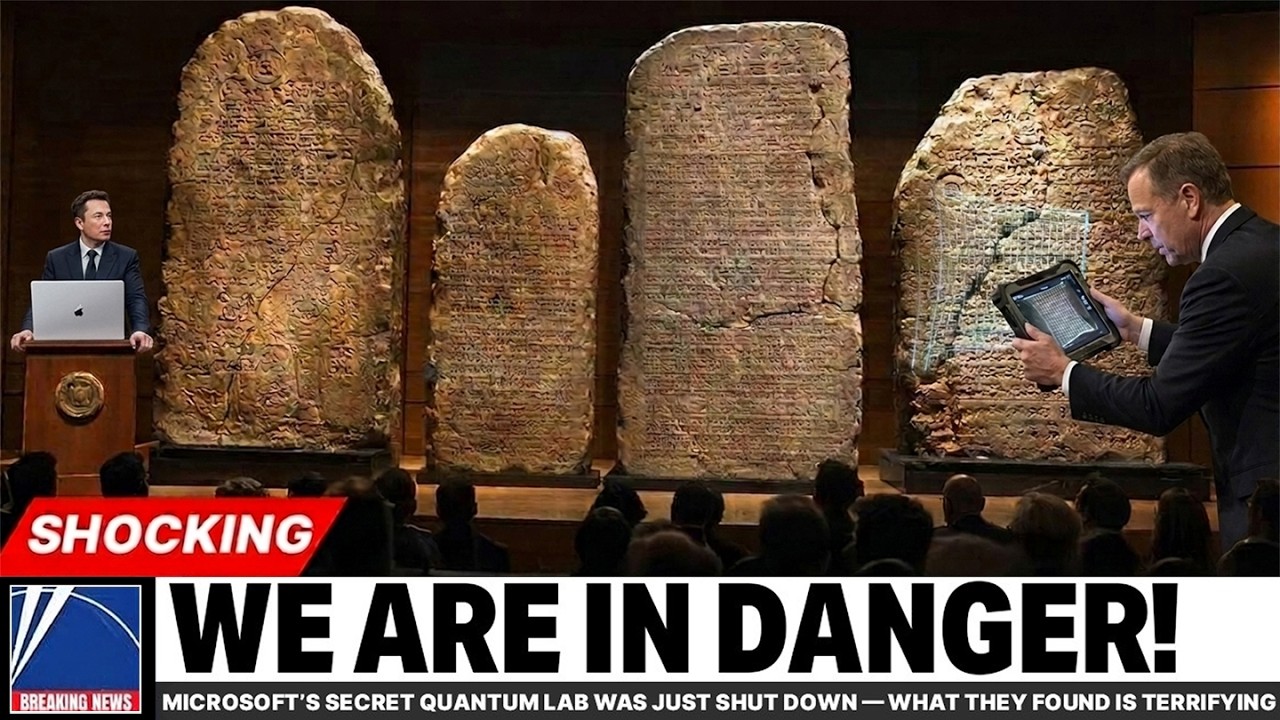
Scientists have harnessed cutting-edge artificial intelligence to decode ancient Sumerian clay tablets, revealing lost knowledge that challenges established views of human civilization’s origins. This revolutionary breakthrough unearths sophisticated medical treatments, political insights, and cultural complexities thought impossible for a 5,000-year-old society, rewriting history in real time.
Deep beneath a Berlin museum, thousands of clay tablets lay untouched for decades, their secrets locked by the impossibility of translation. These artifacts, etched with cuneiform writing, have baffled scholars due to their complexity and the scarcity of experts capable of interpreting them. Until now, much of their content was presumed inaccessible forever.
Sumerian civilization, emerging roughly 5,000 years ago between the Tigris and Euphrates, has long been credited with foundational human innovations: writing, cities, laws, religion, and agriculture. Their cuneiform script, impressed in clay, preserved a vast archive of human experience, yet only a fraction of this archive was understood, constraining our grasp of ancient history.
Cuneiform is not simply a script but a multifaceted language system that combines symbols representing words, ideas, and sounds. Its interpretation requires decoding a complex puzzle where context, era, and dialect shape meaning. Destroyed fragments, shorthand, and technical jargon compounded the difficulty, stalling progress despite 150 years of painstaking scholarship.
Compounding these challenges, the Sumerian language was preserved as a written relic long after it ceased to be spoken. Scribal copies layered generations removed from native speakers, embedding errors and idiosyncrasies within the tablets. The evolving script over millennia further complicated efforts, making every tablet a distinct enigma demanding rigorous contextual analysis.
Traditional academic efforts were simply overwhelmed. Hundreds of specialists faced hundreds of thousands of tablets; the backlog was insurmountable. Archives in British, Baghdad, Berlin, and international museums brimmed with unidentified texts. Many tablets, potentially holding cultural revelations, gathered dust as the pace of translation failed to keep up with discoveries.
Artificial intelligence has now transformed this landscape. Developed by the Babylonian Engine project, a bespoke AI trained on digitized cuneiform texts, dictionaries, and scholarly works leverages machine learning to unravel the language’s layers. It can simultaneously analyze the entire corpus, finding patterns and meanings invisible to the human eye.
Unlike human researchers limited to incremental progress, this AI absorbs generations of knowledge instantly. It cross-references thousands of tablets, linguistic variations, and historical contexts concurrently, producing translations that are startlingly precise. Where experts struggled for years, the AI achieves breakthroughs in mere moments, accelerating our understanding exponentially.
Early AI-assisted translations stunned experts with their clarity and depth. Previously indecipherable or only partially understood tablets now yield rich content, reconnecting lost chapters of history. The results felt both familiar and revelatory, uncovering nuances that reshape the narrative of ancient Sumerian society with unprecedented detail.
Among the first major discoveries were medical tablets, housed mainly in the British and Penn Museums. Previously thought to be partially comprehended, the AI revealed that about 70% of their content was overlooked due to damage, obscure terms, and complex phrasing. The newfound material depicts advanced diagnostic and treatment methods that challenge assumptions about ancient medicine.
Sumerian healing knowledge emerges as far more sophisticated than scholars believed. Detailed medical observations and prescriptions show a systematic understanding of ailments and remedies. This overturns decades of underestimation, positioning Mesopotamian medicine closer to modern conceptual frameworks than previously imagined, with potential implications for the history of science.
But medical texts are only the tip of the iceberg. The AI has begun unlocking legal, astronomical, and mythological tablets, exposing complex social systems, legal precedents, and rich cosmological beliefs. This trove of wisdom illuminates a civilization with layered governance and spirituality, rivaling or exceeding contemporary ancient cultures in sophistication.
By deciphering economic, administrative, and personal correspondence tables, the AI paints a vivid picture of everyday life and governance in ancient Mesopotamia. These texts reveal bureaucratic precision, trade networks, and personal stories previously obscured, allowing historians to reconstruct social dynamics and economic practices at a resolution never before possible.
The AI’s capability to place ambiguous symbols in their proper temporal and regional context is a historic feat. It discerns subtle variations of cuneiform across centuries and dialects, overcoming obstacles that have stumped generations of linguists. This contextual awareness is key to unlocking the true meanings embedded in the tablets and validating the translations.
The consequences of this breakthrough ripple through numerous academic fields. Archaeology, anthropology, history, linguistics, and the history of science all face paradigm shifts. The AI-illuminated texts revise timelines, reveal lost innovations, and challenge Eurocentric narratives of human advancement, amplifying Mesopotamia’s role as the cradle of civilization.
Efforts continue as researchers collaborate with AI developers to expand datasets and refine algorithms. Each newly translated tablet holds potential revelations, promising a cascade of discoveries that could redefine human prehistory. Museums and academic institutions are racing to digitize and input their holdings, striving to unlock the full archive before further damage occurs.
This milestone highlights the transformative power of AI in humanities research. Where human labor met limits, artificial intelligence breaks barriers, bridging millennia and uncovering voices thought silenced. It ushers in a new era of exploration, where ancient wisdom resurfaces at unprecedented speed, rewriting mankind’s earliest chapters with clarity and urgency.
The fusion of ancient artifacts with modern technology is reshaping our understanding of who we are and where we come from. As more tablets emerge from obscurity, the narrative of civilization’s dawn will evolve, reminding us that history is not fixed but a living story, enriched by every new insight technology can bring.
In this race against time and decay, artificial intelligence stands as a vital ally, rescuing invaluable knowledge trapped in fragile clay. The revelations from the Sumerian tablets are just the beginning; humanity’s distant past has opened a digital gateway, promising a flood of truths that could reshape our collective identity forever.


