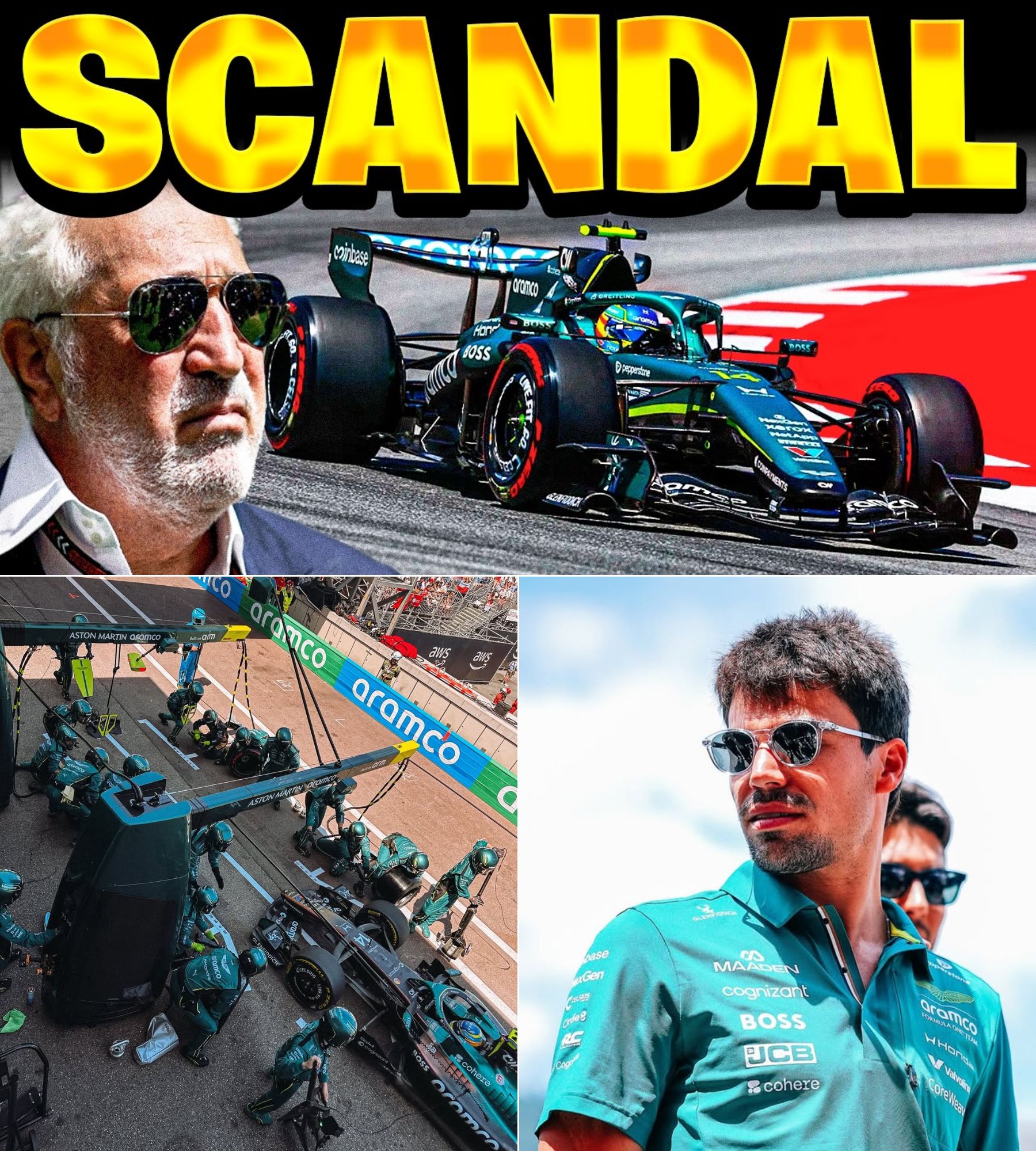
Lawrence Stroll finds himself in a precarious position as Aston Martin’s ambitious F1 project faces a major setback. Just two races into his tenure as team principal, Adrian Newey, the renowned designer brought in to elevate the team, has stepped back, leaving many to wonder if the dream is slipping away.

With only one point after seven races, Aston Martin sits at the bottom of the Constructors’ Championship, a stark contrast to the high hopes that surrounded their new factory, Honda partnership, and elite driver lineup, including the legendary Fernando Alonso. Instead of advancing towards the front, the team appears to be struggling to keep its project from unraveling.
Reports indicate that Aston Martin’s car is lagging around four seconds off the pace, with issues attributed to both Honda’s power unit and Newey’s chassis design. As the team prepares for the Austrian Grand Prix, it has postponed minor upgrades in favor of a more significant overhaul, a move that raises questions about the viability of their entire season.
Stroll’s investment in the team has been substantial, but money alone hasn’t translated into a competitive race car. The recent developments signal a potential crisis, as Newey’s decision to step back from a leadership role may reflect deeper issues within the team’s structure and performance.

Aston Martin was expected to arrive in Austria as a team on the verge of a breakthrough, but the reality is much more sobering. Newey’s hiring was seen as a statement of intent, a sign that Aston Martin was serious about competing for championships. However, the current situation reveals a stark gap between ambition and reality.
The car’s performance has been disappointing, and the early struggles have forced the team to reconsider its strategy. Newey’s departure from the principal role after such a short time raises eyebrows and suggests that the team is in a state of flux. A well-functioning team typically doesn’t require such drastic changes so early in the season.

Aston Martin’s plight is compounded by the fact that they are not just slow; they are uncertain. This uncertainty makes it difficult to develop the car quickly, and delaying upgrades could either be a wise decision or a risky gamble. As the season progresses, the team must navigate the fine line between making necessary adjustments and maintaining momentum.
The upcoming race in Austria is critical. The circuit’s characteristics could expose the weaknesses in Aston Martin’s setup, particularly with Honda’s power unit and the car’s overall performance. The pressure is mounting, not just from the track but from the expectations that come with Stroll’s ambitious vision for the team.

Alonso’s role has become increasingly vital as he engages directly with Newey to help steer the team’s direction. His experience is invaluable, but it also highlights how far the team has strayed from its intended path. The stakes are high, and Alonso’s faith in the project is essential for maintaining morale.
For Stroll, the situation is more than just a business challenge; it’s personal. Watching his son, Lance Stroll, struggle to score points adds another layer of complexity to the already tense atmosphere. The pressure of balancing family and business interests can be overwhelming, especially in a competitive environment like Formula 1.
As Aston Martin heads to Austria, the team must prove it can recover from its current predicament. The upcoming race is not just about speed; it’s about demonstrating resilience and a path forward. Can Aston Martin convince the world that their ambitious dream is still alive, or are they on the brink of a deeper crisis?


