In 1977, humanity sent two machines into the darkness, and they never truly came back.
Voyager 1 and Voyager 2 were launched as scientific explorers, built to take advantage of a rare planetary alignment that occurs only once every 176 years. This cosmic arrangement allowed NASA to use the gravity of Jupiter, Saturn, Uranus, and Neptune like stepping stones, slinging the spacecraft farther and faster than any mission before them.
At first, the goal seemed simple: visit the giant planets, collect data, take photographs, and return knowledge to Earth. But the Voyagers became something far greater. They transformed the outer solar system from a collection of distant points in telescopes into a family of strange, violent, beautiful worlds.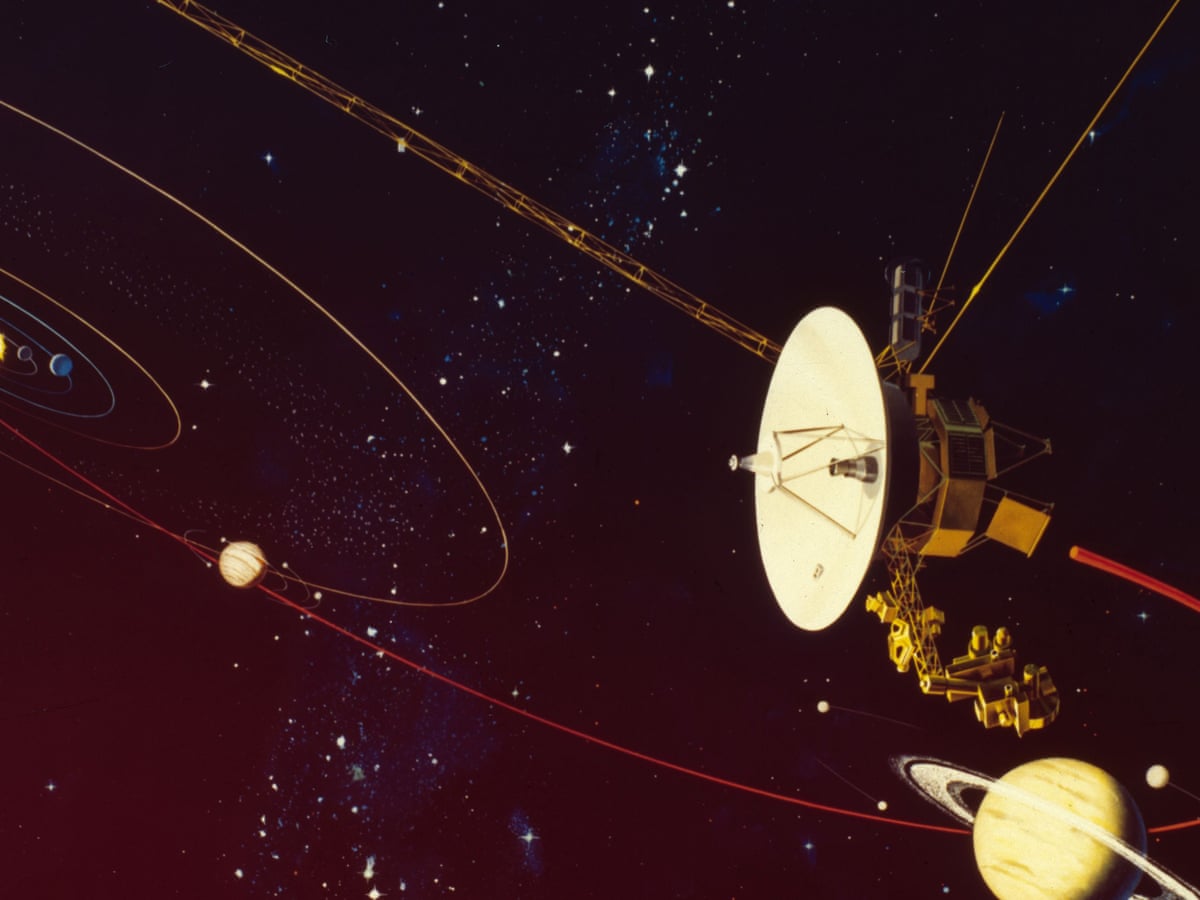
When the probes reached Jupiter in 1979, the planet stopped being just a striped sphere. It became a living atmosphere of storms, turbulence, and motion. The Great Red Spot revealed itself as a gigantic rotating storm, while Jupiter’s moon Io stunned scientists with active volcanoes blasting material hundreds of kilometers into space. Nearby, Europa’s cracked icy surface hinted at a hidden ocean beneath, suggesting that even frozen moons might conceal environments where life could one day be possible.
Then came Saturn, a planet long admired for its elegance. Voyager revealed that its rings were not smooth bands, but thousands of delicate ringlets, gaps, kinks, and strange spoke-like patterns. Saturn’s moons added even more mystery. Titan possessed a thick nitrogen-rich atmosphere, while Enceladus hinted at activity that later missions would link to hidden oceans and erupting plumes.
After Saturn, Voyager 1 began its journey out of the planetary plane, leaving Voyager 2 to continue the Grand Tour alone.
In 1986, Voyager 2 reached Uranus and found a world tilted on its side, with a magnetic field wildly misaligned from its rotation. Its moons were equally strange, especially Miranda, whose fractured surface looked like a shattered world stitched back together.
Then, in 1989, Voyager 2 arrived at Neptune and discovered not stillness, but violence. At the edge of sunlight, Neptune had ferocious winds, a massive storm called the Great Dark Spot, faint dusty rings, and a moon named Triton that showed signs of active geyser-like plumes on one of the coldest surfaces ever observed.
By the time Voyager 2 left Neptune behind, it had changed our understanding of the solar system forever. The outer planets were not quiet, frozen relics. They were dynamic worlds surrounded by moons with geology, weather, chemistry, hidden oceans, and histories of their own.
Perhaps Voyager’s greatest lesson was that moons are not just leftovers orbiting larger planets. Io, Europa, Titan, Miranda, Enceladus, and Triton became worlds worthy of study in their own right. The solar system was not a simple arrangement of planets and satellites. It was a collection of systems within systems, each more complex than anyone had imagined.
Then came one of the most haunting moments in the history of science.
Far from the giant planets, Voyager turned back toward home and captured Earth as a tiny point of light suspended in darkness. That image, later known as the Pale Blue Dot, changed the emotional meaning of the mission. After showing us storms the size of planets, volcanic moons, broken ice worlds, and rings of impossible complexity, Voyager showed us ourselves.
Every life, every war, every dream, every civilization existed on that faint dot.
But the mission still did not end.
Long after the planetary encounters were over, both Voyagers continued outward. The Sun’s influence began to weaken. The solar wind thinned. The spacecraft approached the invisible boundary where the solar system gives way to interstellar space.
Voyager 1 crossed that boundary first. Voyager 2 followed in 2018, becoming the second human-made object to enter the space between the stars.
That is where Voyager 2’s most unimaginable discovery began.
At the edge of the solar system, it found that the boundary between our Sun’s domain and interstellar space was not as simple as scientists once believed. The transition was complex, dynamic, and filled with strange interactions between solar particles, cosmic rays, plasma, and magnetic fields. The solar system did not end like a wall. It faded, twisted, and blended into the galaxy beyond.
Voyager 2 became a direct witness to that strange frontier.
Even now, decades after launch, it continues to send faint signals home from beyond the heliosphere. Each message takes hours to cross the darkness, carrying measurements from a place no human has ever seen and no other spacecraft has explored in such detail.
And attached to the spacecraft is something even more emotional: the Golden Record.
It contains human voices, music, natural sounds, greetings in many languages, and images from Earth. It was not sent because anyone knew it would be found. It was sent because the act of sending it mattered.
Voyager 2 is no longer just a spacecraft. It is a time capsule, an ambassador, and a reminder of what humanity was willing to do when it first reached beyond the familiar warmth of the Sun.
Its greatest discovery may not be a planet, a moon, or a storm.
It may be the realization that the farther we travel, the less empty the universe becomes — and the more fragile, precious, and extraordinary Earth appears behind us.