The widely repeated claim that ancient humans typically died around age 30 is mathematically real but deeply misleading. That figure represents average life expectancy at birth, a number dragged down dramatically by staggering rates of infant and childhood mortality. It does not mean a healthy adult regularly expired at 30, but rather that death struck with brutal frequency at the very beginning of life, skewing the overall average. In reality, mortality in ancient populations was distributed in a U-shaped curve.
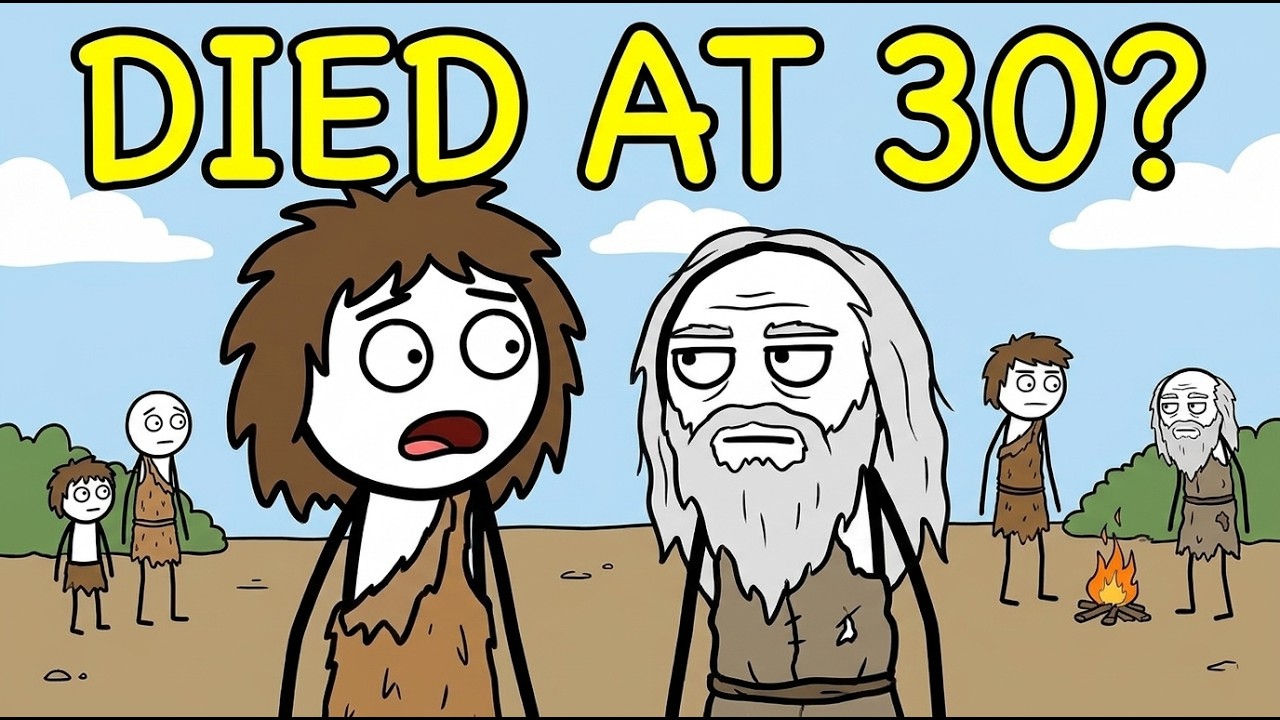
The most dangerous period was infancy and early childhood, when immature immune systems, infections, and accidents claimed a huge share of lives. For those who survived past childhood, the odds of reaching older age improved dramatically. Research on well-studied hunter-gatherer populations indicates that the most common age of adult death—known as the modal age—fell around the late 60s to early 70s. To understand ancient lifespans, it’s essential to distinguish between three different numbers.
Life expectancy at birth is the average number of years a newborn would live under current mortality conditions. Lifespan is how long an individual actually lives. The modal age at death is the age at which deaths are most concentrated. The famous “30 years” figure is an average that can describe almost nobody’s actual experience.
For example, if one sibling dies at age two and another reaches 70, their average age at death is 36, yet neither died at 36. Across several small-scale hunter-gatherer and horticultural populations, average life expectancy at birth was placed broadly in the low 30s, with considerable variation. The same research found that roughly 60% of newborns survived to age 15, and the modal age of adult death was about 72, with variation from the high 60s to high 70s. This does not mean every prehistoric population followed the same pattern, but it dismantles the idea that human bodies were biologically designed to collapse at 30.
The dangers began with birth itself. Human childbirth is unusually difficult due to the large infant head and the constraints of the birth canal. Without modern surgical intervention, blood transfusions, or antibiotics, obstructed labor, hemorrhage, infection, and other complications could quickly become lethal for both mother and child. Ancient people had skilled birth attendants and practical knowledge, but they lacked reliable solutions for several emergencies that modern medicine now treats routinely.
The first month of life was another perilous window. Newborns have immature immune systems and limited energy reserves. A mild infection that would be manageable in an adult could become overwhelming in an infant. Diarrhea, difficulty feeding, and rapid heat loss posed constant threats.
Later infancy and early childhood remained dangerous as children encountered contaminated water, parasites, respiratory infections, and accidents involving fire, water, tools, or animals. The weaning period created additional vulnerability, as children lost some maternal immune protection and began consuming shared food and water. Once an individual reached adolescence, their expected future improved substantially. Across the hunter-gatherer populations used in major comparative studies, a 15-year-old could expect to live on average into roughly their early or middle 50s.
This average includes adults who died at 20, 30, or 40, alongside those who reached 70 or beyond. The modal age of adult death, around 72, reveals that surviving the early hazards often led to a genuinely long life. This capacity for long adult life distinguishes humans from other great apes. Wild chimpanzees rarely reach the ages humans can achieve even without modern medicine.
Human survival was likely reshaped by food sharing, cooperation, skill accumulation, and the value of older individuals. A 55-year-old hunter may run more slowly than a 25-year-old, but they carry essential knowledge about animal movements, weather patterns, safe neighboring groups, and past mistakes. This knowledge made age productive long after physical speed declined. Older adults contributed through gathering, tool-making, childcare, teaching, healing, negotiation, and preserving information across generations.
The presence of older individuals gave groups access to memories no child could possess and no written record could replace. This longevity became useful, giving natural selection a reason to preserve it. But if old people existed, why do prehistoric skeletons so often appear young? The answer lies in the difficulties of skeletal aging and preservation.
Archaeologists estimate age at death using features like dental development, tooth wear, joint degeneration, and bone structure. Children are easier to age because teeth erupt and bones develop in predictable sequences. Adults are much harder, as age must be estimated from gradual degeneration that varies based on genetics, activity, nutrition, and environment. After roughly age 50 or 60, traditional methods become especially imprecise, often lumping everyone from middle-aged parents to the extremely elderly into broad categories like “45+.
”
Early skeletal studies also tended to undercount older adults because reference samples were biased toward younger age structures. Newer approaches have recovered more older individuals from some cemeteries, changing populations that once appeared to have adulthood end suspiciously early. Preservation creates another filter. Infant bones are small and fragile, decaying easily or being buried in locations archaeologists never find.
Some societies buried babies differently from adults, while others used cremation or exposed bodies. Adults also disappeared from the record through travel, conflict, scavengers, soil chemistry, and river movement. The archaeological population is only the fraction of the dead who entered preservable conditions and were later discovered and identified. Population growth can also distort cemetery age profiles.
A rapidly growing population contains many young people, so even ordinary mortality produces more young skeletons. Researchers therefore approach deep prehistoric lifespan with caution. Modern forager data offers detailed mortality curves but are not direct copies of the past, while skeletons come from the past but are incomplete and difficult to age. Each source corrects the weaknesses of the other without eliminating them.
One influential study examined ratios of older to younger adults in fossil dental samples and argued that older adults became much more common during the Upper Paleolithic. The results suggested a major increase in survivorship late in human evolution, possibly creating a feedback loop: more older adults preserved knowledge, stronger cultural transmission improved survival, and better survival produced still more older adults. However, this interpretation is not the final word, as fossil samples are small and “older” in dental studies often means surviving well beyond the age when the third molar finished developing, not necessarily reaching 70. Individual fossils confirm that long adult life existed deep in the past.
Neanderthals and earlier humans survived serious injuries, tooth loss, and chronic conditions long enough for bones to heal and bodies to adapt. Some could not have continued without support from others. Survival leaves evidence of biology; extended survival leaves evidence of relationships. So what actually killed adults before modern medicine?
Infectious disease was likely among the largest categories. A cut from stone, thorn, or animal horn could introduce bacteria that spread through tissue or entered the bloodstream. A dental abscess could become systemic. Pneumonia or gastrointestinal illness could overwhelm the body.
Comparisons with recent hunter-gatherer populations found infection or broadly categorized illness responsible for the largest share of recorded deaths. Ancient populations were smaller and more mobile than later cities, limiting some crowd diseases, but zoonotic infections, parasites, wound infections, and respiratory illness remained constant threats. Accidents formed another major category. Hunting large animals could produce blunt trauma and crushing injuries.
Gathering honey involved heights, while fishing and water travel created drowning risks. A broken leg was not automatically fatal, but far from camp during food shortage and without a way to stabilize the bone, it could become fatal through blood loss, shock, or infection. Violence also mattered, though rates varied enormously among societies and periods. Some communities experienced little lethal conflict for long stretches; others suffered raids, feuds, and warfare.
The archaeological record contains evidence of projectile injuries, skull fractures, and occasional massacres. For women, pregnancy and childbirth added repeated exposure to risk. Even if maternal mortality per single birth was not enormous, the danger accumulated across multiple pregnancies. Hemorrhage, obstructed labor, and infection could kill healthy young women with little warning.
Men faced higher mortality from violence, dangerous hunting, and risk-taking in some contexts. When agriculture emerged, health often initially worsened. Settled communities concentrated waste, people, and animals, giving pathogens reliable transmission routes. Diets narrowed around a few stable crops, and crop failure could devastate an entire settlement.
Dental decay increased, repetitive labor left skeletal stress, and property created new forms of inequality and conflict. A successful population could grow while many members lived with worse health. Later cities intensified crowding and epidemics, and historical life expectancy at birth remained low in many premodern states. There has never been one ancient human lifespan; a Paleolithic forager, Neolithic farmer, Roman laborer, and nomadic herder all inhabited different mortality systems.
Old age in the past did not look exactly like modern old age. A person of 50 might possess heavily worn teeth, arthritic joints, and healed fractures. Smoke exposure could affect lungs and eyes. But chronological age and physical condition did not move together neatly.
A healthy 60-year-old with strong social support could remain highly active, while a 35-year-old carrying injuries and chronic infection could appear much older. Ancient adults could reach old age, usually carrying more history in the body, but they did reach it. This matters because a society containing elders thinks differently from one where no generation survives long enough to know grandchildren. Older adults connect events separated by decades, comparing droughts, migrations, animal movements, and past mistakes.
They make culture less dependent on rediscovery. The survival of older adults may have helped make human culture more cumulative, preserving innovations and improving them rather than repeatedly beginning from nothing. So at what age did most ancient humans die? If you mean life expectancy at birth, a rough figure near 30 is reasonable for several foraging populations and many later premodern societies.
If you mean the most dangerous age, it was often infancy and early childhood. If you mean how long people lived after surviving childhood, many reached their 50s or 60s, and some reached their 70s or beyond. If you mean the most common age of adult death, evidence suggests roughly the late 60s to early 70s. The mortality curve looked less like a wall at 30 and more like a valley: high death rates at the entrance of life, falling as children grew stronger, then rising again as injury, infection, and aging took their toll.
Ancient humans did not usually die because they reached 30. They died because something happened at 3, 23, 47, or 70. The tragedy was not that old age did not exist—it was that reaching it was never guaranteed.