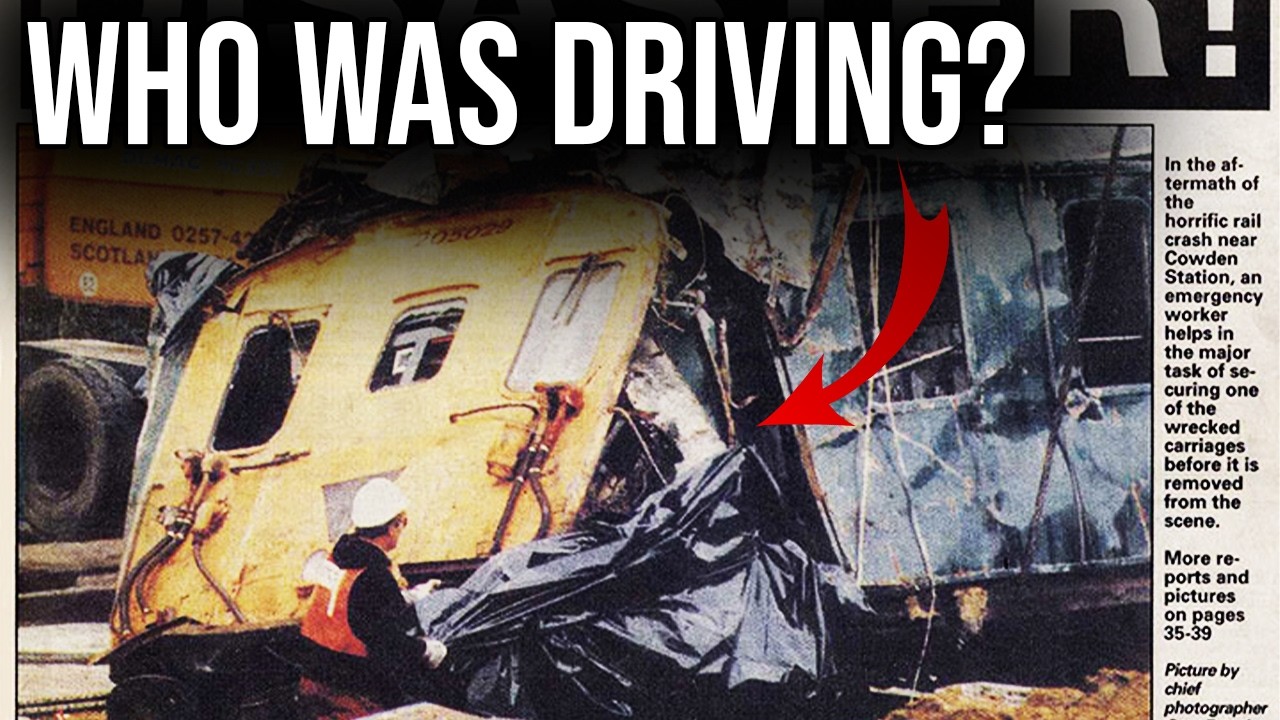
The quiet countryside around Cowden, Kent, became the scene of one of Britain’s most haunting railway disasters on the foggy morning of October 15, 1994, when two passenger trains collided head-on in a catastrophic failure of human judgment, technological safety nets, and institutional oversight. The crash claimed five lives and left investigators grappling with an impossible question that would expose gaping holes in the nation’s railway safety apparatus: why did a competent driver run a red signal with almost a full minute to react, and why was there absolutely no way to stop the inevitable?
The tragedy unfolded on a single-track section of the line between Hever and Oakfield, a remnant of a once-grander route that had connected London to Brighton. Decades of underinvestment had forced British Rail to choose between costly renewal or eventual closure. Opting for the cheaper solution, engineers had converted much of the line to single track in 1990, controlled remotely from the Oxide signal box via color-light signals and an automatic warning system, or AWS.
 The system was designed to be foolproof, but as the morning’s events would prove, it was only as safe as the humans who operated it and the infrastructure that supported it.
The day began unremarkably. Driver Brian Barton, a 31-year-old with a solid record, boarded the northbound 227 service at Oakfield, making himself a cup of tea before departure. His guard, 36-year-old Jonathan Brett Andrews, joined him in the cab, a direct violation of railway rules that he had been disciplined for on multiple occasions, including a final written warning just eight months earlier.
Despite his history, nothing suggested either man was unfit for duty. The weather, however, was treacherous. Dense fog reduced visibility to around 50 meters in places, a condition that would later prove critical.
At 8:00, the train departed Oakfield, stopping as scheduled at Ashurst. There, signalman S. W.
Webb had set the route to allow the northbound train to reach Ashurst but no further. The single line beyond signal OD58 was reserved for the oncoming southbound train, service 224, driven by the experienced 49-year-old David Ree. Ree had just left Cden station, a few hundred yards away, with all signals showing clear.
He had no reason to suspect danger.
as he accelerated toward Oakfield.
The northbound train left Ashurst and began accelerating toward OD58, which was displaying a red aspect. The AWS warning should have sounded in the cab, alerting Barton to brake. Investigators later determined that the AWS likely operated normally, but the signal itself was compromised.
Laboratory tests revealed that OD58’s red light emitted only 13. 6 percent of the luminosity of a reference signal, a degradation of nearly 90 percent. Combined with the thick fog, the effective visibility of that red aspect was slashed to somewhere between 20 and 50 meters.
At the train’s estimated speed of 38 mph, that gave the driver a mere one to three seconds to see, register, and react to the danger. It was a razor-thin margin for error, and in that fleeting window, something went horribly wrong.
 The train passed OD58 at danger and continued, accelerating to around 42 mph as it approached points 532 at Blackham Junction. Those points were set for the southbound train, but the northbound train burst through them, damaging the track mechanism in the process. Miles away, an alarm shattered the silence in Webb’s signal box.
The indication above points 532 was flashing, signaling that the points were no longer properly detected. Webb checked the track circuits and his blood ran cold: two circuits were occupied, meaning both trains were now on the same single line, heading directly toward each other. He realized with sickening certainty that a collision was virtually certain.
He immediately telephoned rail track control at Cden, pleading for emergency services, but he had no way to warn either driver. The cab secure radio system, recommended after the 1988 Clapham Junction disaster, had never been installed on this line. Funding had been frozen, work had slipped, and by 1994, train crews were issued commercial mobile phones that were unreliable, had poor battery life, and were plagued by reception black spots.
Holden, the lead investigator, would later describe this safety system as “a total shambles.” Investigators calculated that with a proper radio, one train could have been stopped in around 80 seconds, the other in 105 seconds. A test train took just over two minutes to travel from the points to the collision site.
There was time to stop the tragedy, but the only man who knew what was coming had no means of communication.
David Ree, meanwhile, had departed Cden station normally, with passengers boarding and alighting without incident. Just 300 meters out of the station, everything changed. Guard Boyd felt an emergency brake application, followed almost immediately by a deafening impact.
Ree had seen the northbound train emerging from the fog and had done the only thing possible: he released his safety device, triggering the brakes, and attempted to move away from the front of the train. But there was almost no time. At approximately 8:27, the two class 205 diesel-electric multiple units, each consisting of two three-car units built in the late 1950s, collided head-on with a combined closing speed estimated between 55 and65 mph.
The force of the impact was catastrophic. The front of the southbound train was driven backwards, its bogies torn away, its cab crushed inward by approximately two meters. The leading vehicle derailed and overturned, coming to rest precariously at the top of a 30-foot embankment.
The northbound train’s leading vehicle was practically demolished, its first 5. 5 meters wiped away, its roof torn off, its frame twisted beyond recognition. Passengers Raymond Pointer, 61, and Mora Pointer, 56, traveling in the leading compartment, were killed instantly, along with drivers Ree and Barton, and guard Brett Andrews.
 The collision lasted seconds, but the recovery operation would take days, hampered by the rural location and the wreckage’s precarious position overhanging the embankment. A 200-ton crane had to be brought in, requiring the construction of a temporary road across surrounding fields just to reach the site. David Ree’s body was trapped beneath the leading vehicle and could not be recovered until that section of train was lifted and moved aside.
The line did not reopen until October 18, three days after the crash.
The official inquiry, led by Major C. B. Holden, quickly ruled out any infrastructure failure.
The signaling records showed categorically that OD58 was red, the points were set correctly for the southbound train, and no electronic fault had occurred. The northbound train had definitively passed a red signal. The question was why.
Holden rejected the theory that Barton had become disoriented in the fog, noting that he had stopped correctly at Ashurst and knew the route intimately. He considered whether the AWS had been isolated, but evidence favored an operational system. He then turned to a simpler, more human explanation: distraction.
Brett Andrews, the guard with a history of unauthorized cab rides, had no operational need to be present. His presence, Holden suggested, may have caused Barton to acknowledge the AWS warning automatically, then turn his head at the critical moment when the red signal became visible through the fog, losing that tiny window of opportunity to register the danger. The margin for error had been impossibly small, and a single moment of inattention had been enough to trigger disaster.
But another, more troubling question emerged: was Brian Barton actually driving the train at all? Brett Andrews had harbored ambitions to become a driver and possessed some operational knowledge. He had repeatedly violated rules by riding in the cab, and his presence at the front of this train was a known fact.
Speculation ran rampant, fueled by contemporary reporting, that Andrews might have been at the controls. The inquiry examined this theory exhaustively, but found insufficient evidence to support it. The pathologist could not determine who had occupied which position, as both bodies had been violently displaced.
Their final positions told investigators nothing about their pre-impact locations. Holden noted that it was slightly more likely that Barton had remained at the controls, but he could not prove it either. The report ultimately concluded that it would be unsafe to base conclusions on presumption when there was no way to know for sure.
 Regardless, the report stated, it was Barton’s train and his responsibility to keep his passengers safe.
The inquest, held at Tunbridge Wells in August 1995, returned verdicts of accidental death for Barton and Brett Andrews, and open verdicts for Ree and the Pointers. David Ree was cleared of any responsibility, his widow Jill focusing her grief on the lack of radios. “Her husband had done absolutely nothing wrong,” she said.
“He’d been traveling under clear signals. The signalman had realized what was happening, but he’d had no means of warning him.” The inquiry agreed, concluding that with proper two-way communication, the collision could have been prevented.
It also highlighted another technology that could have stopped the tragedy before it began: Automatic Train Protection, or ATP. Unlike AWS, which merely warned the driver, ATP would actively supervise the train and intervene if a driver attempted to pass a red signal. Holden was unequivocal: “Had suitable ATP been installed at Cowden, the collision would have been completely prevented.”
But Britain had struggled with the cost and complexity of introducing ATP widely, and Cowden became another tragic demonstration of the limitations of relying on human reaction.
The inquiry also examined the vehicles themselves, noting that the class 205s used Mark 1-style construction, which had performed poorly in severe collisions at Clapham Junction and Cannon Street. Holden wrote that survival prospects in end-on collisions involving Mark 1 rolling stock were “extremely poor.” The report led to further research into strengthening Mark 1 vehicles, though critics argued progress was too slow.
The inquiry made 15 recommendations, covering AWS testing, risk assessment, driver distraction, ATP, radio communication, rolling stock crashworthiness, and onboard recording. It also noted that incab recording equipment, akin to an aviation black box, would have resolved many of the remaining mysteries, but its installation had also fallen behind schedule. Several uncertainties in the investigation, Holden said, would have been completely resolved if such equipment had been fitted.
In the immediate aftermath, change came swiftly on at least one front: cab secure radio was completed on the Arkfield line by December 1994, just two months after the crash. It was a bitter irony that such progress required such a catastrophe to catalyze it. In 2024, the RSSB still highlighted Cowden as an accident with continuing lessons in human factors, communication, and train protection.
Modern railway communication is vastly different from the 1990s, but the fundamental lesson remains: safety systems are only as effective as the humans who operate them and the infrastructure that supports them. At Cden station, a quiet, unassuming stop on a now-peaceful line, a memorial bench and plaque stand as a poignant reminder of the five lives lost. Placed for the 30th anniversary in 2024, they ensure that the story of Cowden is not forgotten, that the quiet community that was shaken to its core continues to remember the day when two trains, a thick fog, anda single missed signal, collided with devastating consequences.
The impossible question that left investigators stumped may never have a definitive answer, but the lessons learned from that foggy morning continue to shape the safety of Britain’s railways to this day.