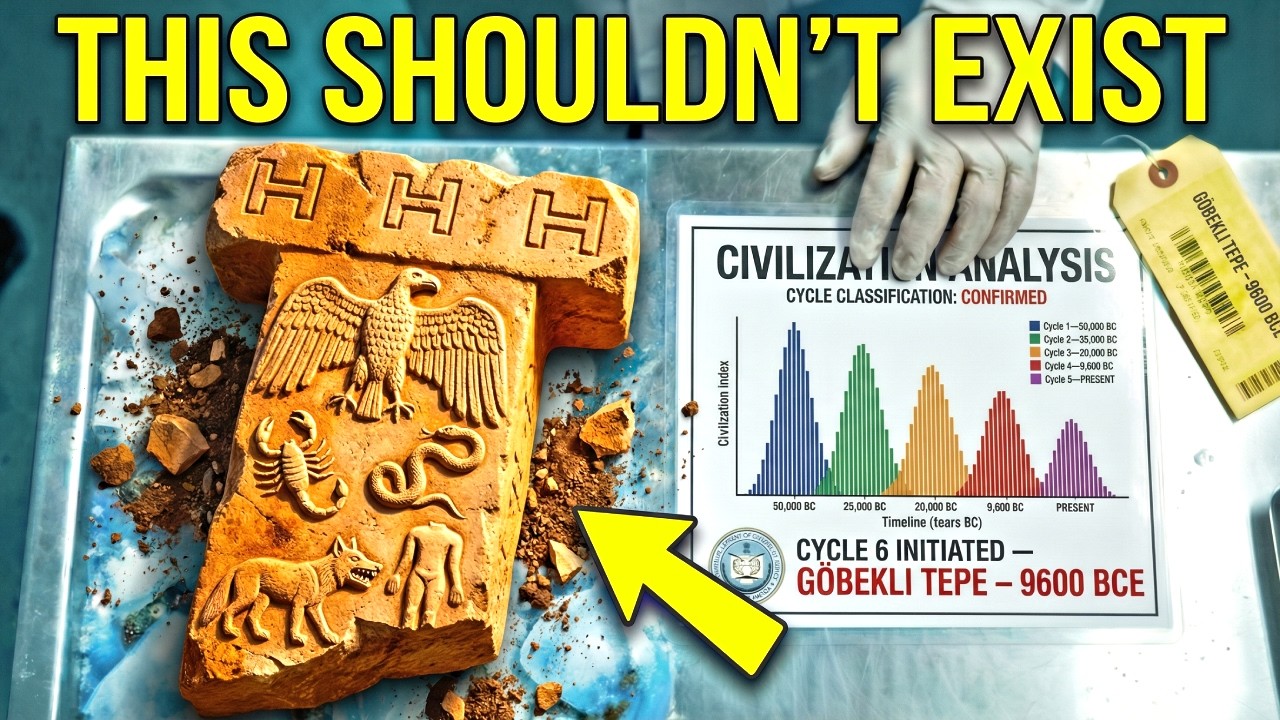
A groundbreaking archaeological revelation has shattered long-held beliefs about human civilization’s origins. Göbekli Tepe, a 12,000-year-old temple complex in southeastern Turkey, uncovers evidence of a sophisticated pre-agricultural civilization predating known ancient societies by millennia. This discovery suggests five lost civilizations existed before us—and we are the sixth.
Göbekli Tepe, perched on a hilltop near Şanlıurfa, Turkey, was first excavated in 1995 by German archaeologist Klaus Schmidt. What emerged redefined history: monumental stone enclosures built around 9,600 BCE, far earlier than Stonehenge or the Egyptian pyramids. These massive T-shaped limestone pillars, weighing up to 50 tons, display intricate carvings defying conventional timelines.
For decades, scholars dismissed Göbekli Tepe as an anomaly, an outlier incompatible with accepted models of human development. Nomadic hunter-gatherers, it was believed, lacked the social organization necessary for such architectural feats. But new discoveries reveal Göbekli Tepe is not isolated—it’s part of a vast network marking a sophisticated civilization unknown until now.
In 2020, Turkey launched the Taş Tepeler project, mobilizing 219 scientists from 36 institutions to excavate twelve sites spread across 150 kilometers of Anatolian terrain. Each site shared architectural techniques, refinement in stone carving, and a standardized symbolic system, proving a widespread civilization with complex institutions existed before the rise of agriculture.
Researchers identified a consistent set of roughly 20 pictographs carved meticulously across all twelve sites. This form of semasiography—a pre-writing, symbolic communication—persisted with stunning consistency, deviating less than 6% in symbol proportions over 800 years. Such uniformity across separated communities reveals an unprecedented organizational authority maintaining symbolic conventions without city-states or bureaucracies.
The symbolic carvings imply not aesthetic preference but strict grammatical rules governing their placement. Animal motifs cluster predictably: snakes appear in specific groupings and associations, the scorpion rarely appears without a bird nearby. These “rules” represent a syntax-like language etched in stone, indicating a level of intellectual complexity and institutional control previously thought impossible for this era.
Enclosure design further emphasizes structured social order: distinct animal symbols dominated individual enclosures, suggesting different groups held unique “emblematic” roles within a shared hierarchy. This was no egalitarian gathering; it was a ceremonial network with divisions and responsibilities—a hallmark of early civilization, predating conventional historical benchmarks by thousands of years.
Pillar 43, a centerpiece at Göbekli Tepe, embodies their extraordinary sophistication. It features 47 figures arranged with mathematical precision, aligned to celestial constellations corresponding to the Younger Dryas period nearly 13,000 years ago. This alignment implies knowledge of astronomy, calendar systems, and catastrophic climate events—insight science only recently confirmed by geology.
Paradoxically, Göbekli Tepe’s development defies every known civilizational pattern. The earliest construction phases boast the most complex and refined artistry. Successive layers reveal a steady decline in skill, craftsmanship, and symbolic accuracy—an inverse trajectory compared to civilizations like Egypt or Rome where knowledge accumulates over centuries.
The precise quarrying methods—thermal shock fracturing—also vanish over time, replaced by crude stone pecking. No evidence shows gradual invention or improvement; instead, complex techniques appear suddenly, mature in execution, then disappear. This pattern suggests inherited knowledge from an unknown predecessor civilization rather than incremental local innovation.
Around 8,000 BCE, the entire Taş Tepeler network was deliberately buried under tons of layered earth. This was not a ruin left to decay but an engineered preservation effort. The stones, carvings, and symbolic systems were sealed intact, protected against millennia of erosion. Such intentional burial marks a conscious choice to preserve, not abandon, their heritage.
This burial coincides with the rise of agriculture in the region—a moment that should have marked accelerating societal complexity and innovation. Instead, the ancient builders sealed their sacred sites and walked away. Ancient DNA confirms these people became the Anatolian Neolithic farmers who spread agriculture across Europe, their specialized knowledge diluted into fragmented folklore.
The collapse of this civilization’s linguistic and technological sophistication over centuries evidences a profound cultural degradation. Symbolic precision dropped from 92% adherence to 58%. Master stoneworking vanished. Ritual knowledge erased. The builders survived physically but lost the intellectual foundation that had sustained their civilization, leaving puzzles for posterity.
Göbekli Tepe stands as evidence of a lost cycle of civilization: rapid rise, peak sophistication, collapse, deliberate preservation, and dispersal. The pattern reappears across human history, suggested by global flood myths, ancient king lists like the Sumerian records referencing supernaturally long reigns, and repeated geological disruptions linked to climate catastrophes.
That Göbekli Tepe’s architects carved messages with intricate grammar and celestial references ahead of mass agriculture upends the linear narrative of history. Their foresight in burial and preservation speaks to a profound awareness of impending cultural collapse—the builders arranged their legacy for a future civilization capable of deciphering it: us.
We are the sixth civilization—emerging amid the ruins of those before, tasked with unraveling their mysteries. The stone monuments endure, but the meaning within remains partially lost to time. The urgent question: will modern humanity heed their message before fading into similar oblivion, or will we unlock and preserve the accumulated knowledge destined for us?
Göbekli Tepe reveals the fragility and fleeting nature of human accomplishment. Its buried temples caution that sophistication and wisdom can vanish completely, leaving only stone and story. This archaeological revelation demands a profound reevaluation of civilization’s origins and challenges our assumptions of progress and permanence in human history.
The hilltop in southeastern Turkey windswept by ancient silence stands as a testament—not just to lost builders but to the enduring possibility of rediscovery and renewal. For 12,000 years their message waited patiently underground. Now it’s our time to listen, learn, and decide how to answer the legacy they entrusted to us.