For decades, astronomers have searched the cosmos not only for new planets or distant galaxies, but for the unexpected—those rare discoveries that refuse to fit into the rules we thought governed the universe. Every so often, an object appears that challenges our understanding of space itself. Now, one mysterious visitor has done exactly that.
The object known as 3I/ATLAS, only the third confirmed interstellar object ever observed passing through our Solar System, has quickly become one of the most intriguing astronomical discoveries in recent years. What initially appeared to be another wandering body from deep space has raised new questions after observations with the James Webb Space Telescope revealed unusual infrared characteristics unlike anything scientists expected to see.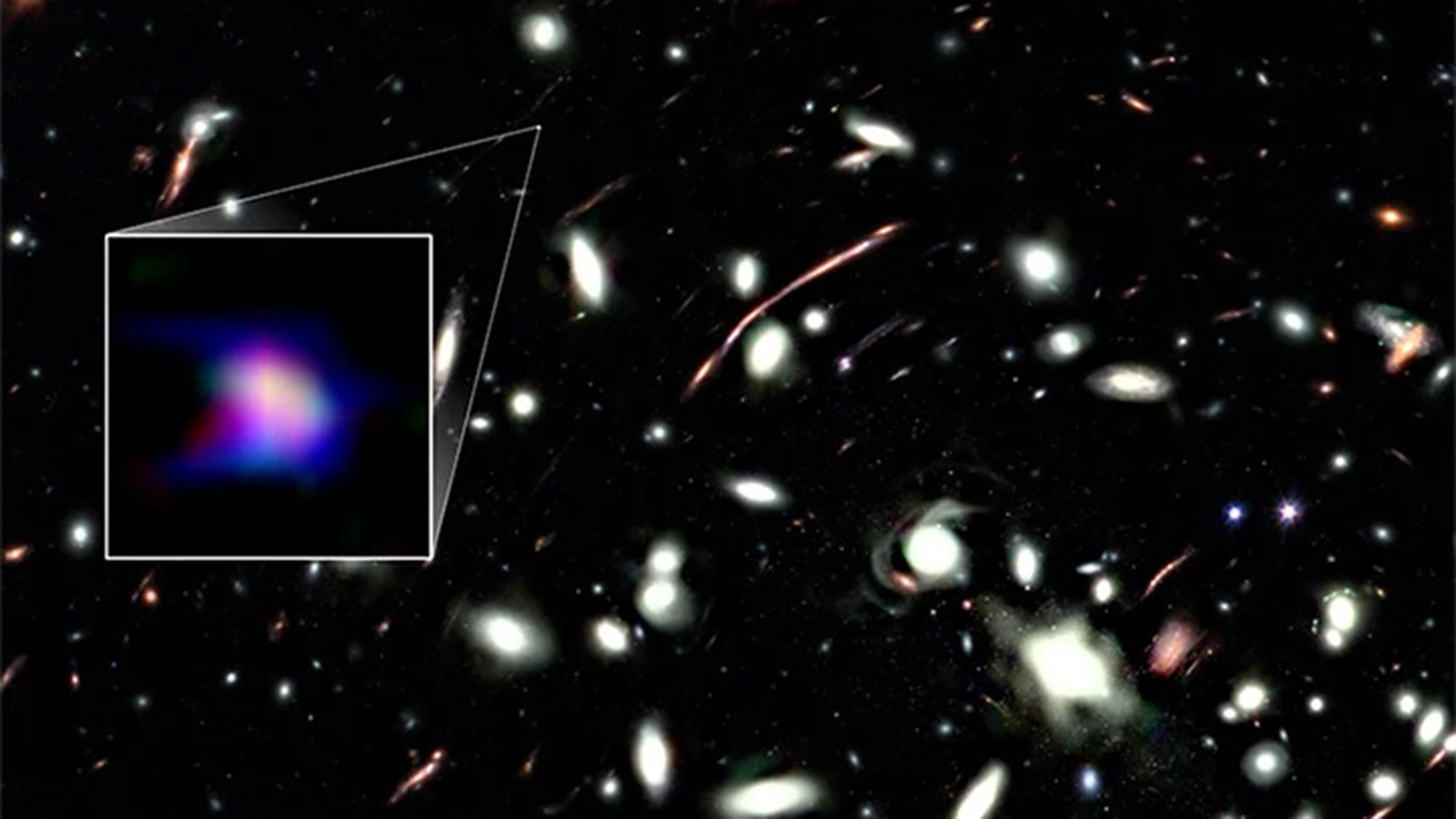
Moving on a hyperbolic trajectory that proves it originated beyond the Sun’s gravitational influence, 3I/ATLAS entered our cosmic neighborhood after an unimaginably long journey through interstellar space. Like its famous predecessors, 1I/ʻOumuamua and 2I/Borisov, it offers scientists a rare opportunity to study material formed around another star.
But almost immediately, astronomers noticed something unusual.
Even before Webb turned its powerful infrared instruments toward the object, telescopes around the world reported that its brightness behaved differently from what standard models predicted. Normally, a comet brightens as sunlight heats its icy surface, releasing gas and dust into space. Asteroids, on the other hand, reflect sunlight in ways that vary with their rotation and surface composition.
3I/ATLAS did neither.
Instead of showing irregular fluctuations or bursts of activity, its brightness remained surprisingly stable. It neither dimmed as rapidly as expected nor produced the dramatic outgassing events commonly associated with icy bodies approaching the Sun. The object appeared to maintain a remarkably consistent glow, prompting astronomers to request more detailed observations using the James Webb Space Telescope.
Webb’s extraordinary sensitivity to infrared wavelengths allows it to detect heat signatures, molecular compounds, and surface characteristics impossible to observe from Earth. Rather than simply measuring reflected sunlight, it can analyze the thermal behavior of distant objects with unprecedented precision.
Those observations offered a far clearer picture of 3I/ATLAS than ever before.
Instead of confirming sensational claims of “artificial lights,” Webb’s data pointed scientists toward a much more complex scientific puzzle. The object’s thermal emission, surface composition, and infrared spectrum suggest that it may possess unusual physical properties unlike those typically seen in known comets or asteroids. Researchers are now investigating whether these characteristics result from an uncommon mixture of volatile materials, an unusual rotation, a highly reflective surface, or physical processes that have yet to be fully understood.
Because interstellar objects spend millions—or even billions—of years traveling through the harsh environment between stars, they are exposed to intense cosmic radiation, extreme temperatures, and collisions with microscopic particles. Their surfaces may evolve in ways that no Solar System object ever experiences, creating appearances that seem unfamiliar when they finally pass close enough for detailed observation.
That possibility makes 3I/ATLAS scientifically invaluable.
Every measurement collected by Webb provides another clue about planetary systems beyond our own. The object’s chemistry could preserve information about the environment in which it formed around a distant star long before the Earth itself existed. By studying its composition, astronomers hope to compare the building blocks of other planetary systems with those found in our own.
As observations continue, scientists remain cautious.
There is currently no verified evidence that James Webb has detected artificial lights, alien technology, or any indication that 3I/ATLAS is anything other than a natural interstellar object. Headlines suggesting otherwise dramatically exaggerate what has actually been observed.
Yet that does not make the discovery any less exciting.
Every confirmed interstellar visitor offers humanity a direct sample of another stellar neighborhood without requiring us to leave our own. Whether 3I/ATLAS ultimately proves to be an unusual comet, a rare rocky body, or something entirely unexpected, it reminds us how little we still know about the countless objects wandering through the vast darkness between the stars.
For now, 3I/ATLAS remains one of astronomy’s most fascinating mysteries—not because it has proven the existence of extraterrestrial technology, but because it may reveal entirely new chapters in the story of how planetary systems form throughout our galaxy.