For nearly half a century, Voyager 1 has continued a mission that far exceeded every expectation. Launched in 1977 for what was originally planned as a relatively short exploration of Jupiter and Saturn, the spacecraft is now the most distant human-made object ever built, traveling through interstellar space more than 15 billion miles (over 25 billion kilometers) from Earth.
Its greatest discoveries, however, are not evidence of alien intelligence or mysterious signals from deep space. They are something arguably more remarkable: proof that the boundary surrounding our Solar System is far more dynamic and complex than scientists once imagined.
Voyager 1’s journey began with historic flybys of Jupiter in 1979 and Saturn in 1980. It revealed active volcanoes erupting across Io, Jupiter’s moon, discovered intricate structures within Saturn’s rings, and transformed our understanding of the giant planets. After Saturn, gravity redirected the spacecraft out of the plane of the Solar System on a one-way journey toward interstellar space.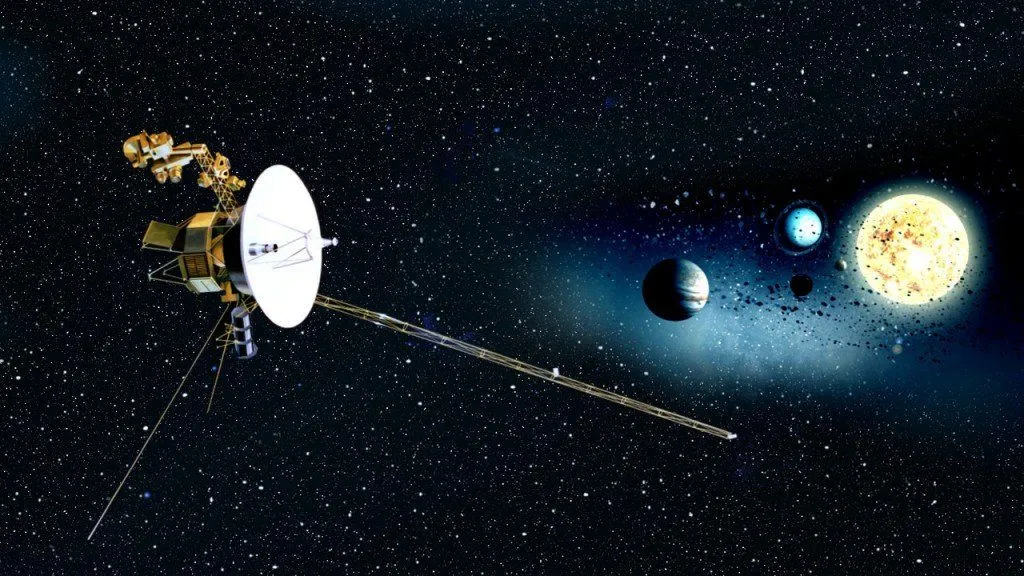
The spacecraft was never designed for such longevity. Powered by radioisotope thermoelectric generators that slowly lose output each year, Voyager has survived through careful engineering and decades of power-saving measures that gradually shut down nonessential systems while preserving a handful of scientific instruments.
Its most important achievement came in 2012, when Voyager 1 crossed the heliopause—the outer boundary where the Sun’s solar wind gives way to the interstellar medium. Contrary to early expectations, this frontier was not a simple, well-defined shell. Instead, Voyager discovered a turbulent transition region shaped by changing solar activity, magnetic fields, and interactions with material between the stars.
Beyond the heliopause, the spacecraft entered an environment humanity had never directly sampled before.
One of Voyager’s remaining instruments measures plasma waves—oscillations in electrically charged gas that fills interstellar space. These oscillations can be converted into audible frequencies, allowing scientists to “listen” to the plasma environment. The resulting sounds are not literal audio recorded by a microphone, but scientifically valid representations of real physical vibrations.
These measurements produced one of Voyager’s most surprising discoveries.
Rather than finding a silent vacuum, researchers detected a persistent background hum within the interstellar plasma. The region between the stars contains a continuous level of plasma-wave activity that reveals the density and structure of the surrounding medium. When powerful solar eruptions eventually reach Voyager years after leaving the Sun, they generate stronger plasma oscillations that provide additional clues about the material surrounding the spacecraft.
These observations showed that the plasma density just beyond the heliopause is significantly higher than many earlier models predicted, suggesting that the boundary between the Solar System and interstellar space compresses material more efficiently than expected.
The findings forced scientists to revise long-standing theories about the heliosphere and its interaction with the galaxy.
Some internet videos go much further, claiming Voyager has detected structured signals, intelligent responses, repeating communications, or evidence that “something spoke back.”
There is no verified scientific evidence supporting these claims.
NASA has never announced that Voyager received artificial transmissions from extraterrestrial intelligence. The rhythmic plasma oscillations observed by the spacecraft are understood as natural electromagnetic phenomena produced by interactions between solar disturbances, magnetic fields, and interstellar plasma. While researchers continue studying many aspects of these observations, none require an intelligent source.
Similarly, stories claiming that Voyager encountered impossible physics, mysterious objects beyond the heliopause, or organized patterns resembling communication are speculative narratives rather than established scientific results.
That does not diminish Voyager’s true accomplishments.
In fact, the reality is extraordinary enough.
Voyager 1 has revealed that the interstellar medium is structured rather than empty, that the heliopause is an active and evolving boundary, and that our Solar System exists within a far more dynamic galactic environment than scientists once believed. Each new transmission continues to refine models of plasma physics, cosmic rays, magnetic fields, and the large-scale structure of our local region of the Milky Way.
The spacecraft itself remains an engineering marvel. Despite operating on only a fraction of its original electrical power and communicating with Earth through an incredibly faint radio signal that takes more than 23 hours to arrive, Voyager continues returning valuable scientific data nearly five decades after launch.
Its most profound discovery may not be evidence of alien contact.
Instead, it is the realization that even the seemingly empty space between stars is alive with physical processes that humanity is only beginning to understand. The edge of the Solar System is not the end of anything—it is the beginning of an entirely new environment, one whose complexity continues to surprise scientists with every bit of data Voyager sends home.


