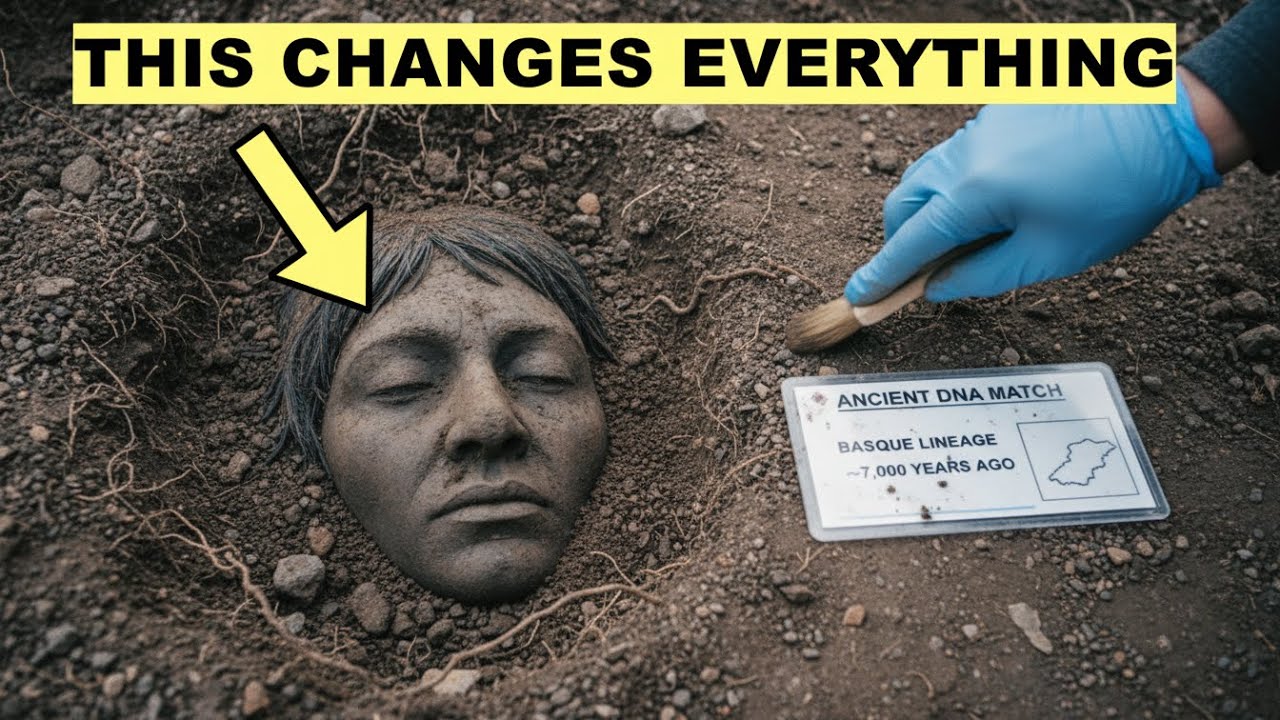
Unprecedented genetic revelations from the Basque population challenge long-held assumptions about Europe’s ancient inhabitants. New DNA analyses demonstrate the Basques survived multiple migrations intact, preserving a unique genetic legacy nearly 7,000 years old—defying the dominant Indo-European genetic influence reshaping the continent. This discovery overturns established European genetic history entirely.
For decades, the Basque people have been a baffling enigma amidst Europe’s complex migration story. As waves of Indo-European settlers rewrote the continent’s genetic makeup, the Basques stood apart, preserving DNA untouched by these transformative events. The latest research reveals why their distinct genetic signature has survived millennia of upheaval. Their DNA is a living time capsule revealing secrets about Europe’s earliest inhabitants.
During the last Ice Age, when glaciers dominated much of Europe, a small region between the Pyrenees mountains and the Bay of Biscay emerged as a vital refuge. Here, ancient humans sought shelter in limestone caves, enduring the harshest climates while painting bison and deer on cave walls—works that remain some of the oldest known European art.
Archaeological sites like Ikayen and Santimamiñe provide stunning evidence of continuous human presence dating back at least 36,000 years. Despite dramatic climate shifts that emptied much of Europe, these Basque refuges supported uninterrupted human occupation, safeguarding ancient genetic lineages rarely found elsewhere on the continent.
Radiometric dating of bones and artifacts confirms unbroken habitation throughout the Ice Age. Researchers identified traces of Neanderthal ancestry preserved in these populations, a lasting genetic footprint shared by all non-African humans. This enduring lineage underscores the Basque region’s role as a sanctuary preserving prehistoric diversity.
Dr. Koni Dearua, lead archaeologist at sites including El Portalón, calls the area a “refuge for human diversity.” Excavations reveal genetic continuities, linking Ice Age hunter-gatherers to early European farmers and modern Basque communities. The region’s caves and valleys nurtured a population resilient to external genetic shifts.
Around 6,000 years ago, new Anatolian farmers arrived, introducing agriculture to the region. Unlike much of Europe, where newcomers replaced indigenous groups, the Basques absorbed these migrants through fusion rather than conquest. Genetic studies show about 70% of modern Basque ancestry derives from Neolithic farmers, yet ancient hunter-gatherer DNA remains preserved.
Rare maternal lineages like Haplogroups H1J1 and H3C2a, prevalent in Basques today, exemplify this unique genetic blend. These lineages trace back to prehistoric ancestors, linking modern individuals directly to the ice age hunters who once painted cave walls and navigated Europe’s ancient rivers.
This extraordinary mixture created a population that absorbed change without losing its roots. The Basque region became a living testament to Europe’s first great genetic fusion, maintaining ancestral identity despite successive waves of migrating peoples transforming other parts of the continent.
Geographic isolation played a pivotal role. The rugged terrain of the Pyrenees formed natural barriers, while strong cultural practices reinforced genetic stability. In rural Basque communities, marriage outside the valley was rare for centuries, promoting genetic continuity and fostering distinctive traits rarely seen elsewhere in Europe.
Mid-20th century blood surveys 𝓮𝔁𝓹𝓸𝓼𝓮𝓭 startling patterns: nearly 70% of one family exhibited Rh-negative blood, a rarity in Europe at large. Such anomalies appeared across many Basque valleys, revealing an unusually high frequency of this genetic trait. Social customs and geography combined to create a genetic lock, preserving these rare markers.
Genealogical records from 1500 to 1900 reveal endogamy rates exceeding 80% in some Basque parishes. Church fines and local enforcement discouraged exogamous marriages, protecting family estates and the Basque language itself. This tight marriage network elevated genetic relatedness to levels rare in the broader European gene pool.
In 2018, Professor Iñigo Ol’s groundbreaking study at Harvard shattered prior assumptions. Sequencing ancient Siberian genomes and comparing them to living Basques, the team uncovered a startling revelation: less than 2% of Basque DNA derives from the Bronze Age Indo-European steppe herders, a stark contrast to the 40–70% found elsewhere in Europe.
This discovery highlights the Basques’ striking genetic isolation from the massive migrations that transformed the continent, providing evidence that their ancestors resisted or narrowly avoided admixture from steppe populations. Ol’s research confirms the Basques retained a genetic heritage largely independent of these sweeping demographic changes.
The Indo-European migrations brought more than genes; they introduced languages and cultures that largely replaced local traditions. Yet, the Basque language, Euskara—long deemed a linguistic anomaly—endured through these upheavals, mirroring the genetic distinctiveness Olive’s team uncovered. For the first time, genetics and linguistics align to confirm the Basques’ exceptional isolation.
Delving further, the study observed that distinct Basque dialect regions correspond with subtle DNA clusters, suggesting the language itself acted as a social barrier. Villages speaking Lapurdian, Biscayan, or other dialects exhibit unique genetic signatures, evidencing that cultural divisions deeply influenced Basque genetic structuring.
A particular Y chromosome lineage, R1b-DF27, emerges as a key marker of Basque male ancestry, originating around 4,200 years ago—coinciding with the arrival of steppe genes across Iberia. Unlike neighboring populations where steppe DNA diluted ancestral lines, this haplogroup anchored firmly in the Basque heartland, passed down unbroken from father to son.
Overlaying genetic maps with dialect boundaries demonstrates a striking overlap—DNA reflects linguistic heritage, preserving a genetic cultural mosaic unseen elsewhere in Europe. These findings suggest longstanding social structures fostering genetic preservation alongside linguistic diversity within this mountainous region.
Ol’s research fundamentally rewrites Europe’s genetic history. The Basques were not isolated relics abandoned by time but deliberate preservers of an ancient lineage amidst a continent in flux. They represent a unique branch on Europe’s family tree, embodying continuity and resilience against waves of migration and cultural transformation.
Today, Basque DNA paints a picture of complexity unrivaled on the continent. Their genetics tell a story of survival, cultural defiance, and a fusion that defies the linear migration models dominating current European prehistory. This is a paradigm shift in understanding who the first Europeans were and how their descendants endured.
The implications extend beyond genetics. From anthropology to linguistics and archaeology, the Basques challenge fundamental narratives about Europe’s peopling, identity, and cultural evolution. Their DNA serves as a biological archive, preserving echoes of Ice Age hunters, Neolithic farmers, and linguistic pioneers in one enduring population.
As research advances, the Basques remind us that history’s deepest mysteries often reside in the smallest, most isolated groups. Their story is not only about genetics but about the power of place, tradition, and human tenacity preserving a unique thread woven through Europe’s ancient tapestry.
This groundbreaking Basque DNA discovery compels scientists to rethink Europe’s ancient past. It urges a reevaluation of existing migration models and shines a light on the intricate interplay between genetics, language, and geography shaping human history. Europe’s origins are more layered and intricate than ever imagined.
In the shadowed caves and rugged valleys of the Pyrenees, the ancient genetic code endures, a testament to perseverance and identity. The Basques stand as living witnesses to an epic saga of human survival and the resilience of identity through millennia of change and upheaval.
Europe’s basal roots, long overshadowed by narratives of conquest and migration, now burst into clarity. The Basque genetic story recalibrates our understanding of European ancestry, unveiling a population that witnessed history’s tides without succumbing—defying time, geography, and genetics alike.
This revelation ignites urgent new questions about prehistoric Europe’s complexity, migration dynamics, and how isolated populations influence continental genetic landscapes. The Basques emerge not as mere survivors, but as key bearers of Europe’s primordial genetic heritage, vital to comprehending our shared past.
Europe’s ancient genetic map is no longer a straight line of waves and replacements—it is a mosaic of endurance and fusion, with the Basques at its very core, rewriting history through their unparalleled DNA legacy. This is a seismic breakthrough destined to redefine European prehistory forever.