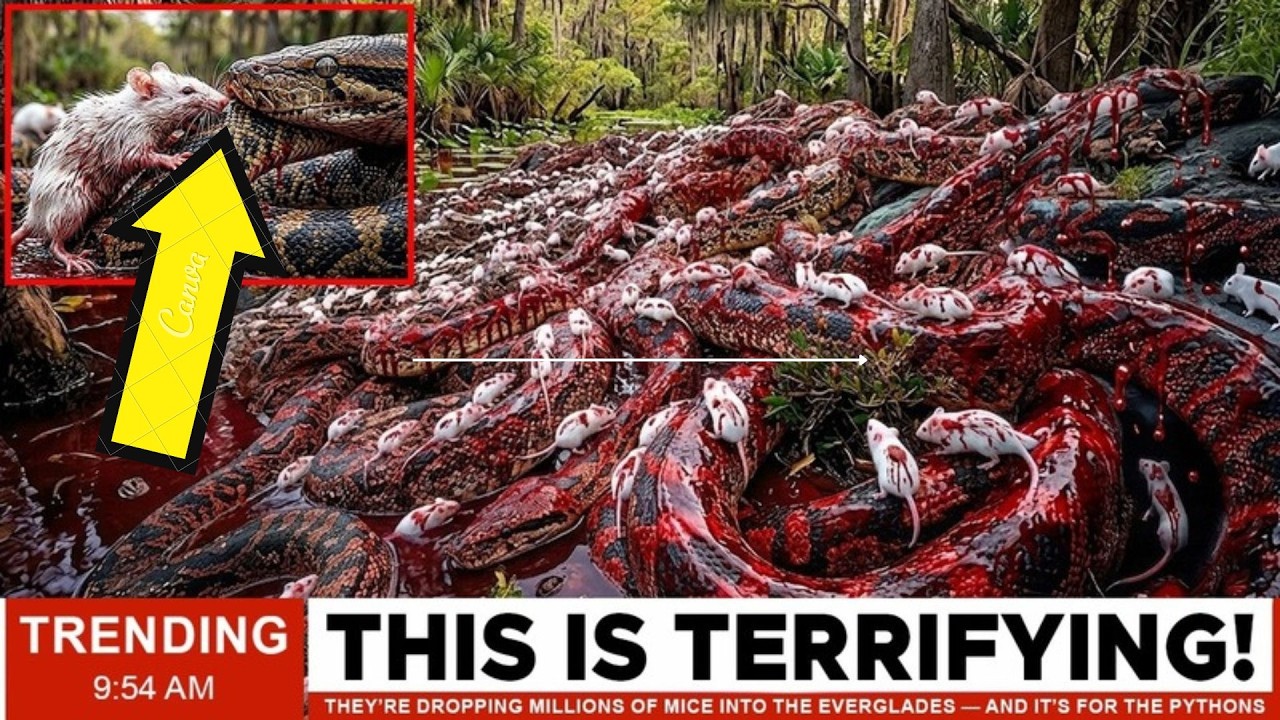
In a groundbreaking wildlife management move, Florida is deploying millions of acetaminophen-laced mice dropped from helicopters to combat invasive Burmese pythons devastating the Everglades. Scientists weigh the deadly effectiveness against catastrophic risks to native species, including endangered panthers and the fragile ecosystem’s balance. The crisis demands urgent attention.
The Everglades’ python crisis is ramping up—a sprawling ecological nightmare fueled by decades of unchecked breeding and predation. The notorious Burmese pythons, initially exotic pets gone wild, now threaten to unravel one of North America’s most biologically complex ecosystems. With every removal effort barely denting their burgeoning population, authorities face a desperate race against time.
From low-flying helicopters, technicians now scatter baited, acetaminophen-laced dead mice into the sawgrass canopy. This innovative, federally researched tactic targets juvenile pythons by exploiting a rare metabolic vulnerability—their inability to process acetaminophen, a common painkiller lethal to juvenile snakes after ingestion. The stakes could not be higher.
This strategy draws on a proven model from Guam, where similar “snake drops” drastically reduced invasive brown tree snake populations that had decimated native birds. The success there demonstrated acetaminophen’s potent lethality to snakes while offering hope for Florida’s python calamity—except Florida’s ecosystem is far more complicated and delicate.
Florida’s pythons have multiplied beyond control, with more than 23,000 captured since 2000. Female pythons lay up to 100 eggs per clutch, and cryptic behavior and swampy terrain make hunting them near-impossible. Juvenile pythons, vulnerable to the mouse bait, are key to curbing future generations and shifting the population trajectory.
Yet the Everglades is no barren island like Guam. It harbors over 350 bird species, dozens of reptile and mammal species, including endangered Florida panthers and the apex Eastern indigo snake. Acetaminophen toxicity threatens these native animals, introducing a toxic domino effect unknown in prior invasive control efforts.
The Florida panther faces staggering extinction risk with only 120 to 230 adults remaining. Small acetaminophen exposure can cause fatal liver failure in cats, making the panthers and other felines vulnerable to accidental poisoning from eating bait mice or contaminated prey. Every operation risks accelerating the panther’s perilous decline.
Secondary poisoning looms large. Raptors feeding on animals 𝓮𝔁𝓹𝓸𝓼𝓮𝓭 to the toxin could suffer breeding failures, further unraveling food webs. Native snakes such as cottonmouths, rattlesnakes, and aquatic species face unknown risks as bait lands near water bodies, ingesting toxic residue or preying on poisoned animals.
Compounding the threat, the Eastern indigo snake, the native predator designed to hunt pythons, preys on mice and might encounter lethal doses. This apex reptile’s ongoing recovery is already fragile, and acetaminophen exposure could undermine vital conservation gains, jeopardizing the very species helping to control python numbers naturally.
The challenge is staggering: millions of bait drops over 7,800 square miles multiple times yearly to affect juvenile python survival rates. Such scale magnifies risks to non-target species and the entire ecosystem’s integrity. Scientists and wildlife managers face a landscape where every intervention risks unintended, potentially irreversible damage.
Similar large-scale chemical interventions elsewhere, like Australia’s 1080 poison campaigns, show mixed outcomes—population recoveries alongside collateral losses in native predators and evolving resistances. No ecosystem-scale effort is free from fallout; the question remains whether benefits outweigh the ecological costs in the richly interconnected Everglades.
Public opinion on novel species control methods adds another layer of complexity. Florida’s history shows fierce pushback against unconventional biological interventions, evidenced by uproar over genetically modified mosquito releases. Announcing millions of poisoned mice flights will likely ignite intense public and scientific debate demanding transparent risk assessments.
Despite progress, hunting programs removing thousands of pythons yearly cannot keep pace with their reproduction. New methods like detection dogs, pheromone traps, and potential genetic controls show promise but lack readiness for broad deployment. The acetaminophen bait drop remains by far the simplest and fastest large-scale solution on the table.
Yet, scientists warn repeatedly: the Everglades ecosystem cannot tolerate collateral damage from this strategy without grave consequences. The same habitat defines both invasive python territory and endangered native species’ homes. Overlapping ranges create a conservation conundrum where saving one species might imperil another, risking ecological collapse.
Every juvenile python killed early prevents future clutches, potentially tipping the population balance. But delivering a lethal dose safely and selectively remains elusive amid the dense, intertwined Everglades biosphere. Even the most optimistic projections acknowledge that this strategy alone cannot fully reverse the python invasion without complementary measures and safeguards.
Meanwhile, the pythons silently thrive. Juveniles traverse low branches scavenging their deadly bait while adults hunt larger prey untouched by strategic poison. Florida’s wildlife gears up for an unprecedented combat operation—high stakes, immense risk, and no guaranteed victory. The sprawling Everglades waits for answers as nature and human ingenuity collide.
As helicopters regularly scour the horizon, dropping poisoned prey, Florida faces the defining wildlife management dilemma of our era: how to annihilate a devastating invasive species without also destroying the delicate web of life that defines the Everglades. The answer will shape conservation science for decades—and define Florida’s ecological future.
This is not a question of capability—acetaminophen works to 𝓀𝒾𝓁𝓁; the science is irrefutable. The critical question is whether this lethal tactic can be deployed without devastating unintended casualties among endangered panthers, native snakes, birds of prey, and countless other species reliant on the Everglades’ fragile complexity.
Florida’s conservation community stands at a crossroads, challenged to balance urgency against caution. Massive funding, sophisticated science, and public engagement converge, but the risk of ecological tragedy looms large. Failure to control pythons means ongoing ruin; failure to protect natives means sacrificing the Everglades’ rich biodiversity on the altar of expedience.
The outcome matters far beyond Florida. This mammoth invasive management trial delivers lessons for global conservation efforts tackling runaway non-native species in complex ecosystems. Success here offers hope; catastrophe, a cautionary tale. The Everglades is ground zero for humanity’s ability to intervene responsibly in nature’s most sensitive battles.
For now, helicopters will continue their haunting flights over the shimmering sawgrass, spreading millions of tainted mice in a desperate gamble. Every drop a potential death sentence for juvenile pythons, but also a peril for panthers, indigo snakes, eagles, and the intricate Everglades mosaic. The stakes have never been higher. The clock is running.