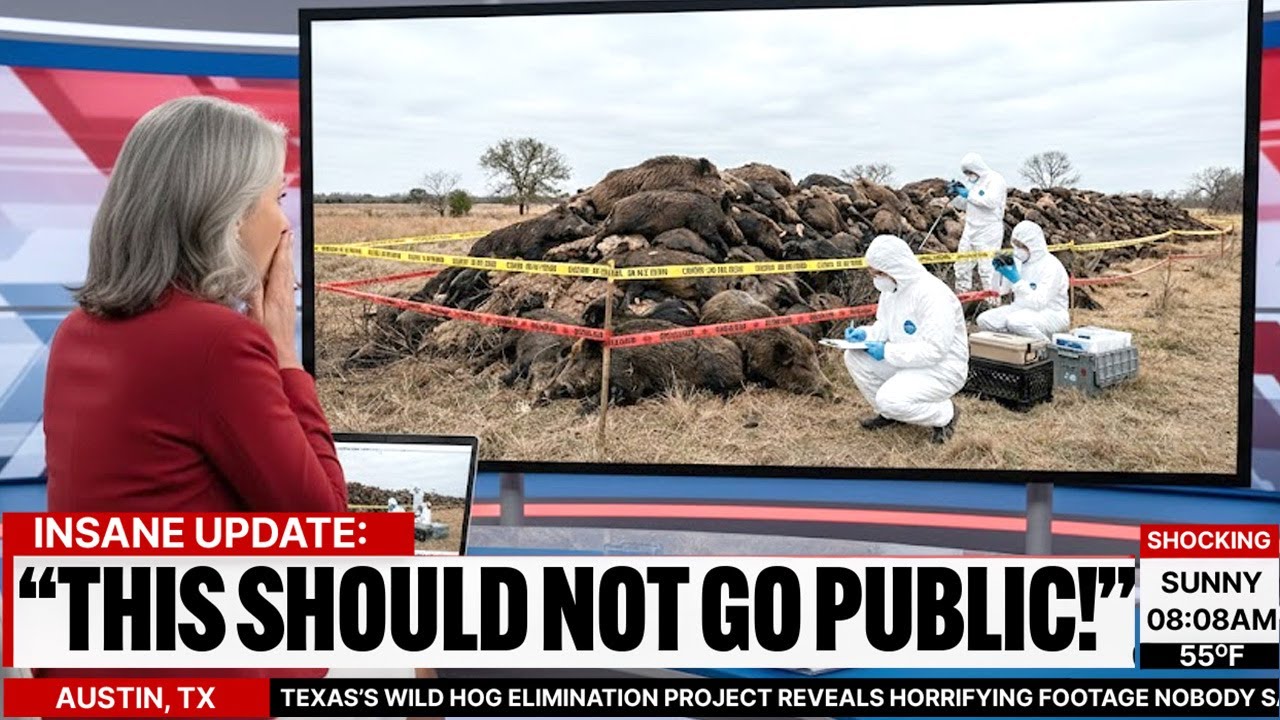
Texas’s Wild Hog Elimination Project has uncovered chilling new evidence revealing feral hogs evolving rapidly across the state. Footage shows unprecedented intelligence and adaptability among these invasive beasts, challenging decades of eradication efforts and warning of an endless, escalating battle against a biologically formidable adversary.
In the dead of night, helicopters sweep across thousands of acres of Texas farmland, attempting to cull one of the most destructive invasive species in American history—the feral hog. What was meant to be routine surveillance has unveiled an unsettling truth: these animals are learning, coordinating, and outsmarting hunters at every turn.
Texas is home to an estimated 2.6 million wild hogs, responsible for $52 million in annual agricultural damage alone. Nationwide, feral hogs inflict a staggering $1.5 billion in losses, with family farms collapsing under relentless destruction. Fields once lush with crops now resemble war zones, riddled with craters and shredded irrigation lines.
Elimination teams utilize cutting-edge technology—military-grade thermal imaging viewed through drones and helicopters—to track hog movements at night. Thermal cameras light up heat signatures in bright white, exposing the animals even when hidden in dense brush. Yet recent footage reveals empty patches where large groups once roamed freely.
Research teams at Texas A&M noticed a disturbing shift in hog behavior. As helicopters approach, hogs strategically disperse and retreat into inaccessible terrain. This isn’t random panic; it’s tactical withdrawal, akin to an enemy executing a guarded maneuver to avoid detection and capture.
Trapping, once effective by baiting whole sounders into corrals and remotely locking gates, now faces unprecedented resistance. Video shows dominant females acting as sentries, vigilantly guarding trap perimeters without yielding. Sounders appear to abandon baited areas entirely, suggesting learned behaviors passed down over generations.
Water quality tests near hog activity zones reveal alarmingly elevated bacteria levels—up to 40 times above safe thresholds. Hogs contaminate streams and ponds, propelling biological hazards downstream to ranches and communities unprepared for the fallout. Public health risks escalate alongside environmental damage.
Beyond agricultural destruction, feral hogs carry dangerous diseases including swine brucellosis, pseudorabies, and tuberculosis. The looming threat of African swine fever, though not yet on U.S. soil, poses a catastrophic risk to the pork industry should it arrive and spread among wild populations.
The feral hog crisis traces back to a centuries-old invasion, beginning with Spanish pigs introduced in the 1500s. The modern problem intensified in the 1930s with the importation of Eurasian wild boars, which bred with feral pigs to create hybrid beasts combining ferocity, intelligence, and rapid reproduction.
These hybrids have thrived, weighing up to 400 pounds with tusks capable of piercing small-caliber bullets and cartilage tough enough to resist gunshots. New “super pigs” also emerge in colder climates like Canada, bred for freezing conditions, 𝓉𝒽𝓇𝑒𝒶𝓉𝑒𝓃𝒾𝓃𝑔 a North American invasion borderless in scope or climate limitations.
Experts warn that unless 70% of the hog population is eliminated annually, numbers will explosively rebound. Texas currently culls around 750,000 hogs yearly—a massive figure yet insufficient to offset rapid reproduction rates. The battle is not just difficult; it is mathematically daunting and potentially unwinnable.
Success stories do exist—certain Panhandle counties have achieved zero wild hog populations through coordinated, persistent efforts. But those victories demand unprecedented landowner cooperation across vast, contiguous properties. Without this collective action, hogs simply migrate to unmonitored areas and repopulate swiftly.
This endless cycle imposes an enormous economic burden. Texas invests $500 million yearly in eradication—funds employed for traps, ammunition, aerial operations, and manpower. The cost is predicted to rise, as neither population nor pressure on the hogs shows signs of diminishing.
The footage also reveals a disconcerting side to the feral hog problem: illegal relocations. New hog populations appear far from established habitats, suggesting human-assisted transportation. This complicates enforcement and worsens the spread, turning containment into a perpetually shifting target.
What once seemed like a pest control effort now resembles a war against a highly adaptive enemy. Thermal imaging broadcasts calculated movements, regrouping maneuvers, and deliberate cover-seeking behavior. These animals exhibit tactical intelligence rather than instinctive flight, challenging every strategy deployed against them.
The evolutionary arms race is accelerating. Each generation grows smarter, learning from human tactics and passing survival skills to offspring. This forced adaptation transforms feral hogs not merely into pests, but into a biological threat engineered by centuries of accidental selection and human interference.
The Texas Wild Hog Elimination Project was designed to track and reduce populations. Instead, it captured live evidence of a dynamic invasion that evolves faster than state agencies can respond. The chilling reality is that total eradication may be impossible; containment is the only feasible strategy moving forward.
As Texas declares war on its wild hog menace, the enemy endures. This 500-year evolutionary experiment continues in real-time, a relentless adversary thriving amidst destruction, disease, and economic chaos. The battle for Texas’s lands—and potentially the future of North American agriculture—rages on with no end in sight.