My Son-In-Law Demanded His Parents Move Into My Lake House — So I Let the Cameras Speak
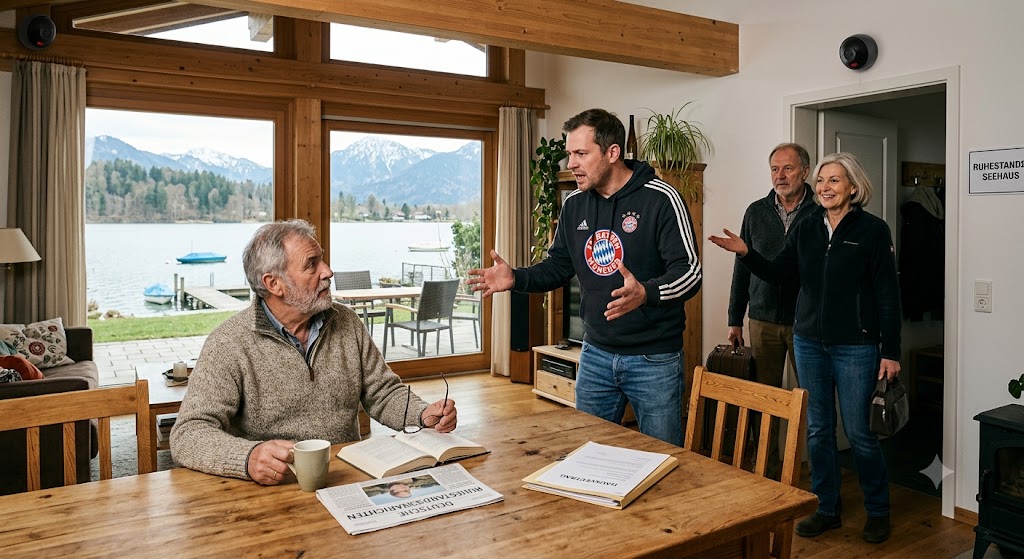
Retirement was supposed to be the reward. Thirty-one years of punching a clock, managing ungrateful coworkers, and surviving office politics sharp enough to draw blood. At the end of it, Amanda and I finally got our prize: a quiet lake house in Pinerest. Three bedrooms, a wraparound deck, and more silence than I’d heard in three decades.
For eight months it was perfect.
Then Stuart opened his mouth.
Our daughter Isabella had married him two years earlier. I’d had reservations from the start — the kind I kept to myself at the wedding. Stuart had a particular talent: he said things in a tone that made them sound like facts when they were actually demands. Amanda called it confidence. I called it something that starts with a different letter.
They lived forty minutes away with our four-year-old grandson, Logan — the only genuinely perfect thing in this story.
On the last Friday of June they came for dinner. I grilled. Amanda made her good potato salad. Logan chased fireflies. It was the kind of nice that makes a man let his guard down.
That’s when Stuart set down his beer and said, “So, Dad… we wanted to talk to you about something.”
I’ve never once liked a sentence that starts that way.
His parents, Reed and Nicole, were struggling. Reed’s back was bad. The apartment was too small. “Just temporarily,” Stuart said. “Three months, maybe four. They could stay here at the lake house.”
The deck got very quiet. A loon called out across the water. I remember thinking, Yeah, me too, buddy.
Amanda said we’d think about it. Stuart smiled before she even finished the sentence — like the answer was already decided.
The campaign started the next week. Texts. Calls. An eight-minute voicemail from Nicole that used the phrase “we just need someone to believe in us” three separate times. Amanda softened. I did not.
Then Stuart came by alone, sat at my kitchen table with boardroom posture, and said the line that changed everything:
“Isabella is really stressed about this. And when Isabella is stressed, it affects our marriage. And when our marriage is affected, it affects Logan.”
He had just held my daughter’s marriage and my grandson’s stability over my head like a conductor’s baton.
I smiled. “Let me talk to Amanda.”
That night I called my old colleague Ashley — the sharpest operator I ever worked with, now a home-security consultant.
“I need cameras,” I said. “Good ones. Inside and out. Discreet. Before the guests arrive.”
Ashley laughed. “Andrew, what are you planning?”
“I’m not planning anything. I’m documenting.”
Six cameras went in: front door, living room, kitchen, back deck, stairs, driveway. Motion-activated. Full audio. Legal. Cloud-backed. Connected to an app on my phone.
Reed and Nicole arrived on a Thursday. Nicole walked in, touched everything, and said, “Oh, this is charming,” in a tone that made “charming” sound like a polite insult. Within forty-eight hours she had rearranged the furniture. I put the reading chair back. She moved it again. We did this three times before I decided to save my energy.
The cameras caught everything.
Week two. 6:15 a.m. Motion alert — kitchen. Nicole on the phone, voice low:
“There’s so much space here… If we play it right, Stew, I think we could make this work long-term. He’s retired. He and Amanda travel. Half the time the house would basically be ours.”
I put the phone down. Sat very still. A heron landed at the edge of the dock and waited with the patience of something that had decided to stay.
I went inside, smiled, and asked Nicole if Reed needed anything for his back. I was so pleasant it should have terrified her.
By week five the pattern was clear. Stuart visited often. Nicole and he had long “private” conversations on the deck. The audio was excellent. Nicole believed the arrangement would become permanent. Stuart had told her they just needed time. Isabella wasn’t part of the plan — which told me her “stress” had been a lever Stuart pulled without her knowledge.
Reed, to his credit, thought it was temporary. He said so to Nicole in a conversation she believed was private. She told him to stop being rigid.
One evening on the dock, Reed sat carefully because of his back and said, “I want you to know I didn’t ask for this.”
“I know.”
“Stuart said you were open to it long-term.”
“We weren’t. We aren’t.”
Something passed over Reed’s face — the expression of a man who had suspected something for a while and just had it confirmed.
The breaking point came while Amanda and I were at the grocery store. Living-room camera alert. Stuart was in my house with a measuring tape. Measuring walls. Nicole talking about which ones weren’t load-bearing. Isabella’s voice in the background, uneasy.
I looked at Amanda holding a bag of apples.
“Everything okay?” she asked.
“Not even a little. We need to go home.”
I pulled into the driveway, saw Stuart’s car, and felt something settle in my chest — not rage, something quieter and far more dangerous.
I walked inside, smiled, and said, “Hey, Stuart. How about we sit down?”
Then I played the recordings.
Nicole’s phone call from week two. The measuring-tape conversation. The key Nicole had taken from my own hook and given to her son. Reed’s admission that Stuart had claimed we were “open to it” before we’d agreed to anything.
I never raised my voice.
Stuart tried to pivot. Nicole called me cold. Reed stood in the doorway and gave the smallest nod of acknowledgment.
I looked at them and said the only thing that needed saying:
“You have two weeks to find other arrangements.”
The next two weeks were loud. Stuart tried every angle — Isabella, Amanda, guilt, family, civilization itself. Amanda watched the recordings. All of them. Including the one where Nicole explained that Amanda was “the softer one” and could be worked on.
Amanda is many things. Soft is not one of them.
“Get out of my kitchen,” she told Nicole on day ten, in a tone I had never heard in thirty-four years of marriage.
Isabella came alone on day twelve. We sat on the dock.
“I didn’t know,” she said. “About the long-term thing. About what he told me.”
“I know.”
“You used me,” she had said to Stuart that day in the living room — quiet, worse than loud.
Moving day came on a Tuesday. Reed found me on the deck at 6:15 with my coffee, held out his hand, and apologized for not pushing back harder. Nicole walked past without speaking, storing a grievance. Stuart stood at the door with his keys and hoped this wouldn’t define us.
I looked at him over my coffee cup.
“Stuart, you used your wife’s emotions as leverage to move your parents into my home without genuine consent, lied about the permanence of the arrangement, had your mother take a key without permission, and stood in my living room with a measuring tape planning which walls to remove. And then you tried to make me feel like I was the problem.
“So here’s what defines us: what you did is documented permanently. And if there is ever another attempt to manage, manipulate, or maneuver this family for your benefit, those recordings go to Isabella. All of them. Every word.
“We clear?”
He nodded once.
“Good. Drive safe.”
They were gone by noon.
Six weeks later Isabella filed for separation. I didn’t celebrate. A marriage ending is never a victory lap. But when she came up alone that first weekend, sat on the deck, and asked, “Dad… how did you know?”
I thought about the smile before Amanda finished her sentence. The measuring tape. The tone of the first request.
“Experience,” I said. “And a decent camera system.”
Some people look at a quiet man who’s worked hard, built something, and stepped back to enjoy it, and they see a soft target. They see someone who will absorb, adjust, accommodate.
What they don’t see is that the patience isn’t weakness. It’s preparation. It’s six cameras and a cloud server and an audio file with your name all over it. It’s knowing that the longer you wait, the more rope they use.
The lake house is quiet again. The chair is back where I like it. Amanda made her good potato salad last Saturday. Logan chased fireflies. Nobody measured any walls.
It was, in every way that matters, perfect.