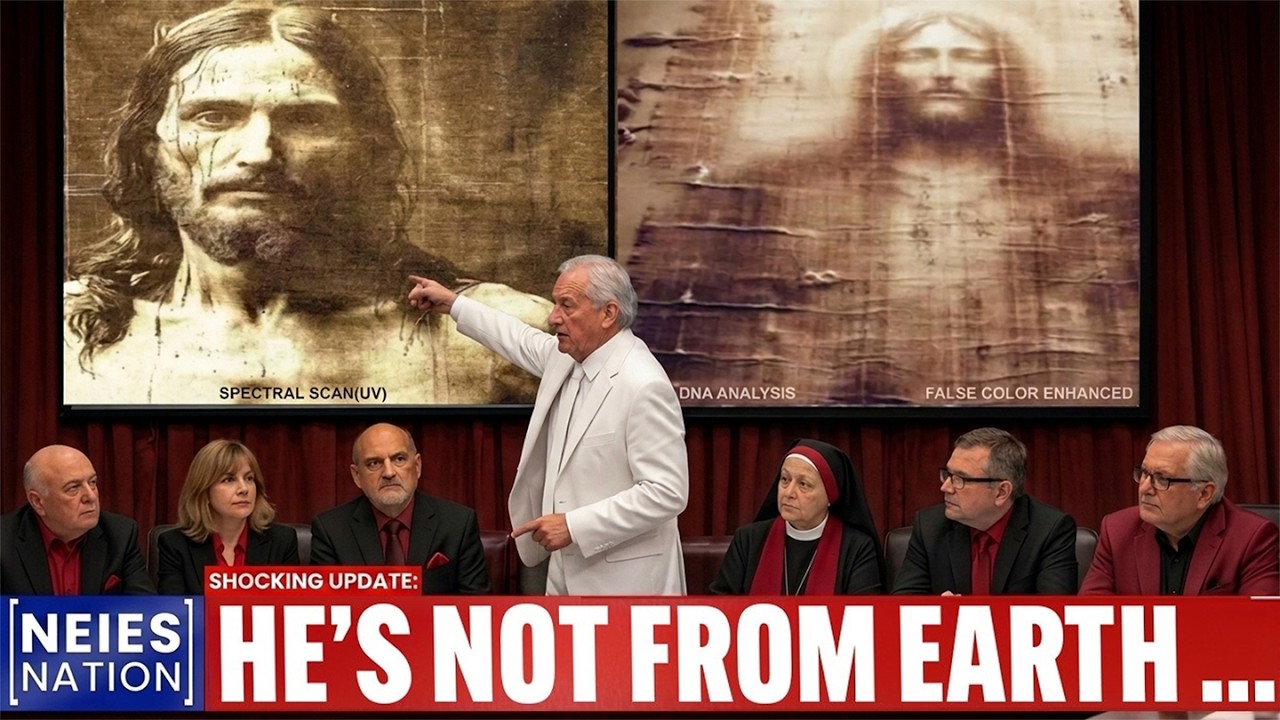
After 46 relentless years analyzing the Shroud of Turin, Jewish photographer Barrie Schwartz uncovered a single molecule—bilirubin—that shattered his skepticism and forced a reckoning with the cloth’s authenticity. This breakthrough challenges centuries of doubt, reigniting fierce debate over one of Christianity’s most enigmatic relics with profound new scientific backing.
In 1978, Barrie Schwartz entered Turin’s cathedral, expecting to expose the Shroud of Turin as a medieval forgery. Raised in a strict Orthodox Jewish household, Schwartz carried no religious bias, armed only with his top-tier scientific photography skills and a commitment to uncover the truth.
His mission was straightforward: find evidence of paint, pigments, or brush strokes on the linen cloth believed by millions to bear Jesus Christ’s burial image. But within an hour, Schwartz was stunned. The shroud defied the characteristics of any known artistic technique, behaving unlike any painting he had encountered.
Doubt gnawed at him for 17 years. The blood stains on the shroud baffled experts—still vividly red after centuries when ancient blood should have turned dark and brittle. Schwartz and his colleagues grappled with this mystery, their skepticism shadowed by the strange blood color that refused to conform to natural aging.
The breakthrough finally came with a phone call from a dying Jewish blood chemist who mentioned “bilirubin,” a molecule linked to extreme physical trauma. This discovery aligned with medical evidence of prolonged suffering consistent with Roman scourging practices, visibly etched in the shroud’s 100-plus scourge marks.
This revelation reframed Schwartz’s understanding. It wasn’t just ancient blood—it was blood altered by severe trauma, explaining the persistent red hue. The bilirubin finding broke through longstanding disbelief, confronting decades of scientific skepticism and theological assumptions surrounding the shroud’s origins.
The shroud’s story dates back to 1898 when photographer Secondo Pia made a discovery that shocked the world. His negative photograph revealed a flawlessly detailed, lifelike image—a true photographic negative—of a man’s face, centuries before the invention of photography itself.
This image’s anatomical precision and reversal baffled experts: no medieval artist could conceive or execute such a sophisticated negative image. The question echoed for over a century—how could this be possible before modern photographic technology?
In 1976, scientists at the U.S. Air Force Academy deepened the intrigue by analyzing the shroud using a VP-8 image analyzer. Unlike all traditional images, the shroud’s image translated into a mathematically accurate three-dimensional human form, defying known artistic methods and technology available centuries ago.
Further investigations revealed the blood on the shroud predated the body image, overturning assumptions that the figure was painted first. The blood soaked into the cloth before the image even formed, dismissing theories of forgery, painting, or contact transfer as impossible explanations.
Blood analysis confirmed hemoglobin, albumin, and serum halos—indicators of real blood drying naturally over time, something unknown to medieval forgers. These forensic details underscored the shroud’s authenticity, evidencing a level of biological accuracy that remains unmatched by any known ancient art form.
In 2017, controversial research from the University of Padua disclosed nanoparticles of creatine indicating rhabdomyolysis, a condition caused by crushing trauma consistent with the brutal Roman flagrum scourging. Though retracted on procedural grounds, the findings echoed earlier blood chemistry studies pointing to extreme physical suffering.
Anatomical details on the shroud further confounded skeptics. Nails appeared driven through the wrists, not palms, confirmed by forensic studies revealing nerve damage and thumb contraction, a detail never depicted correctly in historical crucifixion art but plainly visible on the shroud’s image.
Blood type testing suggested a rare AB classification, also found on the Sudarium of Oviedo, a separate cloth historically documented and linked to the same individual by matching wound patterns and blood stains, hinting at a shared origin for these relics and challenging the medieval forgery theory.
Mitochondrial DNA analysis in 2015 revealed an unprecedented genetic mosaic on the cloth, containing traces from the Middle East, Europe, East Africa, India, and East Asia. This diverse DNA profile aligns with the shroud’s suspected centuries-long journey through major trade hubs, defying simple geographic explanations.
Pollen analysis identified 58 plant species from Europe and the Middle East, including Gundelia tournefortii, a thorny desert plant blooming near Jerusalem during Passover—suggesting the shroud’s direct connection with that historic region and season, a silent botanical signature reinforcing its authenticity.
The 1988 radiocarbon dating placed the shroud’s origin in the medieval era, seemingly debunking its ancient provenance and sparking worldwide headlines. Yet, serious questions about testing methods, sample sites, and subsequent findings undermined the confidence of this conclusion.
Raymond Rogers’ analysis revealed cotton and dye in the tested corner, suggesting a medieval repair rather than original fabric. This discrepancy casts doubt on the validity of the carbon dating, hinting the tested samples may not reflect the true age of the shroud, sustaining the unresolved debate.
Further radiocarbon assessments and research into textile fibers propose the linen may date to the first century, consistent with samples from Masada, reinforcing the possibility that the shroud could indeed be contemporaneous with the historical Jesus.
Today, the shroud remains scientifically inexplicable—no paints, dyes, or modern imaging techniques can replicate its image formation. It survived centuries of damage, encodes three-dimensional data, and resists definitive classification as either artifact or miracle.
For Barrie Schwartz, the shroud was never a gateway to faith conversion. He followed evidence without doctrine, reaching a difficult acceptance of the cloth’s extraordinary nature. His journey epitomizes the complex intersection of science, religion, and history embedded in the shroud.
Now housed in Turin, the Shroud of Turin stands as a silent enigma—neither conclusively proven nor disproven—its secrets encoded in blood, pollen, and enigmatic imagery, relentlessly challenging experts to unravel its ancient mystery.
As new scientific approaches and technologies advance, the shroud continues to beckon researchers worldwide, promising yet more revelations that could redefine our understanding of history, faith, and the boundaries of scientific inquiry.
This ancient relic remains a crucible of controversy and wonder, compelling a reevaluation of long-held assumptions and exposing an unprecedented dialogue between faith and science that refuses to be silenced.
The shroud’s unresolved status ensures it remains one of the most studied and debated artifacts in human history—a puzzle that demands urgent attention and refuses simplistic explanation, inviting every generation to witness its unfolding story.