On September 19, 1945, thousands of people gathered outside Wilshire Methodist Church in Los Angeles hoping to catch a glimpse of America’s most beloved former child star, Shirley Temple, as she married decorated Army Air Forces sergeant John Agar.
The photographs captured a smiling seventeen-year-old bride and a handsome twenty-four-year-old groom in uniform.
To the public, it looked like the perfect Hollywood fairy tale.
Behind the headlines, however, was a marriage that would prove far more complicated than either of them could have imagined.
To understand why, it is important to understand who Shirley Temple had become long before she was old enough to choose her own future.
By the mid-1930s, Temple was not simply Hollywood’s biggest child star—she was one of the most valuable entertainers in America. During the depths of the Great Depression, films such as Stand Up and Cheer!, Bright Eyes, and Curly Top turned her into an international sensation. Her movies generated enormous profits, merchandise bearing her image filled stores, and she became a symbol of optimism for millions of Americans.
President Franklin D. Roosevelt even remarked that as long as the country had Shirley Temple, Americans could keep smiling through difficult times.
That extraordinary success came with an equally extraordinary burden.
From early childhood, nearly every aspect of Temple’s public life was carefully managed by studios, publicity departments, and her mother, Gertrude Temple. Her image as the cheerful, innocent little girl became one of Hollywood’s most valuable brands.
Like many child stars, she eventually faced an unavoidable challenge.
She grew up.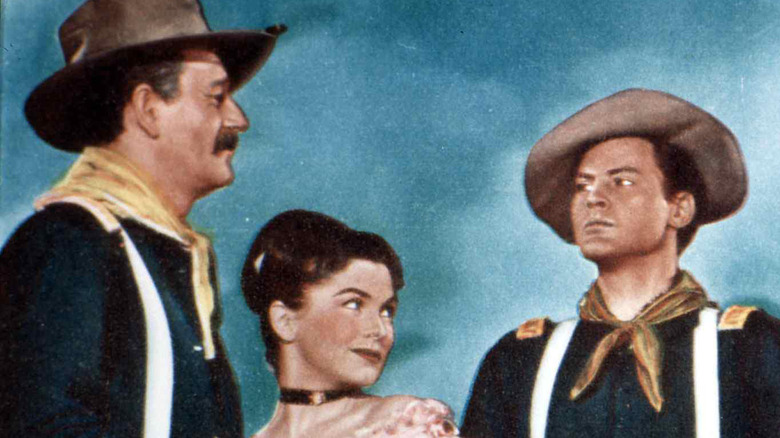
As audiences struggled to accept her transition from child performer to young actress, her career entered a difficult period during the early 1940s. It was during those years that she met John Agar.
Born in Chicago in 1921 and raised in Southern California, Agar had little connection to the entertainment industry. After serving in the United States Army Air Forces during World War II, he met Temple through mutual friends at a social gathering hosted by producer David O. Selznick.
The attraction developed quickly.
Temple later acknowledged in her autobiography that, as a teenager, she was eager to experience adulthood and marriage. Agar represented stability, charm, and life outside the carefully controlled world she had known since childhood.
They married when Temple was just seventeen years old.
Almost immediately, Agar found himself drawn into Hollywood.
Producer David O. Selznick signed him to an acting contract despite his lack of professional experience. While the opportunity launched Agar’s film career, it also created an uncomfortable perception that he had become an actor primarily because he was Shirley Temple’s husband.
Whether entirely fair or not, that reputation followed him for years.
Agar later admitted that adapting to Hollywood was far more difficult than he had expected. Unlike Temple, who had spent virtually her entire life in front of cameras, he entered an industry with little training while facing enormous public expectations.
The imbalance affected both his confidence and their marriage.
Reporters rarely treated him as an independent performer. Instead, interviews frequently centered on his famous wife, reinforcing the public perception that his identity existed mainly in relation to Shirley Temple.
At the same time, Temple herself was navigating the difficult transition from child celebrity to adult woman.
Having spent her formative years under constant public scrutiny, she later reflected that learning how to build an ordinary family life was not always easy. Both she and Agar were young, inexperienced, and suddenly attempting to balance marriage, parenthood, careers, and relentless media attention.
Their daughter, Linda Susan Agar, was born in 1948.
While becoming parents brought moments of happiness, deeper problems were also emerging.
Agar struggled with alcohol during the marriage, something Temple discussed candidly in her autobiography. She described increasing concern about his drinking and its impact on their relationship. Those issues eventually became one of the principal reasons their marriage deteriorated.
The couple divorced in 1950 after less than five years together.
Although the separation was painful, Temple generally avoided portraying Agar as a villain. Instead, she acknowledged the difficulties they both faced while expressing hope that he would eventually rebuild his life.
In many ways, he did.
Following the divorce, Agar gradually established himself as a dependable actor, particularly in Westerns and science-fiction films. He appeared in productions including Fort Apache, She Wore a Yellow Ribbon, Sands of Iwo Jima, Revenge of the Creature, Tarantula, and numerous television series throughout the 1950s and 1960s.
While he never became a major leading man, he built a respectable career spanning several decades.
Temple’s life moved in a very different direction.
She married businessman Charles Alden Black in 1950, a marriage that lasted until his death in 2005. After retiring from acting, she entered public service, serving as United States Ambassador to Ghana and later Ambassador to Czechoslovakia, while also holding several important diplomatic and governmental positions.
Her second career earned widespread respect independent of her childhood fame.
Over the years, stories have occasionally surfaced claiming that Agar later spoke negatively about Temple during government background investigations or attempted to damage her diplomatic career.
These allegations remain disputed and are not supported by strong publicly available documentary evidence. Most reliable biographies instead focus on the challenges of their marriage, Agar’s struggles with alcoholism, and the lasting impact of living in the shadow of one of Hollywood’s most famous stars.
Looking back today, the tragedy of John Agar’s story was not simply that he married Shirley Temple.
It was that two very young people entered a marriage while carrying burdens neither fully understood.
Temple had spent her childhood living as an international symbol before she could truly discover who she was.
Agar entered one of the world’s most demanding entertainment industries without realizing how difficult it would be to establish an identity separate from his famous wife.
Their marriage ultimately could not survive those pressures.
Yet both went on to build meaningful lives in very different ways—Temple as a respected diplomat and public servant, Agar as a hardworking character actor whose career endured long after the headlines about his marriage had faded.
Sometimes Hollywood’s greatest fairy tales are remembered not because they lasted forever, but because they remind us that fame rarely protects people from the ordinary challenges of growing up, finding purpose, and searching for happiness.