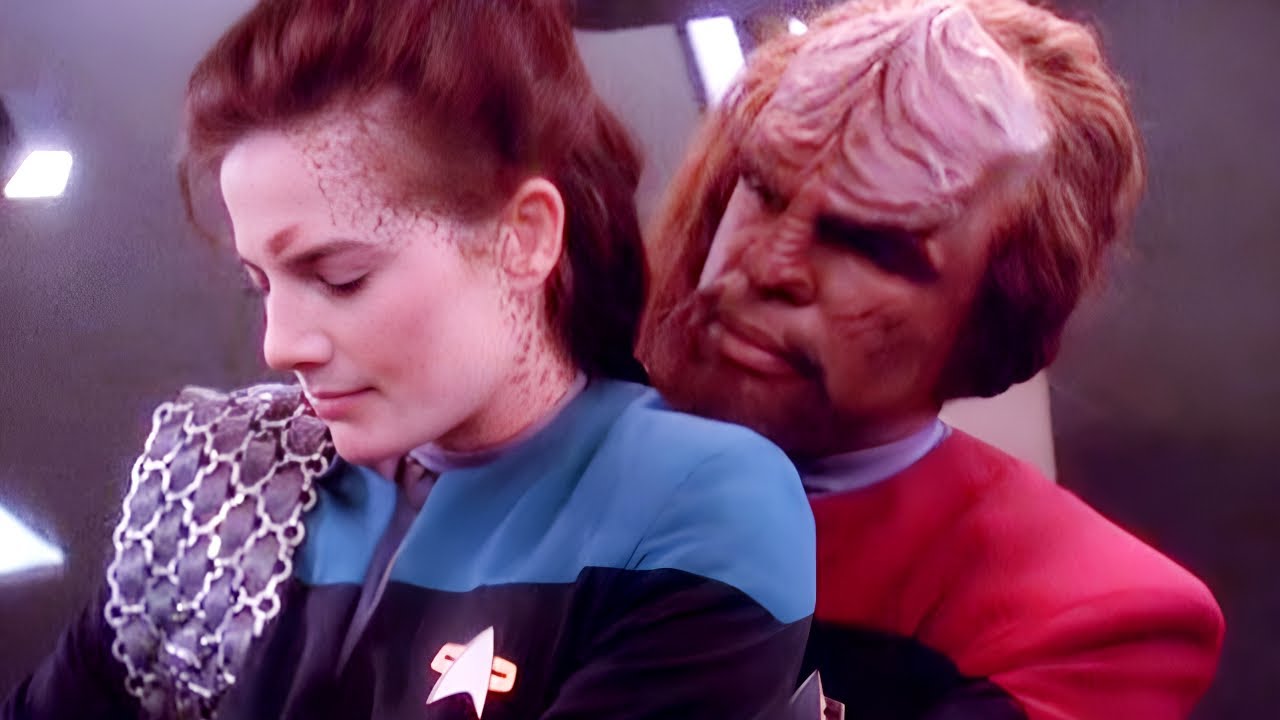
The galaxy of Star Trek: Deep Space Nine was shattered in 1998 when fans learned that Jadzia Dax, the beloved Trill science officer portrayed by actress Terry Farrell, would not be returning for the show’s final season. What initially appeared to be a creative decision quickly unraveled into a tale of contract negotiations gone toxic, allegations of workplace harassment, and a franchise at war with one of its own brightest stars. The departure was not a quiet exit.
It was an explosion that reverberated through the fandom for decades.
 Farrell had spent six grueling seasons bringing Jadzia Dax to life, making her one of the most cherished characters in the entire Star Trek canon. Jadzia was not merely a science officer. She was a vessel for centuries of accumulated wisdom, hosting a symbiont that carried the memories of eight prior lifetimes.
This unique premise gave Farrell the opportunity to portray a character of extraordinary depth, one who could embody calm authority in one scene and unleash fierce Klingon warrior energy in the next. Audiences fell in love with her wit, her warmth, and her undeniable chemistry with the rest of the ensemble cast.
Her bond with Captain Benjamin Sisko, played by Avery Brooks, formed the emotional backbone of the series. The two shared a friendship that transcended the typical captain-subordinate dynamic, rooted in the fact that Sisko had known the previous Dax host, Curzon. That pre-existing relationship informed every interaction, adding layers of trust and familiarity that made the show feel grounded and human.
Farrell’s performance earned critical acclaim and a devoted following that remains fiercely loyal to this day.
But behind the scenes, the atmosphere on the Deep Space Nine set was far from the utopian future the show depicted. According to Farrell, tensions with executive producer Rick Berman began early and never truly subsided. In interviews and her own public statements, she described an environment where she felt demeaned and objectified.
She specifically recalled Berman making inappropriate comments about her physical appearance, including remarks about her body that she characterized as deeply misogynistic and unprofessional.
The breaking point came when negotiations began for the seventh and final season. Farrell did not want to leave the show entirely. She loved Jadzia Dax and cherished the connection she had built with the character.
What she wanted was flexibility. After six years of punishing production schedules and the demanding makeup process that required hours in the chair each day, she asked to appear in approximately half of the final season’s episodes. This would have allowed her to pursue other acting opportunities while still honoring her commitment to the series.
The studio’s response was swift and uncompromising. Farrell was told she had two options: appear in all twenty-six episodes or leave altogether. There was no middle ground, no negotiation, no willingness to accommodate her request.
Farrell later revealed that she felt targeted and pressured, with producers calling her at inopportune moments, even right before filming scenes, demanding she sign a contract. She described the experience as an attempt to bully her into submission, a pressure campaign designed to break her resolve.
One particularly chilling moment came when a junior producer warned her that without the show, she would end up working at Kmart. The comment, intended to intimidate her into staying, instead cemented her determination to leave. Farrell refused to be manipulated, and she walked away with her head held high.
It was a decision born of principle, but it came at a tremendous cost. The character of Jadzia Dax was unceremoniously killed off in the season six finale, “Tears of the Prophets.”
The death scene was brutal. Jadzia, on the verge of beginning a new chapter with her husband Worf, was attacked by the villain Gul Dukat while visiting the Bajoran Temple of the Prophets. The assault left her gravely wounded, and she died in the infirmary with Worf at her side.
It was a devastating moment for viewers who had invested emotionally in her journey. The Dax symbiont survived, however, and was later joined with a new host named Ezri, portrayed by actress Nicole de Boer, for the final season.
 Fans were divided over the replacement. Ezri was written as uncertain, nervous, and overwhelmed by the sudden burden of carrying the Dax symbiont, a stark contrast to the confident and poised Jadzia. The romantic entanglement between Ezri and the still-grieving Worf felt forced to many viewers, and the character never achieved the same level of popularity as her predecessor.
The show pressed on, but something essential had been lost. The soul of Deep Space Nine, many argued, had departed with Farrell.
Rick Berman, for his part, denied any personal animosity toward Farrell and disputed the characterization of the negotiations. He claimed he did not have the authority to fire her and that the ultimatum came from studio executives who insisted she commit to the full season or nothing at all. He also stated he was unaware of the depth of her discomfort on set, suggesting that had he known, he might have intervened differently.
Farrell, however, remained firm in her account of events.
She detailed her experiences in the book “The Fifty-Year Mission,” where she explicitly named Berman and described an environment that she found hostile and demeaning. Her allegations added to a growing conversation about the treatment of women in the entertainment industry, a conversation that would gain even more momentum in the years following the #MeToo movement. Farrell’s willingness to speak openly about her mistreatment helped validate the experiences of countless other actresses who had faced similar challenges in silence.
In the immediate aftermath of her departure, Farrell moved on to other projects. She joined the cast of the CBS sitcom “Becker,” starring opposite Ted Danson, where she played the role of Charlotte, a physical therapist. The atmosphere on that set was dramatically different, lighter and far less fraught with tension.
Farrell has described the experience as a breath of fresh air, an opportunity to reset and rediscover her love of acting in an environment that felt supportive rather than adversarial.
Despite the bitterness of her exit, Farrell’s feelings toward her time on Deep Space Nine have softened over the years. In 2007, she appeared at a Star Trek convention and expressed regret about leaving the series so abruptly, admitting that Jadzia Dax was the coolest character she had ever played. She joked that transitioning from playing a hero to playing a neurotic short-order cook on “Becker” was a difficult adjustment, underscoring just how much the role had meant to her.
In 2014, Farrell attended the Star Trek Las Vegas convention in full Trill makeup, complete with the iconic spots that had become synonymous with her character. She wore a shirt emblazoned with “Dax 539,” a reference to the 539 times makeup artist Michael Westmore had applied those spots during her tenure on the show. The gesture was a loving tribute to the character and a powerful sign that any residual ill will had been replaced by gratitude for the opportunity to have played Jadzia.
She has also expressed a willingness to return to the Star Trek franchise in some capacity, suggesting that she would happily play Jadzia again as a clone, a hologram, or a version of the character from an alternate universe. In 2017, she appeared in the fan-produced series “Renegades,” which featured a character named Jada who was clearly inspired by Jadzia Dax. The project brought together numerous Star Trek alumni and allowed Farrell to reconnect with the fandom that had never stopped supporting her.
Her personal life has been equally eventful. Farrell married actor Brian Baker in 2002, and the couple had a son named Max before divorcing in 2015. Then, in a twist that delighted Star Trek fans everywhere, she became engaged to Adam Nimoy, the son of Leonard Nimoy, the legendary actor who portrayed Spock in the original series.
The couple married in 2017, creating a unique crossover of Star Trek generations that fascinated the fan community. That marriage, unfortunately, also ended in divorce in 2022.
Farrell’s story, however, is only one chapter in the larger saga of behind-the-scenes drama that defined Deep Space Nine. The show was a crucible of creative tension, where showrunner Ira Steven Behr pushed the boundaries of what Star Trek could be, often clashing with Berman and the legacy of franchise creator Gene Roddenberry. Behr’s vision for a serialized war arc, culminating in the Dominion War, was initially met with resistance from executives who believed Star Trek should remain an aspirational, conflict-free universe.
 Roddenberry had famously envisioned a future where humanity had transcended war, poverty, and prejudice. Berman was the guardian of that vision, and he resisted Behr’s desire to plunge the show into a multi-season interstellar conflict. Behr pushed back, arguing that war could serve as a powerful lens through which to examine the very ideals Star Trek championed.
After tense negotiations, Berman reluctantly allowed the arc to proceed, expecting it to last only a handful of episodes.
Instead, the Dominion War became the defining storyline of Deep Space Nine, unfolding over two full seasons and fundamentally changing the tone of the series. The show began to explore moral gray areas that previous Star Trek series had largely avoided. Captain Sisko’s decision to manipulate the Romulans into joining the war, which involved orchestrating a murder and covering it up, remains one of the most controversial moments in franchise history.
The scene where Sisko declares, “I can live with it,” while staring directly at the camera, became iconic.
The war storyline drew in the Klingons, the Romulans, the Cardassians, and the Breen, creating a complex web of alliances and betrayals that kept viewers on the edge of their seats. Behr refused to shy away from the human cost of conflict, showing beloved characters dying and ideals being compromised. It was gritty, morally ambiguous, and unlike anything Star Trek had ever attempted.
Berman admitted to being uncomfortable with how long the arc stretched, but he continued to read every script and discuss every twist.
In hindsight, Behr’s gamble paid off. The Dominion War arc is now widely regarded as one of the boldest and most successful storytelling ventures in the history of Star Trek. It gave Deep Space Nine a weight and complexity that set it apart from its predecessors and successors.
The show’s willingness to confront difficult questions about power, morality, and the fragility of ideals earned it a devoted following that continues to grow in the streaming era. Many fans consider it the finest series in the entire franchise.
The parallel between the on-screen moral compromises of the Dominion War and the off-screen ethical failings within the production is impossible to ignore. Deep Space Nine was a show about testing principles under pressure, and the people who made it were themselves tested by the pressures of network television, executive oversight, and the sometimes punitive culture of 1990s Hollywood. Farrell’s departure stands as a stark reminder that the friction depicted on screen was not confined to the writers’ room.
For Farrell, the wounds have largely healed, but the legacy of her departure remains complicated. She walks a careful line between celebrating her time on the show and speaking truthfully about the circumstances that led to her exit. She has been gracious, but she has not forgotten.
And she has never wavered from her account of what happened, even when it would have been easier to stay silent and preserve professional relationships.
The question of whether Farrell made the right choice in walking away continues to divide fans. Some argue that she was unfairly treated and that her decision to stand her ground was principled and brave. Others suggest that the show was better off with a clean break and that her departure ultimately allowed the series to wrap up its narrative arc with dramatic finality.
What remains undisputed is that Jadzia Dax left an indelible mark on the franchise and that Farrell’s performance has never been forgotten.
 The death of Jadzia Dax remains one of the most talked-about moments in Star Trek history, and the circumstances surrounding it still generate passionate debate. At conventions, in online forums, and in the ever-expanding universe of Star Trek media, Farrell’s story is revisited with the regularity of a classic episode. The circumstances of her exit have become a cautionary tale about the treatment of actors in franchise television and the consequences of rigid, uncompromising executive decision-making.
Looking back, the parallel between her experience and the show’s thematic exploration of moral compromise is striking. Jadzia Dax was a character who stood for integrity and courage, and the actress who portrayed her displayed those same qualities in her dealings with the studio. While she was unable to secure the flexibility she sought, she maintained her dignity and her convictions.
In doing so, she may have paid a professional price, but she earned the enduring respect of the fans who saw through the spin.
The Star Trek franchise has evolved significantly since the late 1990s, with new series exploring fresh corners of the galaxy and revisiting beloved characters in innovative ways. The door has been left open for Jadzia Dax to return in some form, and Farrell has expressed openness to the possibility. Whether that ever comes to pass remains to be seen, but the legacy of her character is secure.
She stands alongside Spock, Kirk, and Picard as one of the most iconic figures in the Star Trek pantheon.
The infighting that marred the final seasons of Deep Space Nine is a reminder that the utopian ideals depicted on screen do not always translate to the real world of television production. The friction between Farrell and the producers occurred against a backdrop of broader franchise tensions, as the creative forces behind Star Trek clashed over its future direction. Berman and Behr, two powerful figures, fought philosophical battles about what the franchise should represent, and Farrell found herself caught in the crossfire.
Years later, Farrell’s account of her mistreatment has taken on renewed significance in light of the broader reckoning with workplace misconduct in Hollywood. Her willingness to name names and detail the harassment she experienced has been cited as an example of the kind of institutional sexism that pervaded the industry for decades. She told her story before it was fashionable or professionally safe to do so, and she has been vindicated by the changing conversation around these issues.
As the Star Trek universe expands with new series and the old episodes find new audiences on streaming platforms, the story of Jadzia Dax and Terry Farrell continues to resonate. New generations of fans are discovering Deep Space Nine and falling in love with its characters, only to learn of the painful circumstances behind Farrell’s exit. The tragedy of what happened is tempered by the knowledge that Farrell has made peace with her past and that her legacy, and that of her character, remains untarnished.
The production of a television series is a collaborative endeavor, and the tensions that arise behind the scenes can sometimes mirror the conflicts portrayed on screen. In the case of Deep Space Nine, those tensions were real and consequential, shaping the course of the series and the careers of those involved. Farrell’s departure was a turning point, one that changed the trajectory of the show and left a permanent mark on Star Trek history.
The decision to kill off Jadzia Dax rather than recast the role or write the character out gently was a choice that spoke to the bitterness of the negotiations. It felt punitive to many fans, an act of retaliation for an actress who had merely asked for a reduced workload. The way the exit was handled has been criticized by fans and commentators alike, and it stands as a blemish on the otherwise impressive legacy of the series.
In the end, the saga of Terry Farrell and Jadzia Dax is a story about the collision of art and commerce, of creative passion and institutional rigidity. It is a story about a talented actress who fought for respect and was met with intransigence. And it is a story about a character who transcended the circumstances of her creation to become beloved by millions.
The pain of the past may never fully fade, but the love for Jadzia Dax endures, and that is a testament to the lasting power of great storytelling.

