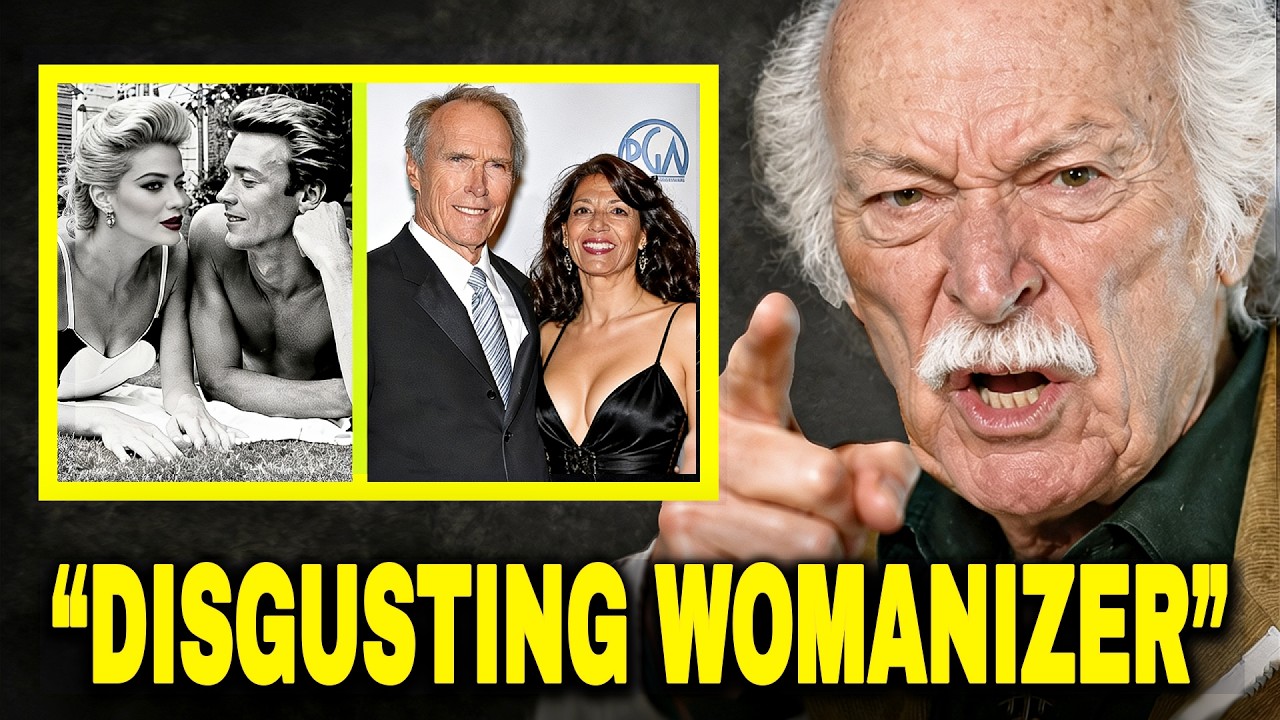
The last thing Lee Van Cleef wanted was to be remembered as a bitter Hollywood has-been nursing a grudge against a more famous co-star. But six years before his death, the legendary Western villain decided to set the record straight about the man audiences always assumed was his rival: Clint Eastwood.
For decades, fans of the Spaghetti Western era have speculated about tension between the two icons. Both defined the genre in Sergio Leone’s legendary films. Both shared the screen in For a Few Dollars More and The Good, the Bad and the Ugly.
 And one, Eastwood, ascended to a level of superstardom that Van Cleef never reached. The natural assumption was that resentment simmered beneath the surface.
Van Cleef’s comments, made in a reflective interview late in his life, revealed the exact opposite. There was no bitterness, no jealousy, no buried feud. Instead, the actor who portrayed some of cinema’s coldest killers offered a calm, thoughtful assessment of Eastwood that has now resurfaced and reshaped how fans understand their relationship.
“The public liked the idea of turning them into competitors,” Van Cleef reflected. “Two gunslingers battling for the spotlight. But from his perspective, it was much simpler than that.
They were just two actors whose careers crossed paths at exactly the right time, each bringing something completely different to the screen.”
Van Cleef’s journey to that clarity was anything but simple. Before he ever stepped in front of a camera, Clarence LeRoy Van Cleef Jr. was a decorated war hero.
Born in Somerville, New Jersey in 1925, he walked away from high school to enlist in the Navy during World War II at just 17 years old.
He served on a submarine hunter and later the USS Incredible, where he and his crew faced a terrifying German weapon: human torpedoes. When a dozen of the manned underwater crafts attacked his ship, Van Cleef and his crew destroyed ten of them. Two detonated against the hull, but the Incredible held.
Van Cleef earned the Bronze Star for bravery under fire long before his face became known to moviegoers.
After the war, Van Cleef drifted through odd jobs, factory work, accounting, even interior decorating, before a friend nudged him into amateur theater in 1947. Within a few years, he landed a role in High Noon, the 1952 classic that would cement its place in cinematic history. He played Jack Colby, one of the four outlaws awaiting the final showdown with Gary Cooper.
 That performance opened doors, but the roles that followed were mostly forgettable. Throughout the 1950s, Van Cleef became the villain of choice in low-budget Westerns. Hollywood saw a face made for menace, sharp cheekbones, piercing eyes, a stare that could cut through steel, and kept casting him as the same kind of character.
He understood the audience looked at his face and saw danger, suspicion, a man who might betray you the second you turned your back. And he accepted that completely. Instead of fighting against it, he learned how to turn it into his greatest strength.
By the late 1950s, the grind had worn him down. Industry insiders suggested he change his appearance, fix his nose, soften his features, if he wanted bigger roles. He refused.
He left acting altogether and returned to interior decorating to support his family. A near-fatal car accident in 1958 left him with a permanent knee injury. His career appeared finished.
Then came the phone call that changed everything. Sergio Leone, the Italian director who had just reinvented the Western with A Fistful of Dollars, wanted Van Cleef. When the actor arrived at the hotel meeting, measuring tape in hand, expecting a decorating job, he was met with a briefcase full of cash.
His wife Joan had no idea what was happening.
“In For a Few Dollars More, Van Cleef played Colonel Mortimer, the aging, methodical bounty hunter opposite Eastwood’s Man with No Name. The role catapulted him to stardom in Italy, where he became a leading man. He followed it with The Good, the Bad and the Ugly, playing Angel Eyes, perhaps the coldest, most unsettling character of his career.”
Even playing the devil, he drew lines he refused to cross. His personal rules were absolute: never threaten a child, never 𝓀𝒾𝓁𝓁 an animal, never murder a woman. It didn’t matter who directed him, even a legend like John Ford.
 Those boundaries held throughout his career.
Eastwood, by contrast, was building something different. Van Cleef watched it up close and recognized it immediately. What impressed him most wasn’t Eastwood’s looks or popularity.
It was his restraint. He noticed how Clint understood the power of stillness.
While many actors tried to dominate scenes with movement or dialogue, Eastwood did the opposite. He slowed everything down. He stayed calm, patient, almost motionless at times, and somehow that made people watch him even more closely.
Van Cleef believed that kind of screen presence couldn’t really be taught.
“Clint wasn’t simply playing a cowboy anymore,” Van Cleef said. “He was building an icon in real time.” He also saw how carefully Eastwood crafted that image.
Every quiet pause, every calm stare, every moment of silence was deliberate. Clint protected that image fiercely.
Van Cleef also rejected any notion that Eastwood overshadowed him. He argued the opposite: their differences made both performances stronger. The tension between Eastwood’s cool, controlled hero and Van Cleef’s morally gray gunslingers was precisely what gave Leone’s films their magic.
Without that contrast, those stories wouldn’t have worked the same way.
The two men reportedly never really knew each other personally. Van Cleef admitted in the interview that they may have crossed paths across a room or something, but there was never a real friendship, and never a real rivalry either. They were two professionals whose careers intersected at exactly the right moment.
Van Cleef understood Hollywood better than most. He knew fame was loud when an actor was young, and that it always faded. He accepted that his own legacy would be quieter, more mysterious.
He was at peace with it. He believed people remembered him differently, not for speeches or grand heroic moments, but for smaller things. The eyes, the walk, the silence, the feeling he created when he entered a frame.
Lee Van Cleef died on December 16, 1989, after suffering a seizure at his home in Oxnard, California. He was 64 years old, having battled heart disease for years. He was laid to rest at Forest Lawn Memorial Park, where his headstone carries a short but fitting tribute: “The best of the bad.”
In the end, his comments about Eastwood revealed no feud and no resentment. There was only understanding. Van Cleef believed Eastwood became exactly the legend he was meant to become, and that he, too, became what he was meant to be in his own right.
One stood in the light as the calm hero. The other carried the danger lurking in the shadows.
Together, framed against dust, silence, and blazing sunlight, they created one of the most unforgettable partnerships the Western genre has ever seen. And in the end, Van Cleef seemed entirely comfortable leaving it to audiences to decide which legend stayed with them most.