When There Was a Crooked Man premiered on Christmas Day in 1970, audiences expected another star-studded Western led by Kirk Douglas and Henry Fonda. Instead, they got a dark, satirical revisionist Western unlike anything Hollywood had produced before. Yet decades later, one of the film’s most talked-about moments isn’t something audiences remember seeing—it’s a scene that was removed before the movie ever reached theaters.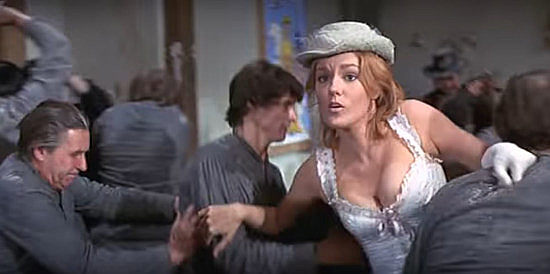
Directed by the legendary Joseph L. Mankiewicz, the film marked the acclaimed filmmaker’s first—and ultimately only—Western. Rather than celebrating traditional heroes, Mankiewicz crafted a cynical story where nearly every character lived in shades of gray. Kirk Douglas played the charismatic outlaw Paris Pitman Jr., while Henry Fonda portrayed the idealistic prison warden Woodward Lopeman, setting up a battle between ruthless self-interest and unwavering principle.
Supporting them was an extraordinary ensemble cast that included Burgess Meredith, Warren Oates, Hume Cronyn, John Randolph, and Barbara Rhoades as the prim Victorian schoolteacher Miss Jesse Brundage.
Unlike the hardened criminals surrounding her, Miss Brundage represented order, civility, and restraint. Her role was designed as comic relief, but also as a symbol of dignity placed inside a world descending into complete chaos. During the film’s climactic prison riot, that carefully controlled image was meant to collapse in spectacular fashion.
According to Barbara Rhoades, the original sequence was far more daring than the version audiences eventually saw.
Following Joseph L. Mankiewicz’s direction, her elaborate Victorian clothing was scripted to be torn away piece by piece as panic consumed the prison. The sequence reportedly culminated with Rhoades running completely nude across the desert prison set—not as exploitation, but as an exaggerated satirical joke about respectability literally being stripped away during total disorder.
Rhoades later explained that she committed fully to the scene exactly as it had been written. Although she joked about not feeling embarrassed in front of the crew, she understood that the moment demanded complete trust in both the director and the story they were trying to tell.
Warner Bros., however, reached a different conclusion.
Despite Hollywood becoming increasingly adventurous in the late 1960s and early 1970s, studio executives reportedly feared that the sequence pushed the film beyond what mainstream audiences would accept. Concerns about censorship, controversy, and commercial appeal ultimately led to the footage being removed before the film’s theatrical release. Only fragments of the scene remained, leaving viewers unaware of how much had originally been filmed.
Ironically, the deleted sequence became even more famous because it was never shown.
A handful of promotional photographs survived, including stills that suggested the extent of the original scene. These images circulated among collectors and film historians for decades, fueling speculation about whether an uncut version of the movie might still exist somewhere inside the Warner Bros. archives.
Barbara Rhoades’ sequence was far from the only casualty of the editing process.
Joseph L. Mankiewicz reportedly delivered a version of the film running close to 165 minutes, but Warner Bros. insisted on extensive cuts. Entire storylines disappeared, several supporting characters lost significant development, and actress Lee Grant’s role was reduced to only a brief appearance. Critics later observed that while the finished film contained brilliant ideas and memorable performances, it often felt as though important pieces of the story had been removed—and they were right.
The result was a Western that developed a loyal following over time but never fully reflected Mankiewicz’s original vision.
Looking back years later, Barbara Rhoades spoke about the deleted scene without bitterness. For her, it represented one of the boldest performances of her career—a moment she had fully committed to, only to watch it disappear in the editing room before audiences ever had the chance to judge it for themselves.
Today, There Was a Crooked Man remains an intriguing Hollywood curiosity: a film remembered not only for its remarkable cast and unconventional storytelling, but also for the legendary footage that became one of classic cinema’s most enduring “lost scenes.”