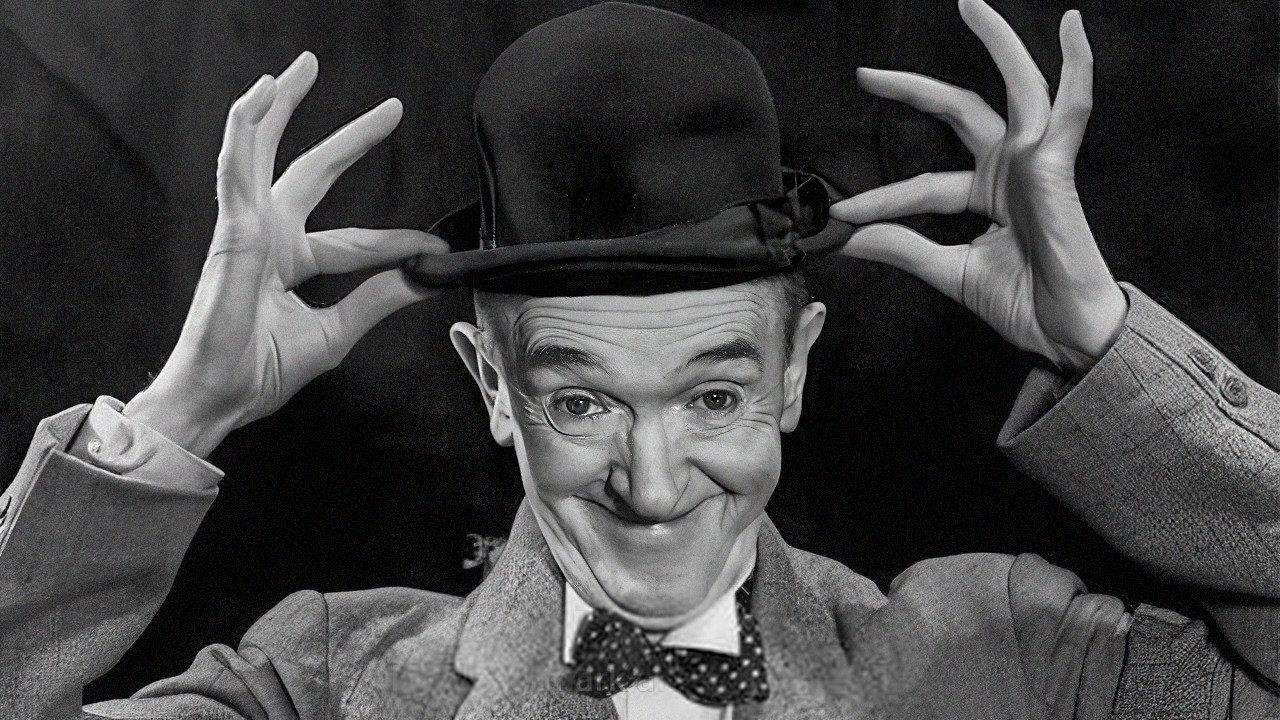
The man who taught the world to laugh spent his final years unable to find a single reason to smile. New details emerging about the life of Stan Laurel, the beloved half of the legendary comedy duo Laurel and Hardy, reveal a story far darker than the gentle, bumbling character audiences adored on screen. Behind the bowler hat and the bewildered expression was a man shattered by the death of an infant son, a string of catastrophic marriages, financial ruin, and the unbearable loss of his creative soulmate, Oliver Hardy.
Laurel, born Arthur Stanley Jefferson in Ulverston, England, in 1890, grew up in the theater. His father managed playhouses and wrote scripts, while his mother performed on stage. But the childhood that should have been magical was marked by sickness and solitude.
 As a frail boy often left in his grandmother’s care while his parents toured, young Stan escaped into a world of toy theaters and puppet shows, rehearsing for a future he could not yet imagine.
By his mid-teens, Laurel was sneaking onto amateur stages, and by 1906, he had borrowed his father’s best suit to perform at the Britannia Panopticon. When his father spotted him in the audience, Stan braced for punishment. Instead, his father bought him a whiskey and soda, a silent blessing that set him on a path toward Hollywood.
He joined Fred Karno’s comedy troupe, where he shared stages and lodgings with a young Charlie Chaplin, learning the art of physical comedy that would define his career.
In 1912, the troupe toured America, and when the company dissolved, while others sailed home, Laurel stayed behind with almost nothing. For years, he scraped by in vaudeville, working alongside Australian actress Mae Dahlberg, who became his stage partner and common-law wife. It was Dahlberg who pushed him to change his name, insisting the thirteen letters of Stan Jefferson were unlucky.
The name Laurel stuck, but the partnership soon soured.
Producer Joe Rock saw potential in Laurel but viewed Dahlberg as an obstacle. In a ruthless move, Rock paid for her passage back to Australia, ending their relationship and clearing the way for Laurel’s solo ascent. By 1925, Laurel was writing and directing at Hal Roach Studios, his acting career seemingly behind him.
Then fate intervened when Oliver Hardy suffered a kitchen accident. Laurel stepped in front of the camera to fill the role, and comedy history was made.
 The pairing was instant magic. Hardy’s smooth, confident demeanor played perfectly against Laurel’s childish confusion. But while audiences saw two equal partners, the truth was that Laurel was the architect of nearly every film.
He wrote the gags, edited the footage, and obsessed over timing. Hardy himself deferred to Laurel’s creative genius, understanding that his partner was the engine driving their success. Their 1932 short, The Music Box, earned an Academy Award and cemented their legacy.
Yet even as the world celebrated, Laurel was crumbling inside. In 1927, he and his wife Lois welcomed a daughter. Three years later, in May 1930, Lois gave birth to a son, Stanley Robert Jefferson, born two months premature.
The infant fought for nine days before dying. Laurel, who rarely spoke of the loss, buried his grief and returned to work, but the wound never healed. The marriage collapsed, and by 1934, the couple divorced.
What followed was a chaotic spiral of relationships. Within a month of the divorce, Laurel married Virginia Ruth Rogers, while confessing he was still in love with Lois. That marriage failed, and the couple remarried only to divorce again.
In between, Laurel wed Russian actress Vera Ivanova Shouvalova, known as Elana, in a union so legally messy they reportedly held multiple ceremonies. In 1938, Elana publicly accused Laurel of attempting to bury her alive in their backyard. The allegation, never proven, made headlines and painted the kindhearted comedian in a shocking new light.
 Stability finally arrived in 1946 when Laurel married opera singer Ida Kitaeva Raphael. She remained his anchor through the storms that followed. But professionally, Laurel was facing his greatest battle.
A bitter contract dispute with Hal Roach escalated into a years-long lawsuit. Roach, who had deliberately staggered Laurel and Hardy’s contracts to maintain control, paired Hardy with another comedian. Laurel sued, spending a fortune he did not have.
Though he won a settlement and returned to finish two more films, the damage was permanent.
The duo left Roach Studios, signed with other production houses, and watched their golden era fade. Their final Hollywood film, The Bull Fighters, released in 1945, was a pale echo of their former glory. A desperate attempt at a comeback, Atoll K, filmed in Europe in 1951, was plagued by illness and language barriers.
Laurel contracted dysentery, while Hardy’s heart was failing. The film flopped, ending their movie careers not with triumph, but with exhaustion.
Behind the scenes, Laurel’s finances had collapsed. Multiple alimony payments consumed nearly 65 percent of his income. His former partner Mae Dahlberg resurfaced to sue for lifelong support.
 His own cousin Edgar invested his money in failing oil ventures, losing hundreds of thousands of dollars. Laurel sold his mansion, his Rolls-Royce, and his furniture. His wife Ida took a job at a department store to keep the household afloat.
At his lowest moments, Laurel borrowed money from Hardy to cover basic expenses.
The final blow came on August 7, 1957, when Oliver Hardy died of a heart attack at age 65. Laurel was inconsolable. He refused every offer to perform with another partner, insisting that Laurel and Hardy were a single entity that could never be recreated.
Without Hardy, Laurel retreated into isolation. His own health declined through the early 1960s as heart problems and the toll of decades of physical comedy caught up with him.
On February 23, 1965, Stan Laurel died of a heart attack in Santa Monica at age 74. The world mourned the loss of a genius who had brought joy to millions. But those who knew the full story understood the deeper tragedy.
This was a man who lost his son, his marriages, his fortune, and his best friend, all while maintaining the gentle smile that made strangers feel comforted. He gave the world laughter and received heartbreak in return. In the end, the comedian who made everyone laugh died with a heart that had been broken for years.
His legacy remains, but so does the quiet sorrow of a life that deserved far more happiness than it ever found.