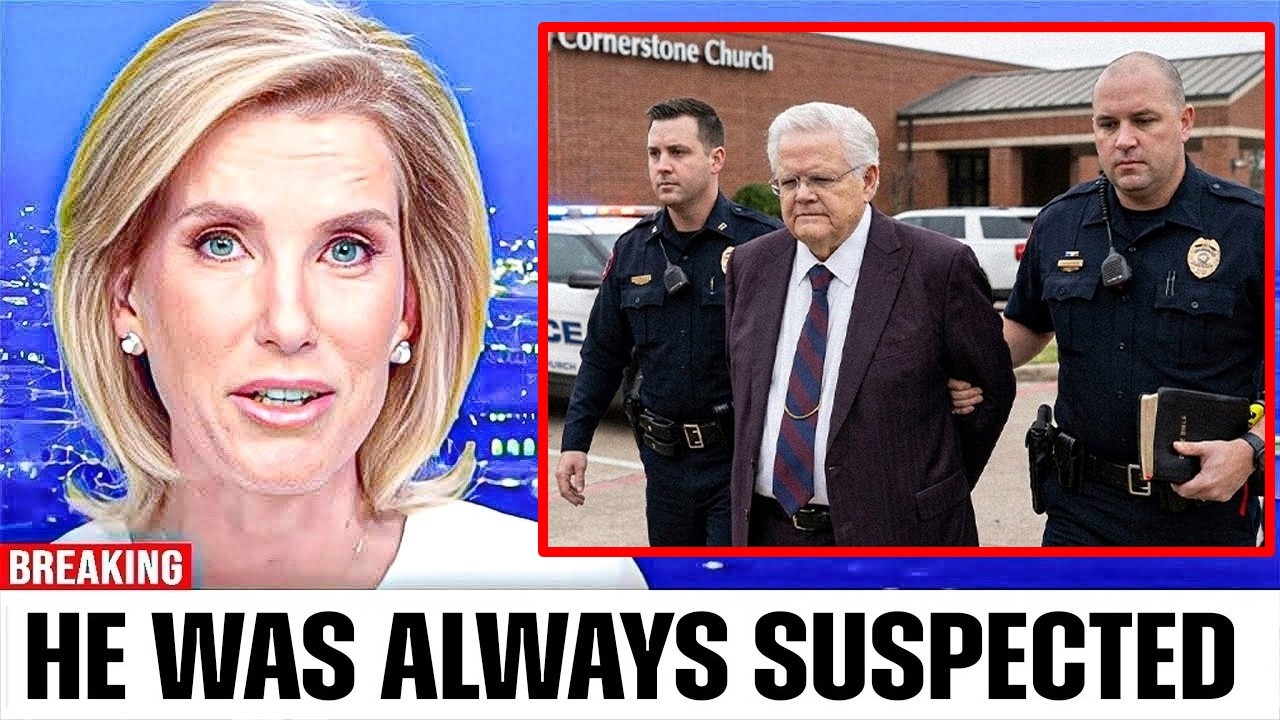
At 86 years old, after surviving COVID-19, weathering decades of controversy, and watching his successor take the pulpit, Pastor John Hagee’s future now hangs in the balance, with millions of followers asking whether America’s most influential evangelical voice is entering his final chapter.
The question is no longer theoretical. It is urgent. It is immediate. And for the 22,000 members of Cornerstone Church in San Antonio, Texas, it is deeply personal.
John Charles Hagee, the man who built a religious empire from a single small congregation, is now facing the most uncertain period of his six-decade ministry. His health has become a subject of whispered concern. His political alliances have become a double-edged sword. His prophecies have been challenged. And his legacy is being written in real time, whether he is ready or not.
The moment that changed everything came in October 2020, when the world learned that Hagee had contracted COVID-19. He was 80 years old at the time, squarely inside the highest-risk category identified by public health officials. The announcement was made not by the pastor himself, but by his son, Matt Hagee, during Sunday services at Cornerstone Church.
The diagnosis had been confirmed the previous Friday. Doctors had detected the illness early, which offered a glimmer of hope. But the news sent shockwaves through the evangelical community because COVID-19 had already killed hundreds of thousands of Americans. Age was not on Hagee’s side, and everyone knew it.
The timing made the headlines even more dramatic. Just days earlier, President Donald Trump and First Lady Melania Trump had also tested positive for the virus. Hagee had been one of Trump’s most vocal evangelical supporters during the 2016 campaign and throughout his presidency. The parallel was impossible to ignore, and religious and political news outlets seized on the coincidence.
Messages of support poured in from around the world. Among the most striking came from Israeli Prime Minister Benjamin Netanyahu, who publicly wished Hagee a speedy recovery and described him as having no better friend to Israel. It was a powerful reminder that Hagee’s influence extended far beyond the walls of his Texas megachurch, reaching the highest levels of international politics.
Fortunately, Hagee survived. The early detection likely spared him the prolonged hospitalization that many elderly patients endured. But the scare changed the conversation permanently. For the first time, supporters began confronting a difficult reality: John Hagee would not lead forever.
Now, at 86, that reality is impossible to avoid. The man who once stood behind the pulpit for hours, delivering lengthy sermons with a commanding voice that reached millions across North America, has visibly slowed. The next generation is already preparing to carry the torch. And the question of succession looms larger than ever before.
To understand what is at stake, one must understand how Hagee built his empire. He was born on April 12th, 1940, in Baytown, Texas. Raised in a deeply religious environment, he dedicated his life to ministry at an early age. He earned degrees from Southwestern Assemblies of God University and Trinity University before completing a master’s degree in educational administration from the University of North Texas in 1966.
That same year, he founded Trinity Church in San Antonio. Few could have imagined that his small congregation would eventually become one of the largest evangelical churches in America. But his journey was never smooth, and the obstacles he faced would have destroyed lesser men.
In 1975, Hagee’s career nearly ended before it reached its peak. He resigned from Trinity Church after publicly admitting to what he described as immorality, following the breakdown of his first marriage to Martha Downing. It was a devastating setback, the kind of 𝒔𝒄𝒂𝓃𝒅𝒂𝓁 that might have permanently destroyed many ministers’ careers. Instead, it became a launching pad for something even larger.
Later that same year, Hagee established a new congregation known as the Church at Castle Hills. Attendance exploded over the following years. The church expanded multiple times and eventually became Cornerstone Church, a name now recognized around the world. According to the church, Cornerstone now serves approximately 22,000 members, making it one of the largest megachurches in Texas.
His television ministry grew alongside the church. Sermons were broadcast across the United States and Canada, reaching millions through live streams and digital platforms. Hagee was no longer just a pastor. He was a media phenomenon, a brand, and a political force all rolled into one.
But his influence extended far beyond Sunday worship. In 1981, shortly after Israel destroyed Iraq’s Osirak nuclear reactor during Operation Opera, Hagee launched what became an annual event called A Night to Honor Israel. It was a public demonstration of support for the Jewish state, and it would reshape the trajectory of his entire career.
In 2006, that commitment led him to found Christians United for Israel, commonly known as CUFI. The organization has grown into one of the largest pro-Israel advocacy groups in the United States, regularly bringing thousands of supporters to Washington, D.C. to meet with members of Congress. Supporters view Hagee as one of Israel’s strongest Christian allies. Critics argue that his political influence has blurred the line between religion and activism.
Few dispute one central fact: John Hagee built far more than a church. He built a religious and political movement that has shaped evangelical America for decades. And that movement is now at a crossroads, with its founder facing the twilight of his life and the inevitable question of what comes next.
The health scare of 2020 was not the only challenge Hagee has faced. His political alliances have repeatedly become liabilities, exposing him to scrutiny that a purely religious figure might have avoided. The clearest example came during the 2008 presidential election, when Hagee endorsed Republican Senator John McCain.
McCain initially welcomed the support because Hagee commanded a large evangelical following that could prove decisive in a tight race. But the relationship quickly became damaging after reporters examined Hagee’s earlier sermons and public remarks. He had described the Catholic Church in deeply hostile terms, connected it to historical anti-Semitism, and made disputed claims about Catholic responsibility for violence against Jews.
Catholic organizations condemned the remarks. McCain came under intense pressure to explain why he had accepted Hagee’s endorsement. On May 12th, 2008, Hagee issued a written apology expressing regret for statements Catholics considered hurtful. William Donahue, president of the Catholic League, accepted the apology. But the controversy did not end there.
Additional attention focused on a sermon in which Hagee suggested that Adolf Hitler had functioned as a hunter who drove Jewish people toward the land of Israel. Critics argued that this language portrayed the Holocaust as part of a divine plan. Hagee rejected accusations that he was anti-Semitic. But the political damage had already intensified beyond repair.
Later that month, McCain publicly rejected Hagee’s endorsement. The separation was significant because it demonstrated the limits of Hagee’s political power. His support could mobilize conservative Christians, but his archived sermons could also become a major liability for candidates seeking a broader national coalition.
The 2008 episode did not remove Hagee from politics. He later supported Donald Trump in the 2016 presidential election and endorsed Nikki Haley during the 2024 Republican primary campaign. Yet every political alliance carried the same risk. Hagee’s decades of recorded statements could be examined again at any moment, returning old controversies to the headlines and 𝓉𝒽𝓇𝑒𝒶𝓉𝑒𝓃𝒾𝓃𝑔 the candidates he supported.
His theological views have also generated relentless criticism throughout his career. One of the most debated areas has been his teaching about biblical prophecy and the modern state of Israel. Hagee has long argued that Christians have a biblical obligation to support Israel, a conviction that led him to establish CUFI in February 2006.
Because of this work, Hagee became highly respected by many Israeli political leaders, including Prime Minister Benjamin Netanyahu, who has repeatedly praised his unwavering support. At the same time, some of Hagee’s sermons about Jewish history drew intense criticism from both Jewish scholars and Christian leaders who found his interpretations deeply problematic.
One of the most controversial involved his interpretation of Jeremiah 16:16, where he suggested that figures such as Theodor Herzl and even Adolf Hitler played roles within God’s plan to return Jewish people to Israel. Critics argued that these comments appeared to portray the Holocaust as part of divine providence, a conclusion they considered deeply offensive and historically dangerous.
Hagee repeatedly denied being anti-Semitic and insisted his remarks had been misunderstood. But the controversy has remained one of the most frequently cited episodes of his career. It is a stain that supporters dismiss as a misunderstanding and critics cite as evidence of reckless theology that should never have been broadcast to millions.
His comments on homosexuality also generated years of criticism. Following Hurricane Katrina in 2005, Hagee claimed that the disaster represented God’s judgment connected to a planned gay pride event in New Orleans. The statement was widely rejected by religious leaders across multiple denominations, including many who shared his conservative theology.
After the US Supreme Court legalized same-𝒔𝒆𝒙 marriage in 2015, he declared that America had become the new Sodom and Gomorrah, warning that the nation faced divine judgment if it continued to reject biblical teachings on marriage. Supporters viewed these remarks as a defense of traditional Christian doctrine. Opponents argued they unfairly targeted the LGBTQ community and fueled division at a time when the nation desperately needed healing.
Hagee also attracted criticism for his views on Islam and climate change. He has repeatedly argued that Islam promotes violence and has contrasted what he describes as Islam’s violent nature with Christianity’s message of love. Muslim organizations and interfaith leaders strongly condemned these comments, saying they incited fear and misunderstanding.
On environmental issues, Hagee rejected the scientific consensus on climate change, dismissed international agreements such as the Kyoto Protocol, and argued that concern over global warming distracts Christians from preparing for Christ’s return. Because his theology teaches that the end times are approaching according to God’s predetermined plan, he has maintained that humanity cannot alter God’s timetable.
Perhaps the most damaging challenge to Hagee’s reputation came from his promotion of the so-called blood moon prophecy. In 2013, he published “Four Blood Moons: Something Is About to Change,” arguing that a rare sequence of four total lunar eclipses carried profound biblical significance.
The eclipses were scheduled to occur between April 15th, 2014 and September 28th, 2015, with each one falling near important dates on the Jewish calendar. Hagee linked the astronomical event to passages from the books of Joel and Acts, which described the moon turning to blood before the day of the Lord.
He argued that earlier eclipse patterns had appeared near major moments in Jewish history, including the establishment of Israel in 1948 and the Six-Day War in 1967. His book and televised sermons suggested that the 2014 to 2015 tetrad could signal another major event involving Israel or the beginning of a dramatic prophetic shift.
The prediction became highly profitable as a religious media event. Hagee’s book reached a large evangelical audience, while television programs, conferences, and sermons repeatedly promoted the idea that the eclipses deserved urgent attention. Fear, as always, proved to be an effective driver of engagement.
However, astronomers explained that a lunar tetrad is a predictable natural phenomenon caused by the alignment of the sun, Earth, and moon. They also noted that lunar eclipses are visible from different parts of the world and do not carry scientifically measurable connections to political or religious events.
When the final eclipse occurred in September 2015, no clearly identifiable event matched the scale of the warnings that had surrounded the prophecy. Hagee did not announce a specific date for the end of the world, which allowed him to argue that the eclipses were signs, rather than a precise timetable.
Nevertheless, critics said the campaign encouraged followers to interpret ordinary astronomical events as evidence of an approaching global crisis. The blood moon episode mattered because it 𝓮𝔁𝓹𝓸𝓼𝓮𝓭 a central weakness in Hagee’s public ministry. His authority was built partly on presenting biblical prophecy as a guide to current events, but broad predictions were difficult to test and easy to reinterpret after the fact.
Supporters continued to view him as a gifted teacher of prophecy. Skeptics saw the episode as an example of religious fear being turned into publicity and book sales. Either way, the episode added another layer of complication to his legacy and raised questions about his credibility that have never fully disappeared.
Now, as Hagee enters his late eighties, the question of succession has become unavoidable. His son, Matt Hagee, has already stepped into a prominent role at Cornerstone Church. He has been the one to make difficult announcements, including the COVID-19 diagnosis in 2020. He represents the next generation of leadership, but stepping into his father’s shoes is a monumental task.
The transition is not simple. John Hagee is not just a pastor. He is the founder of a movement. He is the voice that millions recognize. He is the figure who built Christians United for Israel into a political powerhouse with direct access to the highest levels of government. Replacing that presence is not a matter of hiring a new preacher. It is a matter of preserving an institution.
The question of legacy is also complicated. Supporters see a fearless religious leader who stood firm on his beliefs, defended Israel, and built one of the largest evangelical ministries in America. Critics see a controversial televangelist whose statements about Catholics, Muslims, LGBTQ individuals, and the Holocaust have caused deep offense and lasting harm.
There is also the question of health. Hagee survived COVID-19, but the scare revealed his vulnerability. At 86, every public appearance carries additional significance. Every sermon could be his last. Every broadcast is watched with a new level of attention. The energy that once defined his ministry has inevitably diminished.
The ministry he built reaches millions. The organization he founded shapes political discourse in Washington. The church he pastored for decades is preparing for a future without him at the center. And the evangelical movement he helped define is changing around him, with younger believers asking new questions about politics, prophecy, and the role of religion in public life.
What comes next for John Hagee? It is a question that cannot be answered with certainty. But it is a question that must be asked. Because the final chapter of his remarkable career is now being written in real time, and the world is watching with bated breath.
The answers will determine not only how Hagee is remembered, but also what happens to the institutions he built. Will Cornerstone Church continue to thrive under new leadership? Will CUFI maintain its political influence without its founder’s commanding presence? Will the next generation embrace his theology or chart a new course?
These are the questions that hang over every public appearance, every broadcast, and every sermon. The empire that John Hagee built over more than half a century is now facing its greatest test, and the outcome is far from certain. The only certainty is that things are not looking well for Pastor John Hagee, and the world is waiting to see how the story ends.