Sally Field has shattered the decades-old romanticized image of her relationship with Burt Reynolds, revealing a dark undercurrent of control, manipulation, and professional sabotage that defined their time together on and off the screen. In a series of candid interviews and her 2018 memoir In Pieces, the two-time Oscar winner has painted a devastating portrait of Hollywood’s most electric romance, exposing a struggle for power that began with a phone call and ended with an empty seat at the Academy Awards.
Field, now 79, described walking into the relationship as a vulnerable young actress still fighting the stigma of her television past. She had starred in Gidget and The Flying Nun, roles that trapped her in a wholesome, lightweight image. Reynolds, by contrast, was the embodiment of 1970s Hollywood masculinity, the most popular actor in America.
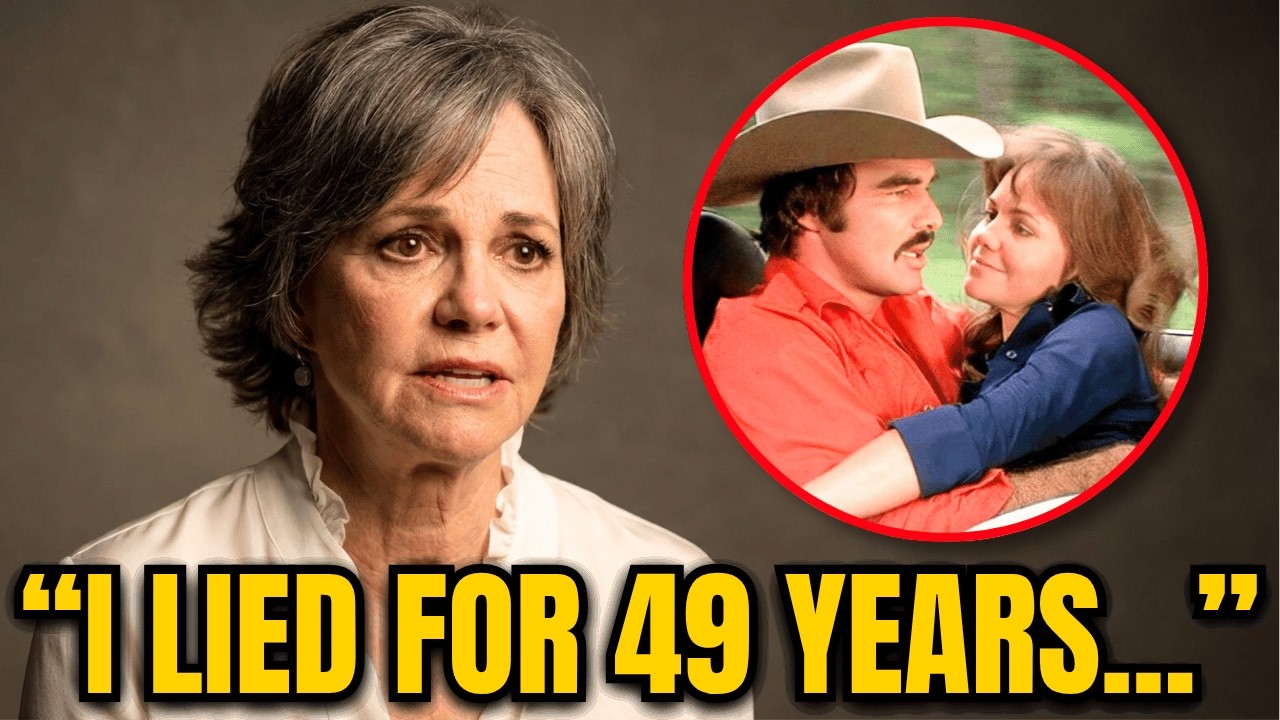 When he called her for Smokey and the Bandit, Field was stunned. She could not understand why he wanted her. He told her he had always loved her, remembering her from Gidget.
He had not even seen her dramatic breakthrough in Sybil.
The first film, released in 1977, felt like a genuine collaboration. Field recalled that the screenplay was terrible, and Reynolds suggested they improvise. Cameras were attached to the car, and the two actors created their exchanges while driving.
The chemistry was immediate and intense. Reynolds later wrote that audiences could see two actors falling in love on screen because that was exactly what was happening. Field described herself as a perfect combination of unresolved weaknesses, drawn to his confidence while her desire to be chosen made it easier to surrender parts of herself.
But the conditions that created the first film’s magic were unstable. Field said she remembers only one of their four movies together as a real collaboration. In the three that followed, she no longer felt like the quick, unpredictable woman matching Reynolds line for line.
She felt reduced to just a girl, present because she had become trapped in the larger situation surrounding him. The films revolved around Reynolds’ character, his anxieties, his friendships, and his public image. She was the leading man’s romantic partner, both in life and inside stories designed primarily around him.
Field’s memoir connected Reynolds to a far older wound. She has said that her stepfather, actor and stuntman Jock Mahoney, sexually and emotionally abused her during childhood. Yet Mahoney was also magnetic, playful, and capable of making the family feel enchanted.
That contradiction shaped her understanding of love. A person could feel wonderful and dangerous at the same time. Affection did not erase fear.
Fear did not automatically destroy attachment. Field believed her relationship with Reynolds repeated that emotional structure, trying to make an old pattern end differently by winning the love of another charismatic, powerful man.
Field also described her concern about Reynolds’s condition during the making of Smokey and the Bandit. She wrote that he used Percodan, Valium, and barbiturates, and sometimes received injections whose purpose was unclear to her. Worried about his stress and physical symptoms, she arranged a discreet examination at the Miami Heart Institute.
The tests reportedly found no heart problem. Field urged him to consider psychological help for anxiety, but she said he dismissed the suggestion. She was not merely falling in love with Reynolds.
She was monitoring him, worrying about him, and attempting to protect him while gradually surrendering authority over herself.
 The decisive moment arrived as a stack of pages. When Field brought home the script for Norma Rae, Reynolds did not simply question whether the movie would succeed. According to Field, he threw it back at her.
He objected to the character’s sexual history and used a degrading label for the role. Field recalled Reynolds suggesting that her growing ambition was getting the better of her. Her reply was only six words.
This is the better of me. That sentence marked a break from the frightened woman who had felt like a clown before their first date. Field was no longer waiting for Reynolds to define which parts of her were acceptable.
Field met with director Martin Ritt and accepted the role. She later described that decision as the beginning of finding her legs. The film’s most famous image shows Norma climbing onto a table inside the mill and raising a cardboard sign bearing one word, union.
One by one, the workers stopped their machines. The overwhelming mechanical roar gives way to silence because one person has finally made herself impossible to ignore. Field’s off-screen transformation was not identical to Norma’s story, but she has said that performing the character changed her.
Learning how the character stood inside her own body helped Field recognize strength that she had struggled to use in private.
The role Reynolds opposed did more than advance Field’s career. It gave her a language for resisting the relationships surrounding her. His objection also reveals a painful irony.
Reynolds had once argued that executives should hire Field because talent was attractive. When that talent began carrying her beyond his movies, his support reportedly turned into resistance. The man who helped open the door appeared uncomfortable when Field walked through it alone.
In 1979, the film was selected to compete at the Cannes Film Festival. Reynolds discouraged her from attending, asking whether she honestly thought she would win anything. Field went without his confidence.
Field attended with members of the filmmaking team, including director Martin Ritt. She later remembered the screening as an overwhelming experience. When the audience responded to the film, she cried.
Field won the 1979 Best Actress Award for Norma Rae. The role Reynolds reportedly dismissed had now received international recognition. The trip he discouraged became one of the defining events of Field’s professional life.
 If a partner questions your achievement before it has even happened, is that realism or fear of who you might become if you succeed? Field was discovering that Reynolds’ judgment was not the final measure of her ability.
The 52nd Academy Awards took place on April 14th, 1980. Field was nominated for Best Actress. According to Field’s account, Reynolds was unhappy with the attention surrounding her.
She remembered him as being unkind during that period and said he would not attend the ceremony with her. The rejection could easily have turned one of the most important nights of her career into an extension of their private conflict. Instead, comedian and filmmaker David Steinberg and his then wife offered to accompany her.
They did not treat Field’s nomination as an embarrassment or a threat. They turned it into a celebration.
When Dustin Hoffman opened the envelope, Field’s name was inside. She walked onto the stage and accepted the Academy Award for Best Actress. The role Reynolds had reportedly tried to discourage had made her an Oscar winner.
Reynolds’ absence sharpened the meaning of the night. He had once helped place her beside him in a major movie because he believed in her talent. When that talent brought her to the Academy Awards independently, he was not in the seat next to her.
The relationship did not end cleanly at the podium. Field and Reynolds remained connected on and off, and she still appeared in Smokey and the Bandit II, released later in 1980.
For years, Reynolds told a sorrowful version of the story. In his 2015 memoir, he described Field as the love of his life. He said he missed her terribly and blamed himself for destroying the relationship.
The aging Hollywood heartthrob looked back on the woman who got away and admitted that he had failed to hold on to the perfect person. That version also preserved something flattering about Reynolds. He became the flawed man wise enough to recognize his greatest mistake.
Field became the lost love whose value confirmed the depth of his feelings. There were elements of truth that made the story persuasive.
When Field addressed Reynolds’ romantic narrative in 2022, she rejected the role he had assigned her. She said he had not been someone she could safely remain around. In her view, he had reconstructed the relationship after the fact, making her more important in his memory because she was something he could no longer possess.
 The issue is not whether Reynolds regretted losing Field. He may have regretted it profoundly. The issue is whether his regret can overwrite her experience of being controlled, diminished, and hurt.
The two had been estranged for decades by the time Reynolds began publicly calling her his greatest love.
Field’s 2026 interviews add another layer. She still does not describe Reynolds as entirely monstrous. She remembers a man who could be wonderful, vulnerable, and lovable, while also possessing qualities she experienced as frightening.
That complexity is not a contradiction. People often remain attached precisely because the person causing pain is not cruel every moment. The warmth makes the frightening behavior harder to name, and the history of affection makes leaving feel like betrayal.
Field even speaks about their beginning with humor. She remembers the bewildering first date, the bodyguard at the door, and her own nervous clowning.
Her lighter revelation that Reynolds was her worst on-screen kisser, because, she said, too much drooling was involved, became a 𝓿𝒾𝓇𝒶𝓁 joke in 2022. Yet, the more important correction concerned the larger fantasy. Audiences believed they had watched a love story begin during Smokey and the Bandit.
Reynolds later encouraged the belief that the story never truly ended for him. Field’s account suggests something different. The first film may capture genuine love, but the three films that followed reveal how easily professional partnership can narrow when one star holds greater power.
The relationship’s most revealing moment was not their first kiss or final breakup.
It was Reynolds throwing away a script because Field wanted something outside the life they had built around him. Her choice to retrieve that future changed everything. Who owns the story of a relationship when one person turns it into a beautiful legend, and the other remembers how difficult it was to escape?
The strongest new insight is not that Reynolds secretly hated Field, or that every loving moment was false. It is that he could recognize her talent before the industry did and still resist the independence that talent created. Support that lasts only while someone remains within your control is not complete support.
Field’s journey from Smokey and the Bandit to Norma Rae was therefore larger than a change in genre. In the first movie, Reynolds gave her an opportunity and she proved she belonged. In the second, she accepted an opportunity he did not want her to take and discovered she no longer needed him to tell her she belonged.
Sally Field’s account does not erase the affection visible in Smokey and the Bandit. It reveals the darker struggle behind it. Four shared films, one relationship, and a Norma Rae script Reynolds allegedly threw away before it carried Field to Cannes and the Oscars.
Do his later regrets change how you see their story?

