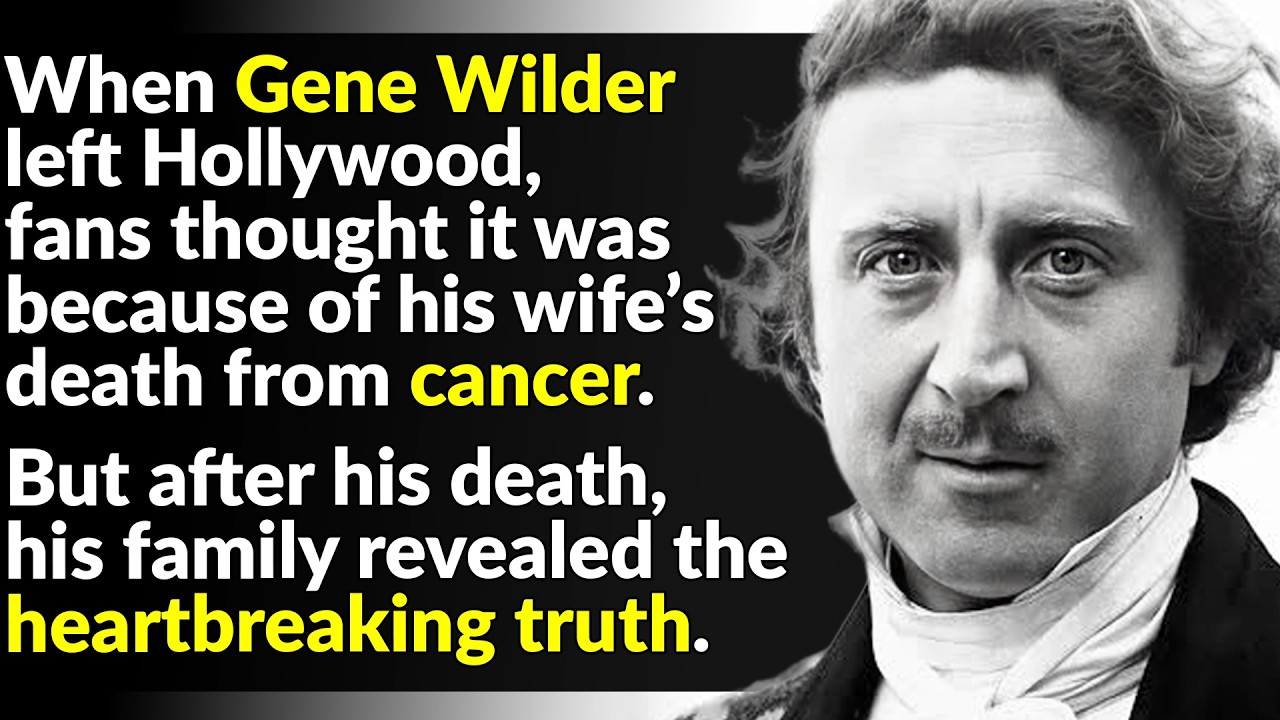
For decades, the world believed Gene Wilder simply walked away from Hollywood to grieve the loss of his beloved wife, Gilda Radner, to ovarian cancer in 1989. The truth, hidden until after his death in 2016, is far more heartbreaking and complex. Wilder’s retreat was not a quiet surrender to sorrow but the final act of a man who had been fighting a lifelong war against a demon of guilt, trauma, and a secret illness he refused to let define his legacy.
The story begins long before the chocolate factory, in Milwaukee, Wisconsin, in 1933, when Wilder was born Jerome Silberman. His mother, a fragile woman suffering from rheumatic fever, became the axis around which his entire childhood spun. A doctor’s cruel, offhand warning to the eight-year-old Wilder—that arguing with his mother could kill her—cemented a lifetime of fear.
 He spent hours pressing a brick wrapped in cloth to her chest to ease her pain, but it was his own comedic performances, silly voices and clean jokes, that truly soothed her. This desperate need to make his mother happy, to keep her alive, forged a bond so intense that it would later manifest as a crushing sense of guilt. “My mother was suffering every day of her life,” Wilder recalled.
“What right did I have to be happy if she was suffering?”
This internal torment, which Wilder called “the demon,” drove him to seek solace in the strangest of places. After a devastating experience at the Black-Fox Military Institute in Hollywood, where he was tormented for being Jewish and allegedly taken advantage of by his roommate, Wilder found refuge in theosophy, a quasi-religious occult movement. His aunt introduced him to the cult, and he fell headfirst into its beliefs, convinced he was an angel who must avoid smoking to receive messages from God.
To combat the demon, he would kneel in public parks, on buses, and on streets, muttering prayers like “Forgive me, Lord, for what I don’t know.” This was not the behavior of a man destined for comedic greatness, but of a deeply troubled soul.
Wilder’s path to stardom was paved with personal tragedy. He spent nearly two years working as an aide in a psychiatric ward, administering electroshock therapy, before his mother’s death in 1957 finally freed him from the demon’s grip. “As long as my mother was alive, so was the demon,” he later said.
 “When she passed, I was free.” But freedom came at a cost. His first marriage to Mary Mercier was a loveless arrangement, with Wilder admitting they made love every six months “like clockwork.”
His second marriage to Joan Schutz, born from a sense of responsibility after her daughter began calling him dad, ended in scandal when she suspected an affair with his Young Frankenstein co-star, Madeline Kahn. The truth was likely more complicated, but the pattern was clear: Wilder was searching for love, but his own demons kept him from finding it.
Then came Gilda Radner. When Wilder met the SNL star on the set of Hanky Panky, he knew he had found his perfect match. Radner, trapped in a miserable marriage to guitarist G.
E. Smith, said Wilder made her life go “from black and white to Technicolor.” They married in 1984 and adopted a Yorkshire terrier named Sparkle, but their dream of having a child was shattered by repeated miscarriages.
 Radner’s mysterious illnesses were eventually diagnosed as stage four ovarian cancer. Wilder remained hopeful, convincing himself she would pull through because he couldn’t imagine life without her. But in 1989, Radner lost her battle, and Wilder was left shouting at the walls.
“This doesn’t make sense,” he kept thinking.
The grief was overwhelming. The few films Wilder made after Radner’s death were major flops, and he lost his comedic touch. He found love again with lip-reading expert Karen Webb, marrying her in 1991, but only months later, he retired from filmmaking entirely.
He called those final years the happiest of his life, but the public was left wondering why a man with so much talent would walk away from the spotlight. He turned down roles in Mrs. Doubtfire, Stuart Little, and Big Daddy, only making a rare appearance on Will & Grace, which earned him a Primetime Emmy.
 “I don’t like show business,” he said. “I like show, but I don’t like the business.”
The heartbreaking truth, revealed by his family after his death, was that Wilder was suffering from Alzheimer’s disease. He struggled to remember his own career highlights, once forgetting the name of his hit film Young Frankenstein at a party and acting it out to jog his memory. He chose to suffer in silence, not wanting to darken the world’s memory of his joyful performances.
As his nephew explained, “He simply couldn’t bear the idea of one less smile in the world.” Wilder’s final years were spent painting, writing novels, and shunning Hollywood, but he never stopped acting, even as his mind faded.
Wilder’s legacy is not just the laughter he brought to millions, but the quiet dignity with which he faced his own end. He knew that his portrayal of Willy Wonka had brightened the world, and he refused to let his illness cast a shadow over that memory. In his final moments, as he lay on his bed drifting between life and death, his music player started playing Ella Fitzgerald’s rendition of “Somewhere Over the Rainbow.”
According to family and friends, Wilder smiled and drifted off. The man who once said, “I’d be insane to lose my insanity,” left the world with a final, heartbreaking lesson: sometimes the greatest gift we can give is to let others remember us at our best, even if it means suffering in silence.