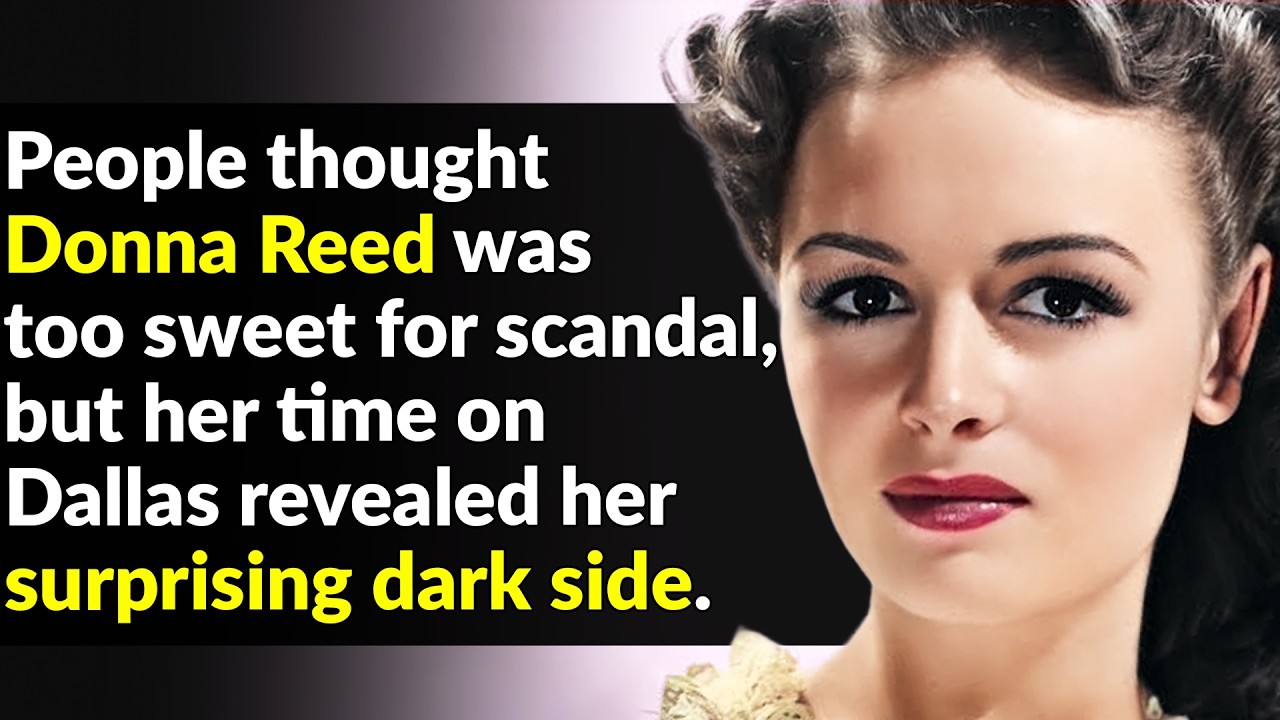
A new investigation into the life of beloved actress Donna Reed reveals a startling contrast to her wholesome on-screen persona. The Oscar-winning star, best known for playing Mary Hatch Bailey in “It’s a Wonderful Life” and the titular role in “The Donna Reed Show,” was not the sweet, docile housewife she portrayed. Behind the scenes, Reed fought fiercely when she felt wronged, and nowhere was that more evident than in her explosive legal battle with the producers of the hit series “Dallas.”
Reed joined the cast of “Dallas” in 1984 as a temporary replacement for Barbara Bel Geddes, who had undergone heart surgery. The role of Miss Ellie Ewing was a high-profile gig on one of television’s biggest shows. Reed signed a three-year contract, expecting to play the matriarch until Bel Geddes recovered.
 But when Bel Geddes returned to health faster than anticipated, the show’s producers abruptly fired Reed. She was blindsided, and her reaction shocked Hollywood insiders who thought they knew the gentle star.
Instead of quietly accepting her dismissal, Reed unleashed a legal fury. She filed a lawsuit against Lorimar Productions, the company behind “Dallas,” alleging breach of contract. In an uncharacteristically aggressive move, she sought an injunction to halt production of the series entirely.
The request was denied by a judge, but Reed refused to back down. Her attorney told the press that Reed was “mad as hell” and would settle for nothing less than getting her role back. This was not the Donna Reed America thought it knew.
The legal battle dragged on for months, making headlines across the country. Reed’s wholesome image was shattered as she publicly fought the studio. Lorimar admitted they had breached her contract and offered to pay her the remaining money owed.
But Reed rejected the cash settlement, insisting on the role itself. She wanted to return to the set, not walk away with a check. The studio, however, could not give her the part because Bel Geddes had already reclaimed it.
In August 1985, Reed finally agreed to a settlement, but it came with a staggering price tag. Lorimar paid her more than $1 million to resolve the dispute. The sum was enormous for the time, but for Reed, it was never about the money.
She had wanted vindication and the chance to continue her work. The settlement ended the public battle, but it also marked the end of her acting career. She never appeared on screen again after the “Dallas” debacle.
 The scandal revealed a side of Reed that fans had never seen. She was known for her grace, her anti-war activism, and her devotion to family. But when her professional integrity was challenged, she fought back with a ferocity that stunned even her closest associates.
The woman who had played the perfect wife and mother on television was, in reality, a tough negotiator who refused to be pushed around by studio executives.
Reed’s dark side did not emerge from malice but from a deep sense of betrayal. She had built her career on hard work and authenticity, and she believed the “Dallas” producers had treated her unfairly. Her lawsuit was a stand against the power imbalance in Hollywood, where actors were often disposable.
She wanted to send a message that even the sweetest star could bite back when provoked.
The legal fight took a toll on Reed’s health. Just months after the settlement, she entered Cedars-Sinai Medical Center for what was initially thought to be bleeding ulcers. During exploratory surgery, doctors discovered advanced pancreatic cancer.
The diagnosis was terminal. On Christmas Eve 1985, she was sent home to spend her last holiday with her family. She died on January 14, 1986, at the age of 64.
 Reed’s death shocked the nation, but the scandal of her final years lingered in the public memory. Many wondered if the stress of the lawsuit had contributed to her illness. Her husband, Grover Asmus, later established the Donna Reed Foundation for the Performing Arts to honor her legacy.
But the image of the sweet housewife had been permanently complicated by her fierce legal battle.
The revelation of Reed’s behind-the-scenes behavior has reignited debate about the pressures faced by actresses in Hollywood. She was a product of an era that demanded perfection, but she refused to be a doormat. Her fight with Lorimar was a rare glimpse into the steel beneath the soft smile.
It showed that even the most beloved stars have breaking points, and when pushed, they can become formidable adversaries.
Donna Reed’s story is a cautionary tale about the gap between public persona and private reality. She spent decades cultivating an image of domestic bliss, but her final act was one of defiance. The woman who milked cows on an Iowa farm and won an Oscar for playing a prostitute in “From Here to Eternity” was never just one thing.
She was complex, driven, and unafraid to stand up for herself.
 The “Dallas” lawsuit remains one of the most dramatic episodes in television history. It exposed the fragility of contracts in the entertainment industry and the willingness of stars to fight for their rights. Reed’s decision to sue a major studio was risky, but she believed it was necessary.
She had spent her career being underestimated, and she was determined to prove that she was not to be trifled with.
In the end, Reed’s legacy is not just about her iconic roles but about her courage in the face of adversity. She taught her children to stand up for what is right, and she lived by that principle until her final days. The news of her dark side may surprise some, but those who knew her best understood that her sweetness was always balanced by strength.
She was a woman who used her head when handling herself and her heart when handling others—except when those others crossed her.
The Donna Reed who emerged from the “Dallas” scandal was not a villain but a warrior. She fought for her career, her dignity, and her family. And in doing so, she left behind a complicated legacy that challenges the simple narratives of Hollywood’s golden age.
Her story is a reminder that even the most beloved figures have layers, and that the truth is often more compelling than fiction.