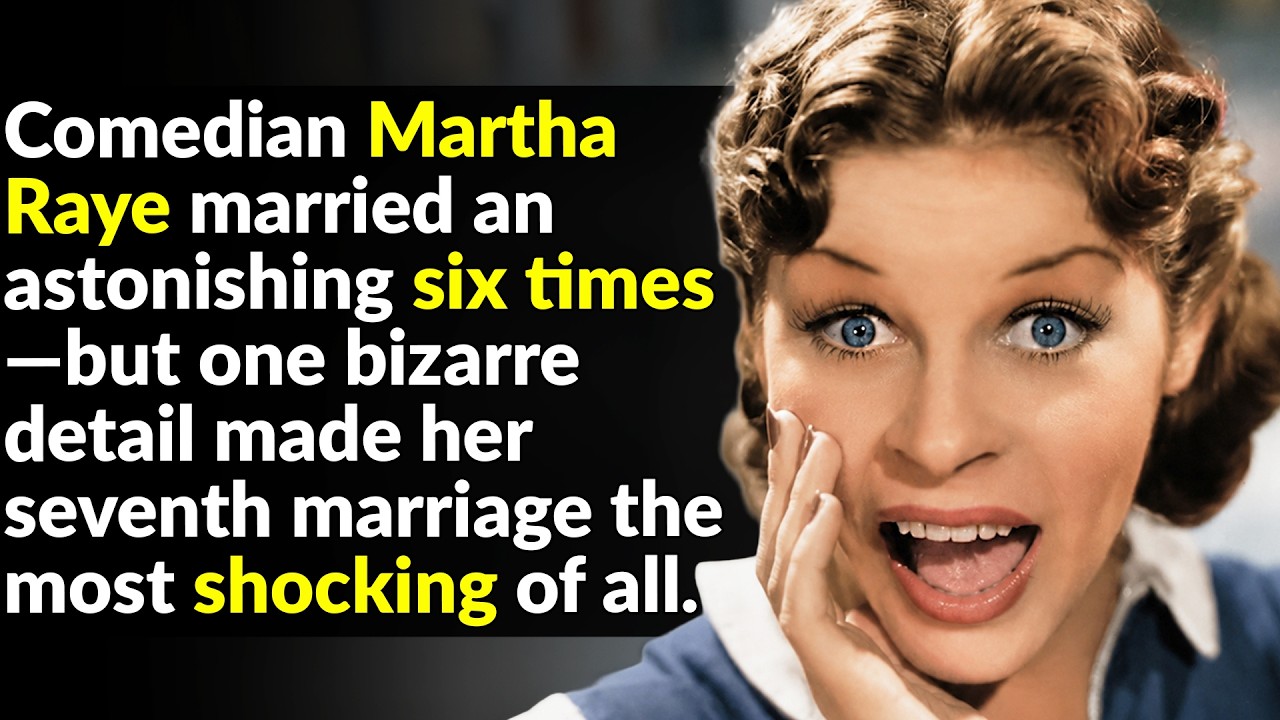
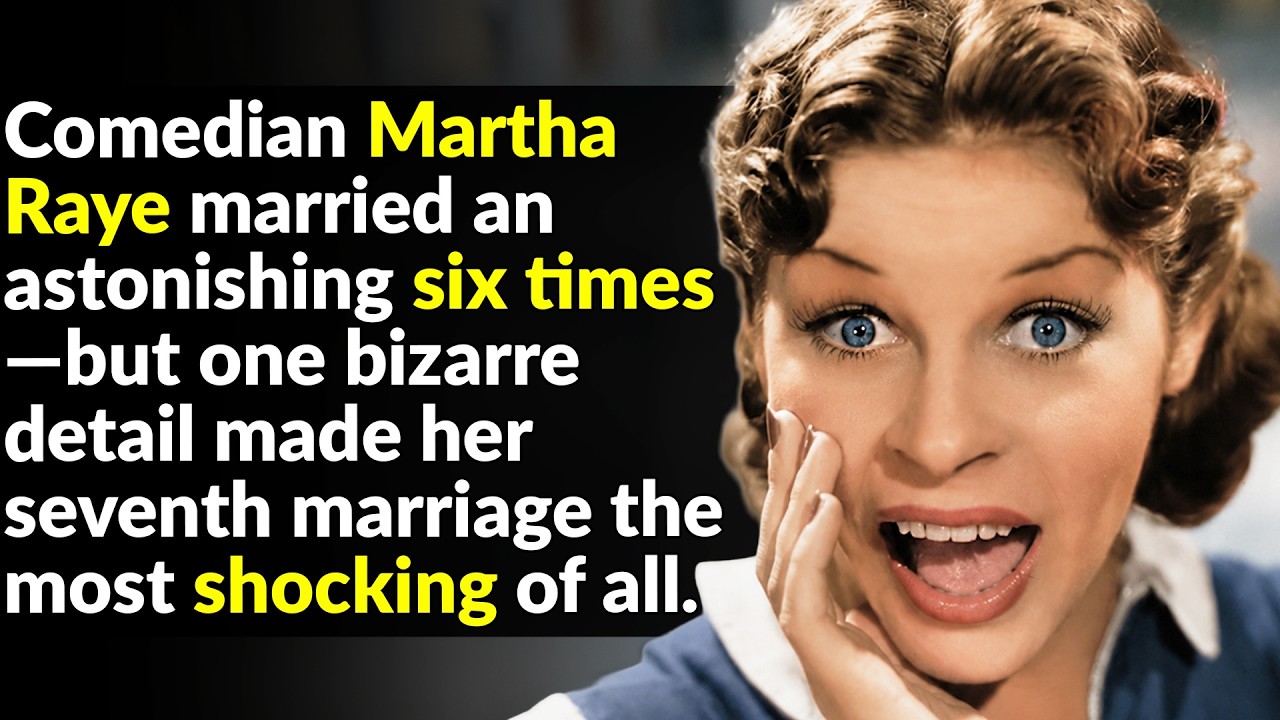
Martha Raye, the beloved comedian whose oversized smile and zany antics made millions laugh, lived a private life so tragic that her final days were marked by tears, not laughter. The woman known as “Big Mouth” to her adoring fans married six times in less than two decades, but it was her seventh marriage at age 75 that proved the most shocking of all—a union to a man 33 years her junior that would ultimately define her heartbreaking final chapter.
Born literally on a stage in Butte, Montana, to vaudeville performers Mabel and Peter, Ray entered the world backstage before her mother returned to work just two days later. This inauspicious beginning set the tone for a life spent desperately seeking approval from audiences and partners alike, a pattern that would spiral into a devastating cycle of failed relationships and self-destruction.
 By the time she was a child, Ray and her brother Bud were already performing as a duo, captivating crowds with her remarkable singing voice and expressive features. But her hunger for the spotlight masked a deep vulnerability that would later be exploited by those closest to her.
Her big break came in 1936 when producer Norman Taurog saw her in a nightclub and immediately cast her opposite Bing Crosby in “Rhythm on the Range.” Paramount signed her on the spot, and her enormous smile earned her the lasting nickname “Big Mouth.” She became a caricature of herself in Warner Bros.
and Disney cartoons, but behind the laughter, Ray was hiding a painful secret: she had almost no formal schooling and often needed scripts read aloud to her.
At just 20 years old, Ray began a tragic pattern of impulsive relationships. She got engaged to orchestra leader Johnny Torrence in 1936, only to break it off two months later. Then came makeup artist Hamilton “Buddy” Westmore, whom she married in May 1937 and divorced four months later, citing extreme cruelty.
The spiral continued with three more marriages in just six short years, each ending in heartbreak.
 Her fourth marriage to Nick Condos in 1940 brought a brief respite. They had a daughter, Melody, and the union lasted longer than any before it. But even as her personal life stabilized temporarily, Ray’s career took a transformative turn when she joined the USO during World War II.
She became a beloved figure to troops, flying into combat zones despite a paralyzing fear of flying. Bob Hope once said she was “Florence Nightingale, Dear Abby, and the only singer who could be heard over the artillery fire.”
To cope with her terror of flying, Ray began drinking heavily on those trips, a coping mechanism that would eventually consume her. Despite her soaring professional success—including co-starring with Charlie Chaplin in “Monsieur Verdoux” and launching her own popular television show in 1954—her personal life remained a wreck.
By 1956, a series of tragedies struck. Her fifth marriage to Edward T. Bagley ended after just two years, and her show was canceled.
 Alone and depressed, Ray took a handful of sleeping pills in Miami. She was saved just in time, and the outpouring of love from fans gave her hope again. She treasured religious medals sent by strangers and signed off her TV shows with “Goodnight, sisters” in gratitude to the nuns who cared for her.
But hope was fleeting. She married for the sixth time to Robert Osborne just months after her hospitalization, and that marriage ended quietly in 1960. For the next 30 years, Ray remained single, focusing on her career and her USO work, which took her to Vietnam and earned her honorary military ranks, including colonel in the Marines and an honorary Green Beret.
Yet her health deteriorated. Anemia, blood pressure problems, and circulation issues plagued her. In 1962, she was found unconscious on a Malibu beach.
Still, she kept working, guest-starring on shows like “The Love Boat” and even becoming a spokesperson for Polident denture cleaner, using her big mouth as a selling point.
 The final tragedy unfolded in the early 1990s. After a series of strokes left her wheelchair-bound, Ray met Mark Harris, a 42-year-old who became her manager and press liaison. Within a month, she married him—her seventh husband.
Friends and the press were alarmed by the age gap and the speed of the union.
In December 1991, Ray had a disturbing breakdown while watching the film “For the Boys,” starring Bette Midler. She sobbed uncontrollably, convinced Midler had stolen her life story and her USO legacy. Urged on by Harris, she sued Midler, but the case was dismissed, damaging Ray’s reputation in Hollywood.
Her health continued to fail. Gangrene in her foot led to amputation. On October 19, 1994, Martha Raye died of pneumonia at age 78, still married to Harris.
The U. S. Army gave her a final tribute: burial with full military honors at Fort Bragg Main Post Cemetery, a fitting end for a woman who gave so much to the troops.
But her personal legacy remains complex. She made countless people laugh, but she only made herself cry, right up to her bitter final moments. The woman who was born to entertain died alone in many ways, a cautionary tale of fame, vulnerability, and the relentless pursuit of love in all the wrong places.