The septic tank of a former Irish mother and baby home in Tuam, County Galway has yielded the remains of hundreds of infants, a discovery that has shattered the nation’s conscience and 𝓮𝔁𝓹𝓸𝓼𝓮𝓭 a decades-long conspiracy of silence involving the Catholic Church and the Irish state.
Local historian Catherine Corless, who first uncovered the scale of the tragedy in 2012, compiled a list of 796 children who died at the St. Mary’s mother and baby home between 1925 and 1961. Her relentless investigation revealed that the vast majority of these children had no recorded burials in any cemetery across Galway or neighboring counties.
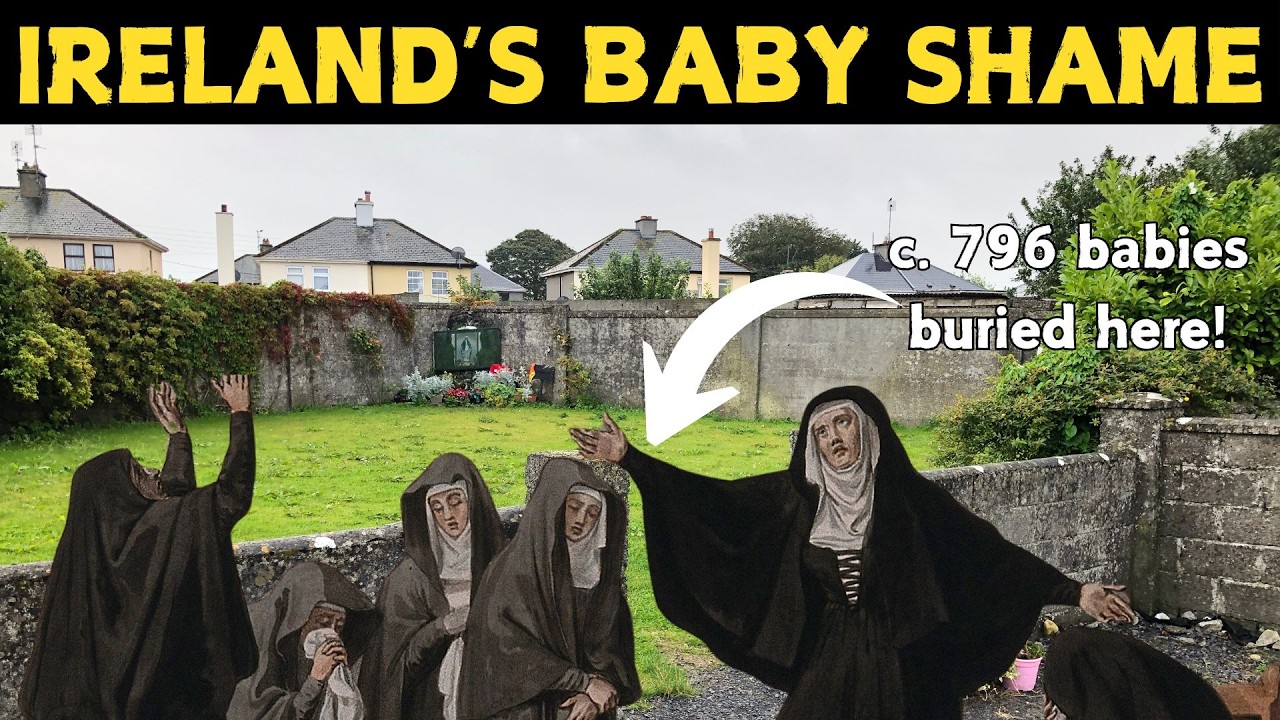 The only logical conclusion was that their bodies had been disposed of in the home’s septic tank, a structure that had been sealed and forgotten for decades.
The home, run by the Order of Bon Secours, was one of dozens of similar institutions across Ireland where unmarried mothers were forced to give birth in secrecy and shame. The children were often taken from their mothers immediately, many were subjected to neglect and malnutrition, and the mortality rate was staggering. A 1944 report cited by the Irish Mail on Sunday described children as “emaciated and not thriving,” with “pot-bellied” appearances indicative of starvation.
The report noted that 271 children and 61 unwed mothers were crammed into a facility designed for 243. Despite this documented evidence of horrific conditions, the home continued operating for another 17 years.
The septic tank itself is a structure divided into 20 chambers, built within the decommissioned large sewage tank. The Commission of Investigation into Mother and Baby Homes, established by the Irish government in 2015, confirmed in 2017 that “significant quantities of human remains” were present. The remains were of children aged from about 35 foetal weeks to three years old.
The Commission’s final report, released in January 2021, estimated that approximately 9,000 children died in 18 such institutions across the Republic of Ireland, a mortality rate of about 15% of those born there.
The story of the Tuam babies first came to light in the 1970s, when two 12-year-old boys playing in the area discovered a concrete slab covering the old septic tank. When they broke it open, they saw bones piled high. One of the boys later told the Irish Mail on Sunday: “It was a concrete slab.
We used to be in there playing but there was always something hollow underneath it so we decided to bust it open and it was full to the brim of skeletons. The priest came over and blessed it. I don’t know what they did after that.
 I had nightmares over it, I could see all the skulls, it’s like what you would see on the Discovery Channel.”
Another witness, Mary Moriarty, fell into the hole in the early 1970s and saw “little bundles” wrapped in cloths that were black with rot, “packed one after the other, in rows up to the ceiling.” She estimated there were hundreds of them. When she later gave birth to her own son in the local maternity hospital, she realized the babies had been wrapped in the same cloths used by the nuns who worked there.
She told the BBC: “That’s when I copped on what I had seen after I fell down that hole were babies.” She was told they were stillborn, unchristened babies who couldn’t be buried in consecrated ground.
The Irish state’s response has been slow and inadequate. The Commission of Investigation was established in 2015, but its final report was delayed until 2021. The excavation of the Tuam site only began in 2025, 11 years after Corless’s investigation became international news.
The excavation is scheduled to last two years, with the hope that at least some of the children can be identified through DNA analysis and given proper burials. However, the technical challenges are immense. The remains are tiny, contaminated, and often degraded, making DNA extraction difficult.
Close blood relatives are needed for comparison, but many of the mothers have died, and some may have had no other children.
 The modern Sisters of Bon Secours have apologized, acknowledging that their predecessors “did not live up to our Christianity when running the home” and that “infants and children who died at the Home were buried in a disrespectful and unacceptable way.” The Taoiseach, or Irish prime minister, has issued an apology on behalf of the state.
But for the families of the Tuam babies, apologies are not enough. Many are still searching for answers about what happened to their loved ones. One woman, whose brother disappeared from the home, wonders if his death certificate was faked to facilitate an illegal adoption.
She told interviewers: “If not all of the dead babies are found in the septic tank, then where are they?” The suspicion is that some children were trafficked to the United States or elsewhere, their identities erased and their fates unknown.
The Tuam 𝒔𝒄𝒂𝓃𝒹𝒶𝓁 is not an isolated incident. Similar institutions existed across Ireland, including the Magdalen Laundries, where women were held for years and forced to work in in-house laundries. The last of these homes, Bessborough in County Cork, did not close until 1998.
The British government is also implicated, as similar homes operated in Northern Ireland.
The human rights implications are profound. Amnesty International noted in 2014 that the children who died in Tuam lived and died during the emergence of the international human rights legal framework. The European Convention on Human Rights came into force in 1953, and Ireland was aware of the norms expected of it under the 1948 Universal Declaration of Human Rights.
 The principle of “due diligence” holds that where the state knew or ought to have known of likely or actual violations of human rights, and failed to take appropriate steps to prevent them or investigate and punish the perpetrators, the state bears responsibility.
The excavation of the Tuam site is a step toward justice, but it is only a beginning. The children who died there deserve to be identified, to have their names restored, and to be buried with dignity. Their mothers, many of whom were forced into the homes against their will, deserve to know what happened to their children.
And the Irish state and the Catholic Church must be held accountable for the systematic 𝓪𝓫𝓾𝓼𝓮 and neglect that allowed this tragedy to occur.
The story of the Tuam babies is a story of shame, silence, and complicity. It is a story of a society that punished women for having children out of wedlock while protecting the men who fathered them. It is a story of a church that claimed to uphold Christian values while starving and neglecting the most vulnerable.
And it is a story of a state that turned a blind eye to the suffering of its own citizens.
As the excavation continues, the world is watching. The families of the Tuam babies are demanding answers. And the Irish people are finally confronting the dark chapter in their history.
The question now is whether the truth will be fully uncovered, and whether justice will be served for the hundreds of infants who were buried in a septic tank, forgotten and unloved, for decades.

