The legendary Barbara Stanwyck, the epitome of Hollywood’s Golden Age, has been posthumously revealed to have harbored a lifetime of secrets that shatter her pristine public image, from a violent first marriage that ended in a shocking act of child endangerment to a clandestine affair with a younger heartthrob that remained hidden for decades. New details emerging from biographies and memoirs paint a portrait of a woman whose tragic childhood and relentless drive for success masked a deeply troubled personal life, including a failed motherhood that left her son estranged and a series of scandalous romances that defied the era’s moral codes.
Stanwyck, born Ruby Catherine Stevens in 1907, endured a childhood of unimaginable horror that set the stage for her tumultuous life. At the tender age of three, she witnessed a drunk man brutally kick her pregnant mother in the stomach during a streetcar ride, causing her mother to fall and miscarry, leading to a fatal sepsis infection. Just two weeks after the funeral, her father abandoned the family, traveling to work on the Panama Canal and never returning, leaving young Barbara orphaned and thrust into a foster care system that shuffled her through up to four different homes a year.
 This instability turned her into a troublemaker, a runaway, and a poor student who picked fights, but it also ignited a fierce determination to escape her circumstances through the silver screen, inspired by silent film heroine Pearl White.
Her escape into show business began at 16, performing in a Times Square nightclub, and by 20, she landed a small role in the Broadway production “The Noose.” It was there that she fell into a scandalous affair with her married co-star, Rex Cherryman, a relationship that ended in tragedy when he died of septic poisoning in France at age 31, just after a doctor-recommended sea voyage. In the wake of his death, she grew close to vaudeville star Frank Fay, a man ten years her senior who offered mentorship and a sense of security she had never known.
Their marriage, which seemed ideal on paper, quickly soured as Stanwyck’s Hollywood career skyrocketed while Fay’s faltered, breeding bitterness and resentment that poisoned their union.
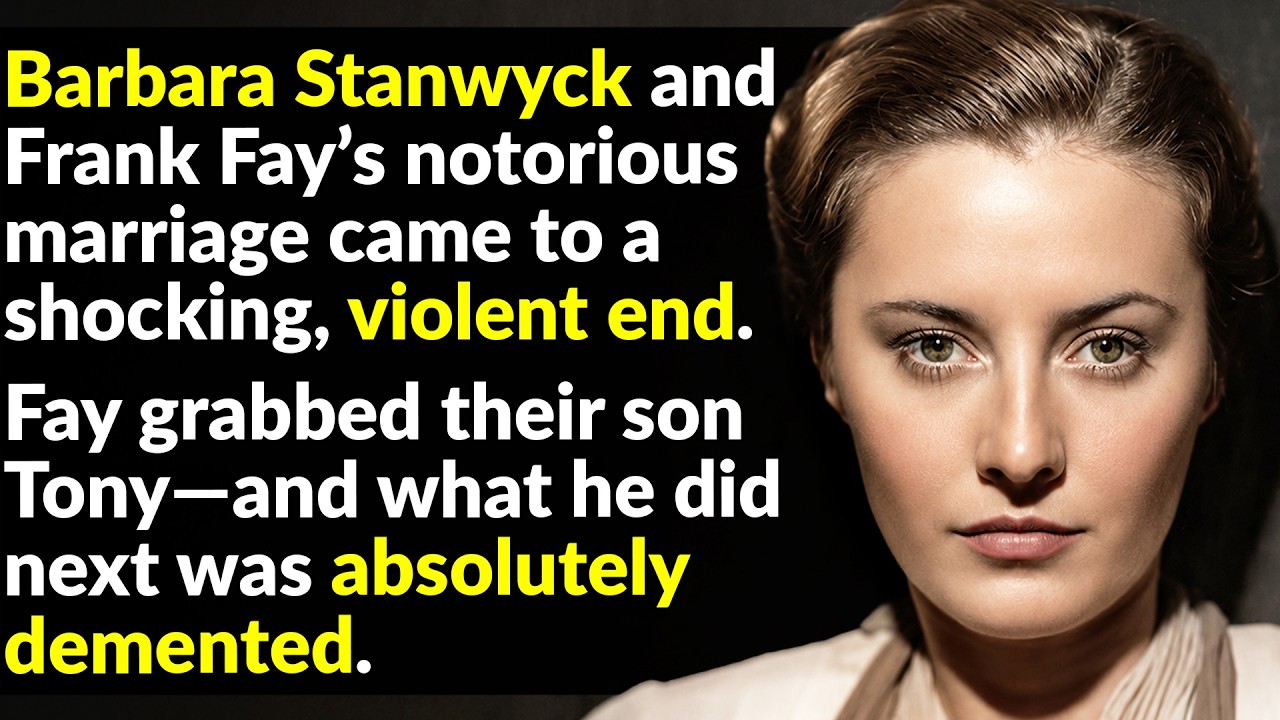
The marriage to Frank Fay was a disaster from the start, marked by his heavy drinking and physical aggression toward Stanwyck. Desperate to repair the rift, she adopted a baby boy named Anthony after discovering she was infertile, but the child only exacerbated the tension. The couple’s volatile relationship reached a legendary and demented end when, during a heated argument, Fay grabbed their son Tony and hurled him into a swimming pool, an act of violence that became Stanwyck’s final straw.
She filed for divorce in 1935, but the trauma of that moment and the years of abuse left deep scars, and many believe their tumultuous marriage inspired the film “A Star Is Born,” written by their friend William Wellman.
Despite her professional success, Stanwyck’s personal life remained a minefield of scandal and secrecy. After her divorce, she met actor Robert Taylor in 1936, a man four years her junior who was a stark contrast to her domineering ex-husband. Their relationship, which began as a friendship, was pressured into marriage by studio fears of scandal in 1939, but rumors swirled that it was a lavender marriage, with whispers that both might be queer.
 Stanwyck’s lack of femininity and Taylor’s gentle beauty fueled speculation, but the marriage was doomed by his infidelities, including affairs with Lana Turner and Ava Gardner, the latter of whom played the other woman in the film “East Side West Side,” chillingly mirroring Stanwyck’s own life.
The betrayal cut deep when Taylor had an affair with Italian actress Lia De Leo while filming “Quo Vadis” in 1950, leading Stanwyck to issue a daunting ultimatum. When he agreed to divorce rather than stop his philandering, she demanded alimony, securing 15 percent of his income despite being one of Hollywood’s highest-paid actresses. The couple separated in 1951 but remained friendly, even starring together in her final feature film, “The Night Walker,” in 1964.
When Taylor died of cancer in 1969, Stanwyck was devastated, with friends claiming she considered him the love of her life, yet she never remarried, a decision that masked a deeper secret.
Two years after Taylor’s death, Stanwyck embarked on a passionate affair that remained hidden until after her own death from lung disease and congestive heart failure in 1990. In 2008, actor Robert Wagner, a famous heartthrob, revealed in his memoir that he had an affair with Stanwyck after they met on the set of “Titanic” in 1953, when she was 45 and he was just 22. The 23-year age gap would have caused an uproar in Hollywood, forcing them to be discreet, but the studio pressured Wagner to marry young actress Terry Moore, a move that incensed Stanwyck.
Despite their four years together, the romance fizzled out, but the secret remained locked away for decades.
 Stanwyck’s most scandalous secret, however, was her failure as a mother, a truth that she guarded fiercely until her final breath. After adopting Anthony, she realized she was not cut out for motherhood, and her strict parenting techniques and high expectations only pushed him away. When he was 12, he suffered a serious injury at summer camp that landed him in the hospital, but Stanwyck never returned doctors’ calls or visited his bedside.
She eventually sent him to military school, effectively washing her hands of him, and they became estranged, with Anthony resembling her in just one respect: both were effectively orphans.
The estrangement deepened over the years, with Stanwyck refusing to attend Anthony’s wedding, sending only a bathroom set, and never meeting her grandson, instead sending $100 and a gift. She brushed off mentions of her son, saying he was long gone, and on her deathbed, she laid out brutal instructions banning him from visiting her. Anthony, who had always held out hope for reconciliation, was devastated by her final wishes, which destroyed their bond once and for all.
This coldness, combined with her tumultuous marriages and hidden affairs, reveals a woman who, despite her on-screen elegance and resilience, was haunted by her past and incapable of forming lasting, healthy relationships.
The revelations about Stanwyck’s life have sent shockwaves through Hollywood and beyond, challenging the narrative of her as a stoic, hardworking icon. Her appalling childhood, marked by the violent death of her mother and abandonment by her father, drove her to seek fame and security, but it also left her emotionally scarred and unable to connect with those closest to her. The scandal of her first husband’s violent act, the lavender marriage rumors, and the secret affair with a much younger man all paint a picture of a woman who lived in constant fear of exposure, hiding behind a facade of professionalism and strength.
 As the world digests these revelations, Stanwyck’s legacy is being reexamined, with film critics and historians noting that her personal tragedies mirrored the roles she played on screen. Her performance in “East Side West Side,” where she played a betrayed wife while her real husband had an affair with her co-star, was a chilling example of life imitating art. The secret affair with Robert Wagner, which she took to her grave, adds another layer of complexity, showing that even in her later years, she sought love and passion but was forced to hide it from a judgmental public.
The impact of these secrets extends beyond Stanwyck’s personal life, raising questions about the pressures of Hollywood’s Golden Age, where studios controlled every aspect of an actor’s life, from their marriages to their public image. The lavender marriage rumors, the pressure to marry to avoid scandal, and the cover-ups of affairs all highlight the systemic control that studios exerted over their stars. Stanwyck’s story is a testament to the lengths actors went to protect their careers, often at the expense of their personal happiness and relationships.
In the wake of these revelations, fans and historians are left to grapple with the duality of Stanwyck’s life: the hardworking, respected actress who was a true definition of an actor’s actor, and the deeply flawed woman who was an awful mother, a victim of abuse, and a keeper of scandalous secrets. Her deathbed ban on her son visiting her is perhaps the most heartbreaking detail, showing that even in her final moments, she could not let go of the pain and resentment that defined her life. The story of Barbara Stanwyck is a cautionary tale about the cost of fame and the secrets that can fester behind closed doors.
As the news spreads, it is clear that Stanwyck’s legacy will never be the same. The scandalous secrets she kept, from the violent end of her first marriage to the hidden affair with Robert Wagner, have forever altered the narrative of her life. Her son Anthony, who died in 2006, never got the closure he sought, and his story serves as a reminder of the collateral damage of her choices.
The world now sees Barbara Stanwyck not just as a legendary actress, but as a complex, tragic figure whose life was a series of missed opportunities for love and connection.
The full extent of Stanwyck’s secrets may never be known, but what has come to light is enough to rewrite history. Her story is a powerful reminder that even the most glamorous lives can hide the darkest truths, and that the pursuit of fame and security can come at a devastating personal cost. As the world mourns the loss of the idealized image of Barbara Stanwyck, it must also confront the reality of a woman who was, in many ways, a victim of her own past, unable to escape the shadows that followed her from that fateful streetcar ride in 1910.