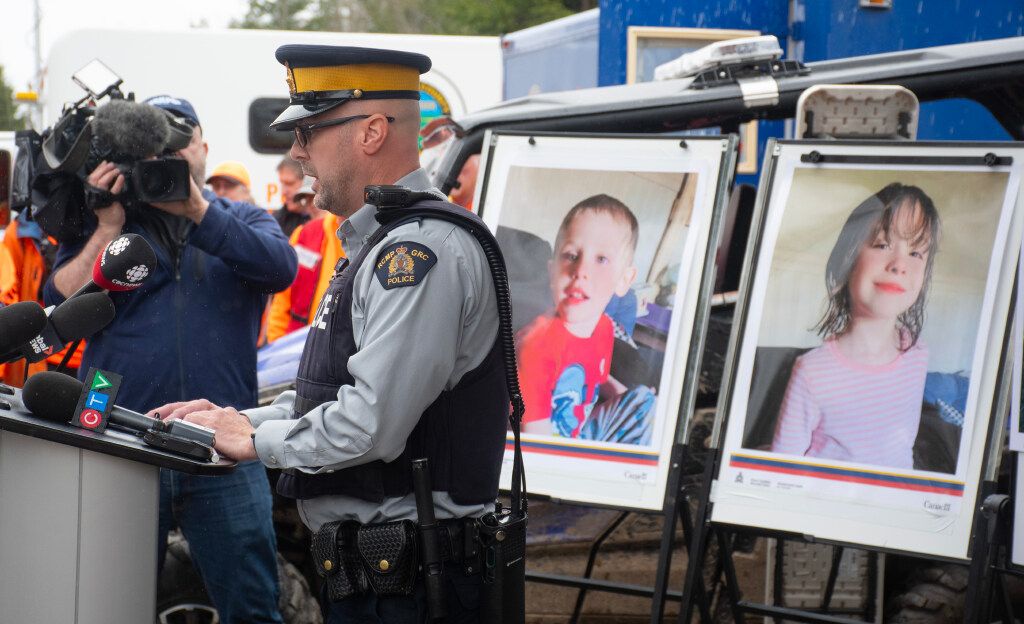
The disappearance of two young children can leave an entire community searching for answers.
When Lily and Jack Sullivan went missing in Nova Scotia, attention quickly turned toward the timeline of events, the family’s statements, and the unanswered questions surrounding what happened that day.
As investigators continued working to understand the case, public discussions focused not only on physical evidence but also on the words spoken by those closest to the children.
Some observers began analyzing interviews and public statements, looking closely at language choices, emotions, and the way events were described.
However, it is important to remember that differences in wording, stress responses, or communication styles do not prove someone is responsible for a crime.
People respond to traumatic situations in many different ways.
Some become emotional.
Some become focused on details.
Some repeat certain phrases because they are trying to explain events clearly under extreme pressure.
In the public statements from Malia Brooks Murray and her partner Daniel, commentators have examined several patterns.
One point discussed was the way the couple emphasized their role as parents and their efforts to care for the children.
Some viewers interpreted this as defensive.
Others viewed it as a natural response from parents trying to protect their reputation during an overwhelming situation.
Another focus was their repeated use of “we” when describing actions taken after the disappearance.
Language analysts sometimes examine collective phrasing because it can show how people remember shared experiences.
But using “we” can also simply reflect that two people were acting together during a crisis.
The word “instantly” also received attention.
Some commentators questioned whether such wording left unanswered questions about the exact timeline.
In missing-person cases, timelines are often among the most important details investigators examine.
Small differences in memory are common during stressful events, which is why authorities rely on evidence, records, and interviews rather than language analysis alone.
Another discussion point involved Daniel’s description of his actions while looking for the children.
Some viewers interpreted certain words as emotionally distant.
But people describe emergencies differently.
One person may say they were “searching.”
Another may describe “checking,” “looking,” or “covering an area.”
The wording alone cannot determine intent.
Perhaps the most emotional part of the discussion has been how parents speak about unimaginable fear.
When someone describes the worst moment of their life, their words may focus on different aspects:
The fear.
The confusion.
The helplessness.
The pain of losing control.
There is no single “correct” way for a person to express trauma.
What remains most important in cases like this is the search for verified facts.
Investigators look at timelines.
Physical evidence.
 Witness accounts.
Digital records.
And every available piece of information that can help determine what happened.
The disappearance of Lily and Jack Sullivan continues to raise questions and concern among those hoping for answers.
For families and communities affected by missing-person cases, the focus remains the same:
Finding the truth.
Understanding what happened.
And bringing closure to those who are waiting.