The finality of it landed like a physical blow. For twenty-seven years, Ruth Langsford and Eamonn Holmes were the bedrock of British daytime television, a couple whose on-screen chemistry convinced millions that their marriage was unshakeable. That illusion shattered in May 2024, not with a slow fade, but with a single, devastating discovery on a mobile phone screen.
Now, nearly two years later, the 65-year-old presenter has finally broken her silence, and the explanation she has given for the divorce is far more chilling than the tabloid speculation that has swirled around the couple. It is a story not of a sudden flame, but of a slow, corrosive betrayal that she believes was hiding in plain sight for over a decade.
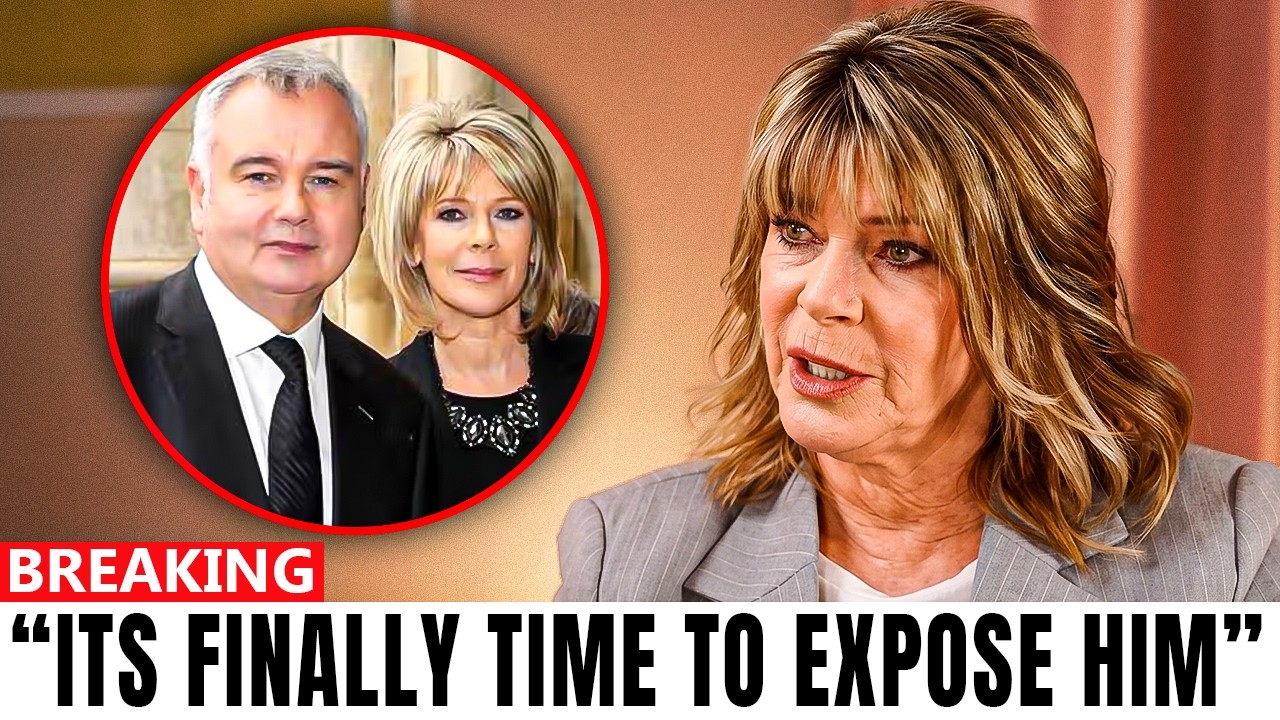 The catalyst for the collapse was not a confession or a confrontation, but the contents of her husband’s phone. Ruth reportedly picked up Eamonn’s device and found messages from Katie Alexander, a former PR professional who had worked with the couple. The texts were not ambiguous.
They were flirtatious, intimate, and damning, providing the incontrovertible proof that the marriage she had fought to maintain was a fiction. In that instant, the life she had built, the home in Surrey, the shared history, and the future she had envisioned, all evaporated. The shock was so profound that it immediately shifted her from a state of denial to a mode of survival, prompting her to hire a high-profile divorce lawyer and begin the painful process of legally severing the ties that bound her to the man she had loved for nearly three decades.
What makes Ruth’s eventual explanation so sharp is the timeline that has since emerged. Reports suggest that the connection between Eamonn and Katie Alexander was not a recent development, but a thread that had been woven through the fabric of his life for years. Allegations point to online messaging that may have begun as early as 2012, long before the public had any inkling of trouble.
While it might have started as harmless fan interaction, the tone allegedly deepened over time, becoming more personal and more secretive. This was not a fleeting lapse in judgment; it was a parallel relationship that existed alongside his marriage, growing in the shadows while Ruth continued to present a united front to the world on shows like This Morning.
The geography of the betrayal adds another layer of cruelty to the narrative. Reports later claimed that Katie Alexander had stayed at a luxury hotel in Surrey, a location that was a mere ten-minute drive from the marital home in Hersham that Ruth and Eamonn shared. For Ruth, this detail was reportedly a source of profound humiliation.
It meant that while she was at home, perhaps caring for Eamonn during his significant health struggles, the 𝒶𝒻𝒻𝒶𝒾𝓇 was happening almost on her doorstep. The proximity made the secrecy feel more brazen, transforming a distant indiscretion into a violation of her immediate personal space, a fact that made the subsequent legal proceedings feel not just necessary, but essential for her own dignity.
 The public announcement of the split on May 25, 2024, was framed with the usual platitudes about remaining friends and handling matters amicably. But the reality was far messier. Ruth was described by friends as devastated, struggling to comprehend how quickly Eamonn’s new relationship became public.
Within months, photographs emerged of Eamonn and Katie on a luxury cruise, looking comfortable and close, images that felt like a slap in the face to those who had watched Ruth grieve. The speed of the transition suggested that this was not the beginning of a new chapter for Eamonn, but the continuation of a secret one, and the public sympathy swung overwhelmingly in Ruth’s favor as she remained silent, dignified, and visibly heartbroken.
Ruth’s decision to hire Catherine Costley, a solicitor known for her fierce approach to high-net-worth divorces, signaled that the initial promise of a civil parting was over. The financial landscape of the divorce became a battleground, with reports emerging of Eamonn’s significant debts, including a £1 million tax bill and losses from property investments. Ruth, who had worked consistently throughout her career, was determined to protect her own financial future.
The narrative shifted from a simple breakup to a complex legal war, where the stakes were not just emotional but also financial, and where the £3. 5 million Surrey home became a symbol of the life that was being dismantled piece by piece.
In her first detailed comments about the aftermath, Ruth described a period of profound darkness. She spoke of crying in the shower before going on air, the tears a private ritual of grief before she had to compose herself for the cameras on Loose Women. She admitted that the biggest emotion was sadness, a feeling so overwhelming that it threatened to swallow her whole.
 She wrote in her memoir, Feeling Fabulous, that it felt impossible to survive, a raw admission that stripped away the gloss of celebrity and revealed the very human cost of a very public betrayal. The future she had imagined, growing old with Eamonn, was gone, and the loss of that imagined future was as painful as the loss of the man himself.
The question that has haunted the public is why she stayed silent for so long. The answer, it seems, is a complex mix of shock, self-preservation, and a desire to protect her son, Jack. Ruth has stated that she will never reveal the exact reason for the divorce, a decision that has frustrated tabloid readers but empowered her in a strange way.
By refusing to engage with the specifics, she has denied the story the oxygen of her own voice, forcing the public to rely on leaks and speculation. This silence is not weakness; it is a calculated act of control, a way of ensuring that the final word on her marriage is not a scandalous headline but her own quiet, dignified truth.
The contrast between Ruth’s path and Eamonn’s is stark. While Ruth retreated from the public eye to heal, Eamonn was photographed with Katie Alexander at football matches, on cruises, and at various public outings. The visibility of the new relationship seemed to many to be a deliberate provocation, a rubbing of salt into a wound that was still raw.
Reports of tension within the new romance, including disagreements over property and money, only added to the sense that the grass on the other side was not as green as it had seemed. For Ruth, however, the focus was not on her ex-husband’s new life, but on rebuilding her own, a process that required time, therapy, and a conscious effort to rediscover who she was outside of the “Ruth and Eamonn” brand.
 Therapy became the turning point. Initially reluctant, Ruth credited a friend for encouraging her to seek professional help, describing it as one of the best decisions she ever made. It allowed her to process the chaos, to understand that she could be alone without being lonely, and to slowly find a sense of calm amidst the storm.
She has been candid about the fact that healing is not linear, that there are good days and bad days, but the crucial shift came when she moved from a place of victimhood to a place of agency. She stated that she was not happy the marriage was over, but she had accepted it, adding that fighting against the inevitable was exhausting and pointless. That acceptance is the foundation upon which her reinvention is being built.
As she approaches her mid-sixties, Ruth Langsford is not fading away. Her memoir, Feeling Fabulous, released in February 2026, is not a tell-all revenge book, but a testament to survival. It details the grief, the fear, and the slow return of confidence, offering a message of hope to women who have faced similar devastation.
She is focusing on her work, her son, and her independence, and the public is responding to her resilience. The narrative has shifted from one of betrayal to one of reinvention. She is no longer defined by the man who left her, but by the strength she has shown in the aftermath, and the quiet, powerful statement that her life is not over, it is simply different.
The final piece of Ruth’s explanation is not a single, explosive revelation, but a cumulative portrait of a marriage that was hollowed out from within. It is the story of a woman who cared for her husband through serious illness, who stood by him through career setbacks, and who was repaid with a decade of deceit. Her decision to speak now, on her own terms, is not an act of revenge but an act of liberation.
She is reclaiming her narrative from the tabloids and from the man who broke her heart. The cold, sharp truth she has finally shared is that the marriage ended long before she found the messages; it ended the moment he chose to live a double life, and her only crime was believing in the one he showed her.