Wilford Brimley, one of Hollywood’s most recognizable character actors, spent decades building a career defined by a gruff voice, a bushy mustache, and a no-nonsense demeanor that made him a fixture in American pop culture. But the man who became famous for Quaker Oats commercials and an unforgettable diabetes catchphrase spent his final years battling a health crisis that few people knew about until the very end. Brimley’s path to Hollywood was unlike almost anyone else’s in the entertainment industry. He never took a single acting class and was never discovered at a talent show.
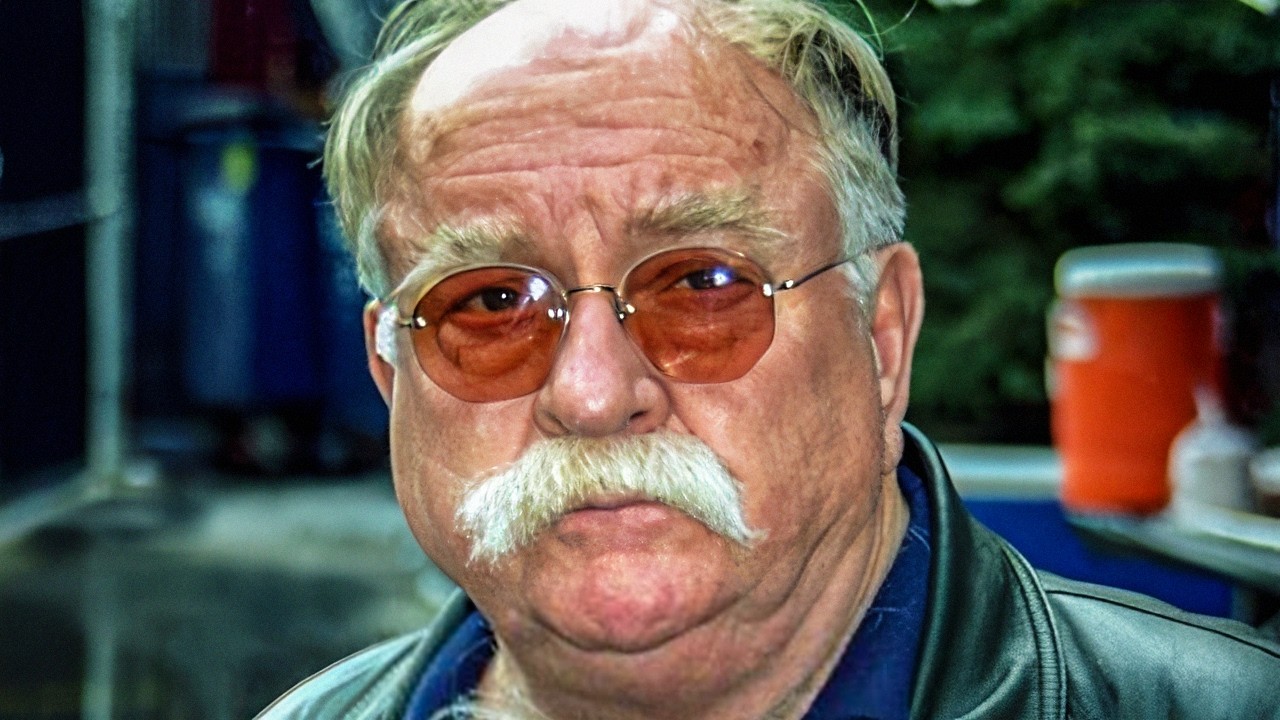
Instead, his journey began with hard labor and military service. Born Anthony Wilford Brimley on September 27, 1934, in Salt Lake City, Utah, he was the son of a real estate broker father and a homemaker mother. When he was just 6 years old, his father sold the family farm and moved them to Santa Monica, California, a transition the young boy deeply resented. Unable to adjust to urban life or the standard school system, Brimley left school at age 14 to work full-time as a traveling cowboy.
He labored as a ranch hand, horse wrangler, and rodeo rider across the American West, taking on dangerous jobs that built the thick skin and working-class understanding that would later inform his performances. At age 19, he enlisted in the United States Marine Corps in 1953, spending three years stationed in the harsh climate of the Aleutian Islands before receiving an honorable discharge. After his military service, Brimley returned to manual labor. During the 1950s, he was hired by the reclusive billionaire Howard Hughes to serve as his private bodyguard, a job that spoke to his quiet reliability.
He also trained as a specialized farrier and opened a blacksmithing business. His entry into film was accidental: during the 1960s Western craze, he was hired on production sets to shoe horses, and directors soon began paying him for uncredited stunt riding and background work. While working as a horse-riding extra on television sets, Brimley met actor Robert Duvall, who recognized his unique presence and pushed him to pursue speaking roles. The friendship proved pivotal.
Brimley’s first major television break came with a recurring role as a blacksmith on seven episodes of The Waltons between 1974 and 1977. In 1979, he gained critical attention playing a nuclear plant worker in The China Syndrome. At 49, he landed his most famous role as Ben Luckett in Cocoon, heavily aged up with makeup to play a character decades older than his actual age. He became a daily presence in American households as the commercial face of Quaker Oats throughout the 1980s and 90s, and he even released a full-length jazz album in 2004.
His rise was remarkable, but behind the gruff exterior and successful career were personal struggles and controversies that few people knew about. Brimley’s no-nonsense persona was not just an act. He was known in Hollywood as a stubborn and opinionated individual who was difficult to work with on set. Directors frequently had to navigate his unyielding personality, and he made no apologies for his directness.
He actively refused to live in Los Angeles, choosing instead to stay isolated on remote ranches in Utah and Wyoming. The city lifestyle that had made him uncomfortable as a child never became more tolerable as an adult. He also faced heavy public backlash for being an open proponent of cockfighting. At a 1998 rally in Phoenix, he opposed an Arizona ballot proposition to ban the practice, arguing that a ban could lead to restrictions on hunting dogs.
He said he traveled from his home in Utah to Arizona to attend cockfights, calling the birds magnificent and saying watching them fight was always thrilling. Brimley also used his own money to support political advertising campaigns promoting horse race gambling in Utah, and he criticized the involvement of the Church of Jesus Christ of Latter-day Saints and other groups campaigning against the initiative. On film sets, Brimley had a reputation for disrupting production with crude practical jokes, frequently exposing his bare backside to cast members and crew between takes. While some found the behavior endearing, others were less amused.
But the same man who could be difficult and controversial also had a deeply compassionate side. In 2009, he co-founded the nonprofit organization Hands Across the Saddle in the Bighorn Basin, which has helped many impoverished families over the years. Brimley’s personal life was filled with contradictions. He was a fierce advocate for personal freedom, a devoted family man with a rebellious streak, and a man who could be difficult to work with yet deeply generous.
Behind the controversies and eccentricities, there was also a love life filled with drama and heartbreak that few people knew about. His first marriage was to Lynn Bagley, a woman he met in Los Angeles while establishing his early blue-collar footing. They were married in Los Angeles on July 6, 1956, and their union lasted 44 years. Together, they had four sons: James Charles, John Michael, William Carmen, and Lawrence Dean.
The marriage suffered a severe tragedy when their son Lawrence Dean died in infancy on May 11, 1966, just weeks after his birth, a grief that stayed with both parents for the rest of their lives. In 1972, the family relocated from Los Angeles back to Utah, reflecting Brimley’s deep discomfort with urban life and his desire to raise his children away from the entertainment industry. Lynn was described as an avid skier and Utah Jazz fan who took great pride in her home and family, and she was deeply involved in community service. She passed away peacefully at her home on June 14, 2000, after a battle with chronic illness.
The marriage had remained intact until her death. Years after coping with the grief of losing his first wife, Brimley found love again with Beverly Berry, whom he married on October 31, 2007, in a private ceremony. The couple split their time between a ranch in Greybull, Wyoming, and a primary residence in Santa Clara, Utah. In 2009, they co-founded Hands Across the Saddle, which provided direct financial assistance to families in the Bighorn Basin.
Over 13 years, the organization gave out more than $800,000 to people going through tough times, and it surpassed Brimley’s goal of raising $1 million in its final year. In 1979, the same year his film career began to explode with The China Syndrome, Brimley was diagnosed with type 2 diabetes mellitus. He later reflected that he was in shock when he first heard the diagnosis, finding it difficult to accept that his body was failing him. Instead of hiding from the diagnosis, he spent over 40 years traveling across the United States to openly discuss the realities of chronic illness, working to dismantle the shame surrounding diabetes care.
In December 2008, the American Diabetes Association officially honored him with a lifetime service award. His advocacy work extended beyond public service announcements; he traveled extensively to Veterans Administration hospitals across America to meet with sick servicemen and teach them how to manage their blood sugar. His diabetes advocacy reached its widest audience through his commercial campaign for Liberty Medical, a home delivery testing supplies company. His distinctive pronunciation of the condition as “diabetes” turned him into one of the earliest viral internet memes.
The meme spawned thousands of parody videos, songs, and jokes, and he was parodied by name on Saturday Night Live by John Goodman as well as on the animated series Family Guy. Unlike many celebrities who grew bitter over internet mockery, Brimley openly embraced the jokes, interacting with fans on Twitter and expressing humor rather than offense. He once tweeted that he was honored to be a part of internet culture and glad people were having fun with his commercial catchphrases. The 41-year battle with diabetes never stopped him from working, advocating, or living life on his own terms.
He continued to appear in films and television shows well into his later years and remained active in his community through his philanthropic work. As he entered his final years, the toll of the chronic illness became more apparent, but he faced his declining health with the same grit and determination that had carried him through every other challenge. In June 2020, Brimley’s health took a sharp, severe downturn that was entirely unrelated to the diabetes he had managed for over four decades. He developed a progressive, severe kidney condition that quickly worsened over a two-month span.
He was admitted to a hospital in St. George, Utah, where he was immediately placed in the intensive care unit. He spent his final weeks on continuous dialysis machines to clear toxins from his blood because his kidneys could no longer function on their own, while simultaneously fighting multiple other unnamed systemic medical ailments that broke down his immune system. Throughout his hospitalization, Brimley remained in character, reportedly blunt with the nurses and doctors but deeply appreciative of their efforts.
He never lost his sense of humor, making jokes about his situation with his trademark dry wit. His wife, Beverly Berry, was a constant presence at his bedside, holding his hand and speaking to him in quiet whispers. Wilford Brimley officially passed away on the morning of Saturday, August 1, 2020, at the age of 85. His long-term manager, Linda Bensky, released the official confirmation stating that his body simply could not overcome the combination of kidney failure and secondary systemic issues.
Bensky shared a heartfelt tribute, saying that Brimley was a man you could trust, that he said what he meant and meant what he said, that he had a tough exterior and a tender heart, and that she would miss hearing her friend’s wonderful stories. She concluded simply: “He was one of a kind. ”
Following his death, his body was cremated according to his wishes. No public Hollywood funeral, star-studded memorial, or public gravesite was established.
His ashes were returned directly to his wife and his surviving sons. It was a fitting end for a man who had never been comfortable with the trappings of Hollywood fame. His death was as private as his life had been, a final act of defiance against the celebrity culture he had never fully embraced.