Demi Moore has spent decades presenting a fearless image on screen, but her private life has followed a much rougher path. Behind the fame were broken marriages, addiction, family trauma, and years in which love appeared to cost her more than it gave. Now, with distance from those events, she has spoken openly about how those experiences shaped her. Moore was born Demetria Gene Harmon on November 11, 1962, in Roswell, New Mexico.
Her biological father, Charles Foster Harmon Sr. , left her mother, Virginia, after a marriage that lasted only two months. When Demi was three months old, Virginia married Dan Guynes, the man Demi grew up calling her father. His work selling newspaper advertising kept the family constantly on the move.
At 13, Demi discovered a marriage certificate that did not match the timeline of her birth and began asking questions. By then, home life had already been unstable. Her mother struggled with alcohol and had a lengthy arrest record, while Dan and Virginia married and divorced each other twice. Demi later recalled having to pull pills from her mother’s mouth during a suicide attempt when she was only 12.
She also dealt with childhood health problems, including kidney trouble and strabismus, which required two operations. A photographer who knew the family remembered her as looking neglected and painfully thin. Demi later explained that she spent much of her childhood bending herself around other people’s needs, with little sense of safety or worth. When she was 15 and living in West Hollywood, Demi said a much older man who knew her mother sexually assaulted her inside the family’s apartment.
She said the man later claimed he had paid her mother $500 for access to her. Demi said she never knew exactly what arrangement had been made, but she believed her mother had placed her in danger. She attended Fairfax High School, but ordinary teenage life did not last. In November 1978, she moved in with 28-year-old guitarist Tom Dunston and left school during her junior year.
She worked as a receptionist at 20th Century Fox and signed with Elite Modeling Agency before taking acting classes and landing small television parts. In August 1979, when Demi was 16, she met musician Freddy Moore at the Troubadour nightclub in Los Angeles. He was older, married, and leading the band Boy. After his divorce was finalized, he married Demi six weeks later.
She was only 18. She had already begun using his last name professionally, and Moore would remain the name the world knew long after the marriage ended. Her first marriage did not last. She and Freddy separated in 1983, and their divorce was finalized in August 1985.
Years later, Demi admitted in her memoir that she had been unfaithful to him on the night before their wedding. After the separation, she briefly dated Timothy Hutton and later John Crier while filming No Small Affair in 1984. Her career, however, was moving quickly. St.
Elmo’s Fire in 1985 became her real breakthrough, though director Joel Schumacher insisted she enter rehab before shooting because her substance use had become serious. After rehab, she remained sober for nearly 20 years. In 1986, About Last Night brought stronger reviews and better scripts, which Demi later called a turning point in her career. Around the same time, she became engaged to Emilio Estevez after about six months of dating.
The couple planned to marry in December 1986, and invitations had already gone out. Then trust broke down. Demi later wrote that Estevez had slept with an ex during an earlier breakup and lied until a pregnancy forced the truth out. She also said a friend later saw him with someone else.
The wedding was postponed, then canceled. Once again, the promise of family had fallen apart. Her next relationship moved even faster. In 1987, she met Bruce Willis at the premiere of Stakeout, a film starring Estevez.
Within weeks, they were dating while he filmed Die Hard. Four months after meeting, they traveled to Las Vegas, where Willis suddenly suggested they get married. They married on November 21, 1987. Their first daughter, Rumer, arrived in August 1988.
In 1990, Ghost became her biggest hit, earning more than $500 million worldwide and earning Demi a Golden Globe nomination. Scout arrived in July 1991. While seven months pregnant, Demi posed nude for Vanity Fair, creating a cover that caused widespread debate. Talula was born in February 1994.
By the mid-1990s, Demi had become one of Hollywood’s biggest stars. She was offered $12. 5 million for Striptease, making her the highest-paid actress in the world at the time. She later defended asking for equal pay, telling Diane Sawyer, “Why shouldn’t all women be paid equal to the quality of the work that they’re doing?
”
But the bigger she became, the harsher the attention got. The press began calling her “Gimme Moore,” and stories about private planes and expensive demands created a diva image around her. Striptease made money but was attacked by critics, and The Juror also failed to impress. In 1997, she shaved her head and went through tough military training for G.
I. Jane, a film she later called one of her proudest achievements. Still, it added to the feeling that her career was cooling. At home, the pressure was just as real.
Demi later wrote that Bruce had told her he was not sure he wanted to stay married. She also believed he worried that her career would pull her away from him and their daughters. Bruce later said there was no single reason for the split, only that people change and grow at different rates, especially under constant public attention. In June 1998, they announced their separation, and their divorce became final in October 2000.
The breakup did not become the bitter Hollywood war many expected. Bruce said he still loved Demi, and both remained focused on raising their daughters together. Demi’s separation from Bruce came during another painful stretch. Her mother, Virginia, died from a brain tumor in July 1998, after mother and daughter had reconciled shortly before the end.
Demi had cut off contact years earlier when Virginia left a rehabilitation program Demi had paid for. Around the same time, Demi pulled back from Hollywood. She moved to Hailey, Idaho, and focused on raising her three daughters. After G.
I. Jane, she stayed off screen for three years. Passion of Mind brought her back in 2000, but she kept turning down offers and remained mostly away from acting. In 2003, Charlie’s Angels: Full Throttle brought her back in a visible role as a villain.
One swimsuit scene created intense attention around her body and age. Instead of enjoying the response, Demi said it made her question where she belonged in the industry. She was 40, returning to a business that had once treated her as one of its biggest stars. That same year, her personal life changed again.
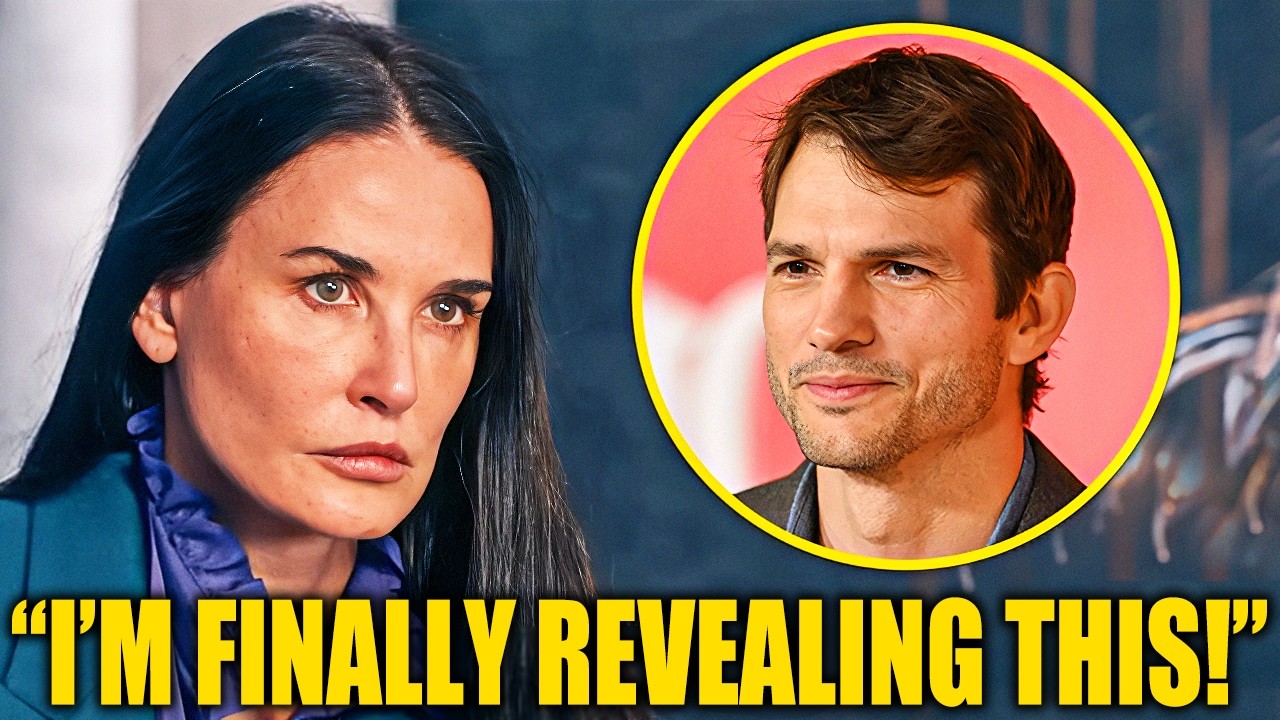
Before a dinner with friends, Demi met 25-year-old Ashton Kutcher in a hotel room. She later wrote that it felt as if nobody else was there. They stayed up all night talking and telling each other their life stories. The 15-year age gap became a public obsession, but Demi said she did not experience the relationship through that lens.
Demi later explained that she had spent years feeling responsible for everything, but with Ashton she felt safe enough to loosen her grip. He accepted her three daughters, seemed comfortable around Bruce, and did not appear frightened by the life she had. Demi joked that she did not come with baggage, she came with trunks. The relationship moved toward marriage, and Ashton proposed during a sunset walk on the beach with a vintage Cartier ring.
They married at their Beverly Hills home on September 24, 2005, in front of close friends and family. Bruce was among the guests. A private loss changed the emotional weight of the marriage. Demi became pregnant with a girl she planned to name Chaplin Ray.
At almost six months, a checkup revealed there was no heartbeat. Demi later struggled to describe the emptiness and confusion she felt. She blamed herself and said the loss decimated her. The couple tried in vitro fertilization more than once, hoping for another pregnancy, but it did not happen.
Ashton later described losing the baby as “really, really painful. ” Demi later admitted that her desire for another child became consuming. She said she lost sight of the family already in front of her and began holding tighter to the relationship. After almost two decades of sobriety, Demi began drinking again.
In her memoir, she described a moment on a trip to Mexico when Ashton questioned whether alcoholism was real and suggested moderation instead. Demi did not later say he caused her relapse. In fact, she wrote, “He’s not the cause of why I opened that door up. ”
Once she started, drinking became tied to the grief she was carrying.
At one birthday celebration, she drank so much that she began passing out in a hot tub and said she could have drowned if other people had not been there. She also began using Vicodin after dental surgery and said she eventually took as many as 12 pills a day. Their sexual boundaries also became complicated. Demi said Ashton wanted threesomes, and she agreed twice because she wanted to prove how open and fun she could be.
Looking back, she called that a mistake. By 2010, rumors around their marriage were getting louder. In her memoir, Demi said she learned through a tabloid report that Ashton had been with another woman in their marital home while Demi was away working. According to Demi, Ashton admitted it when she confronted him.
He argued that their earlier decision to bring a third person into the marriage had blurred the boundaries. Then another allegation arrived in 2011, around the couple’s sixth wedding anniversary. Demi said a notification on her phone told her Ashton had been caught cheating again. She called him and asked directly if it was true.
According to Demi, he admitted it immediately. Her response was simple and furious: “Are you kidding me? ”
In November 2011, after months of speculation, she announced that she was ending the marriage. Her statement said that as a woman, mother, and wife, she held certain values and vows sacred.
Ashton responded that marriage was difficult and that he would cherish the time they had shared. For Demi, the breakup reached far beyond the end of one marriage. She later told Diane Sawyer that it brought her back to the frightened child who had never felt safe. She was careful to say that part was not about Ashton.
It belonged to her own history. After the separation, Demi’s struggles became harder to hide. In January 2012, she suffered a seizure at a party after using synthetic cannabis and nitrous oxide. She later admitted that her life was unraveling.
The incident also damaged her connection with her daughters, who became estranged from her at the exact moment she was struggling to hold herself together. Soon after, she entered treatment for substance abuse, trauma, and codependency. Ashton filed for divorce in December 2012, citing irreconcilable differences. Their divorce was finalized in November 2013.
More important was the slow work of repairing her own life and rebuilding trust with her daughters. Demi later said her daughters gave her the chance to change patterns that had passed through generations. Therapy became part of that work. In September 2019, Demi published Inside Out, a memoir that brought together parts of her life she had kept separate.
She wrote about childhood instability, her mother’s addiction, the assault she experienced at 15, her own substance use, three marriages, motherhood, miscarriage, and the painful choices she made while trying to feel wanted. The book reached number one on the New York Times nonfiction best-seller list. During interviews, Demi returned to one idea: she realized how often she had put another person’s needs ahead of her own. She said, “People are often trained to focus on being desired while forgetting they have desires of their own.
” She made clear the memoir told events from her point of view. Ashton did not publicly answer her specific claims at the time. By September 2024, Demi told The Guardian that dating was not her focus. She explained that this did not mean she had no interest in love.
The difference was that she no longer felt a relationship was needed to fill something missing. She described being in a place of choice instead of lack. At the same time, her career was moving into an unexpected new chapter. She appeared in Feud, Capote vs.
the Swans, and Landman, then took the lead in The Substance. The role asked her to play an aging star desperate to become younger, a subject that closely echoed the pressure Demi had faced for decades. Critics responded with some of the strongest praise of her career. In 2024, she also spoke about staying close to Bruce Willis as his health declined after his aphasia diagnosis progressed to frontotemporal dementia.
When she was in Los Angeles, Demi said she saw him every week and treasured the time their family shared. For The Substance, she won the Golden Globe, Critics’ Choice Award, and Screen Actors Guild Award while also earning BAFTA and Academy Award nominations. In April 2025, People named her the world’s most beautiful, and Time placed her among its 100 most influential people of the year. In 2025, Talula wrote that no one needs to be the bad guy for a situation to heal, while Scout said their family tries to handle difficult relationships with grace, love, and mutual respect.
Ashton also spoke warmly about Demi’s comeback in January 2026, saying he was proud of her performance in The Substance and that she had “killed it. ” Later that year, Demi celebrated Talula’s wedding and continued moving professionally with I Love Boosters and the upcoming thriller Tyrant. Even years later, the Ashton chapter still carried questions Demi could not neatly explain. Too many things broke at once, and the deeper you look, the messier that marriage becomes.
The question remains whether Ashton was truly the relationship that broke Demi the most, or whether it simply reopened wounds that were already there.