For more than three decades, “My Cousin Vinny” has remained one of the most beloved legal comedies in film history, praised for its humor, memorable characters, and surprisingly accurate courtroom scenes. But hidden inside this 1992 classic is a notable error that most viewers never caught, a detail that has recently drawn fresh attention and made audiences look at the film in a completely different way. Among the most discussed mistakes involves Marisa Tomei’s unforgettable performance as Mona Lisa Vito. In one of the film’s most famous scenes, Mona Lisa dazzles the jury by explaining how a car’s differential gear system works, using her hands to illustrate the mechanics in a confident and intelligent display.
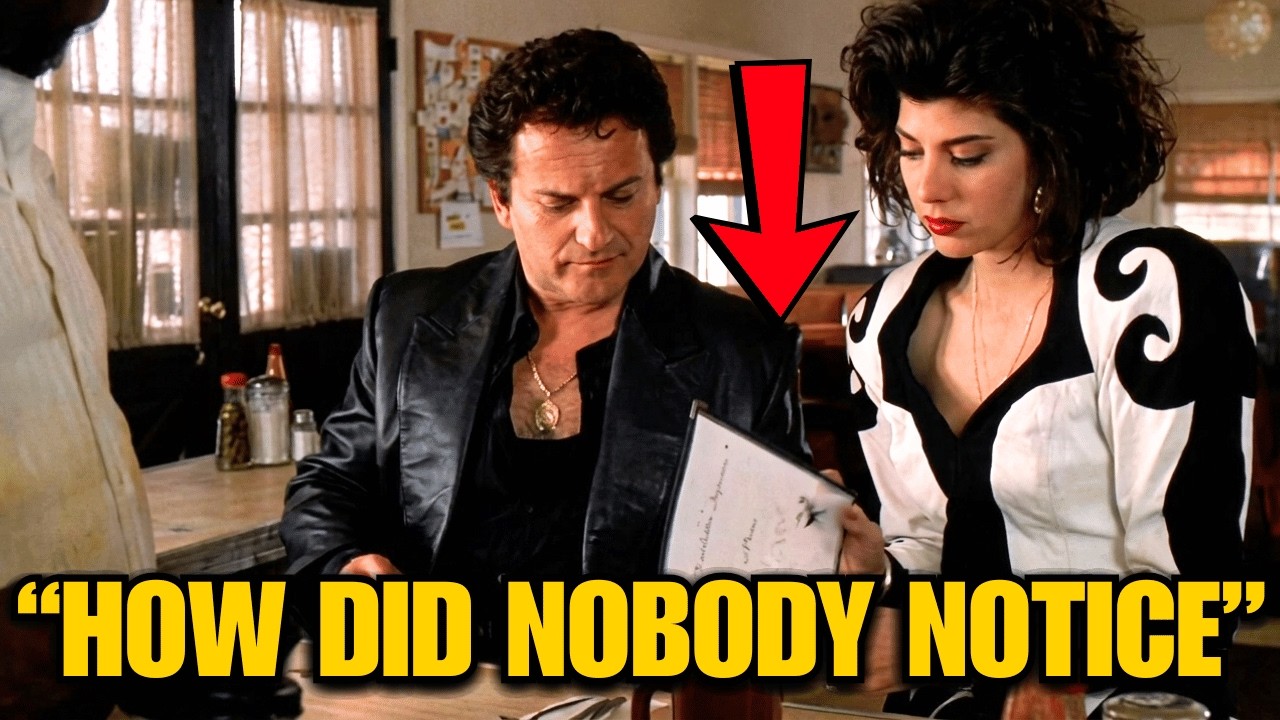
However, eagle-eyed viewers have pointed out that while Tomei’s delivery was strong and convincing, her hand gestures didn’t quite match the actual mechanism she was describing. This small error went unnoticed for years because the scene moves so quickly. The rapid-fire dialogue, sharp humor, and lively courtroom energy masked the inconsistency, turning Mona Lisa’s testimony into both a legal weapon for Vinny and a memorable moment of entertainment. The film also contains several other production gaffes.
A background character appears to move between locations suspiciously fast, almost like a quick game of hide-and-seek between the courtroom and the diner. Viewers have also noticed Mona Lisa’s nail polish color changing throughout the film, adding a small mystery to the proceedings. Just when audiences think Vinny’s car cannot get any stranger, the Cadillac emblem suddenly disappears. There is also an extra who appears to bow at the end of a scene more than once, creating another amusing continuity error.
Beyond the visible mistakes, “My Cousin Vinny” takes creative liberties with some legal details. Certain expert testimony accepted by the judge would likely face far greater scrutiny in a real courtroom, and the lineup scene makes identification seem much simpler than it actually is. The film plays with legal accuracy for comedic effect, and while Vinny’s courtroom strategies are entertaining, real-life legal proceedings require a stricter approach. That was never the goal, however.
The film’s purpose was to create a clever, funny legal comedy. Director Jonathan Lynn worked carefully to balance courtroom accuracy with humor. By combining realistic legal details with perfect comedic timing, he made a film that earned praise from lawyers and judges alike. The movie gained such respect for its courtroom scenes that it has been used as an educational example in law schools, with institutions such as University College, Oklahoma State University, and the University of Arizona incorporating it into their coursework.
The American Bar Association has also recognized “My Cousin Vinny” as one of the best legal films ever made, placing it alongside respected classics like “To Kill a Mockingbird” and “12 Angry Men. ”
In 1992, Hollywood welcomed “My Cousin Vinny” as a playful masterpiece that brought a fresh approach to legal comedy. At its center was Vincent LaGuardia Gambini, the struggling and inexperienced lawyer brilliantly portrayed by Joe Pesci. His unique character and unexpected legal skills made him one of the most memorable figures in comedy history.
Vinny, a Brooklyn man with only six weeks of legal experience, suddenly found himself facing the toughest challenge of his life: navigating a complex Alabama courtroom that would test even the most seasoned attorneys. Vinny was not alone on this difficult legal journey. Mona Lisa Vito, brought to life by Marisa Tomei, joined him with her sharp mind, strong personality, and impressive knowledge of cars. Her relationship with Vinny added another enjoyable layer to the story, creating an unforgettable duo.
Tomei’s performance earned her an Academy Award nomination and later a win for Best Supporting Actress, making Mona Lisa one of the most respected and remembered female characters in comedy films. Jonathan Lynn, born in 1943, built a long and successful career in the entertainment industry. He began on stage, appearing in productions before taking the role of Motel the tailor in the 1967 CBS Records production of “Fiddler on the Roof. ” His journey was unexpected because he graduated from Cambridge University with a law degree, but he followed his passion for entertainment instead.
Lynn worked as a filmmaker, producer, writer, actor, and director, becoming one of the most respected figures in British entertainment. During filming, the production saw moments of unexpected humor. At one point, director Jonathan Lynn had to hide because he could not stop laughing. Instead of sitting clearly behind the camera, he stepped out of sight so filming could continue.
This moment reflected the fun and collaborative atmosphere on set, and Lynn encouraged his actors to bring authenticity and personality to their performances. The story behind the film began with an unexpected meeting between screenwriter Dale Launer and a law student preparing for the bar exam. Although it seemed like an ordinary conversation, the encounter sparked a powerful creative idea. What if someone was wrongly accused of a crime and their lawyer was a struggling attorney who had failed the bar exam 13 times?
This unique concept became the foundation for what would become the beloved legal comedy. Inspired by this thought-provoking idea, Launer dedicated himself to understanding the legal system and the complexities of human behavior. He traveled throughout the American South, studying the region’s culture, traditions, and way of life. His research influenced even the smallest details, including the famous diner cook’s reaction when Vinny asked about the food.
These simple but memorable moments helped create a perfect balance between comedy and authenticity. When the studio began searching for the right actor to play Vinny Gambini, several famous names were considered, including Andrew Dice Clay, Danny DeVito, Peter Falk, Robert De Niro, and Jim Belushi. Launer initially hoped Robert De Niro would accept the role, but studio executives questioned whether he could handle the comedic side of the character. Director Jonathan Lynn then stepped in, turning to Joe Pesci instead, believing his New Jersey background and natural street-smart presence were exactly what the role needed.
Casting challenges continued when veteran actresses Lorraine Bracco and Carol Davis turned down the role of Mona Lisa Vito. Determined to find the perfect actress, Lynn took a risk on Marisa Tomei. Despite being less experienced than some of the other candidates, Tomei possessed the personality, confidence, and energy the role required. A chance meeting between Tomei and Lynn on another film set proved to be a turning point, and her audition impressed everyone.
Meanwhile, Ben Stiller and Will Smith were among those considered for the roles of Billy and Stan, but the filmmakers ultimately prioritized finding actors who could best bring the characters and story to life. The film’s attention to legal detail was remarkable. Lynn had personal knowledge of a real trial, and that experience helped shape the movie’s legal accuracy. The opening defense statement, which became one of the film’s most memorable moments, was inspired by techniques used in actual courtrooms.
An experienced lawyer from Cambridge once told Lynn that a great legal film should be as precise as a judge’s gavel, and that idea influenced him throughout development. He focused on removing unnecessary story elements and ensuring every legal detail seemed believable. One significant change involved the original script, which contained a major plot twist revealing that Vinny suffered from dyslexia, the reason he failed the bar exam six times. Lynn believed this storyline would not work effectively in the final film.
He decided to remove that part and instead focus on Vinny’s determination, confidence, and ability to overcome challenges through hard work. This decision created a noticeable gap in understanding Vinny’s character. According to Launer, removing the dyslexia subplot changed the way audiences viewed Vinny. Without the explanation, he seemed like someone who failed the bar exam six times simply because he was not competent enough, rather than someone who faced challenges because of dyslexia.
In courtroom scenes, when the judge gave Vinny a huge book on Alabama criminal procedure, viewers might wonder why he seemed unfamiliar with legal proceedings. The missing explanation left a question without a satisfying answer. Despite Launer’s initial concern that removing the dyslexia angle might confuse viewers, the change ultimately helped the film move smoothly from Vinny’s difficult journey to passing the bar exam to the main focus of the story. Instead of spending time explaining his personal struggles, the film concentrated on his determined efforts to defend his cousin and friend from a murder charge.
This shift allowed “My Cousin Vinny” to focus on what made it special: Vinny’s unusual courtroom style, confidence, determination, and emotional commitment to proving the truth. The film gained attention for its surprisingly accurate portrayal of courtroom procedures while many legal movies take creative liberties. It showed realistic rules about evidence, courtroom conduct, and witness testimony, helping it stand out from other legal comedies. For law students and aspiring attorneys, the film offers an entertaining way to understand important elements of legal procedure.
It proves that success does not always come from following an expected path, and Vinny’s victory comes from his ability to think differently, use his skills, and remain determined to help the people he cares about. Gag reels and behind-the-scenes bloopers have also become an important part of the film’s modern popularity. These moments reveal actors making mistakes, forgetting lines, or facing unexpected situations during filming. They create a connection between audiences and performers, showing the natural and human side of entertainment.
For many fans who have watched the film multiple times without noticing these details, discovering hidden moments has added another layer of enjoyment to a movie they already loved.