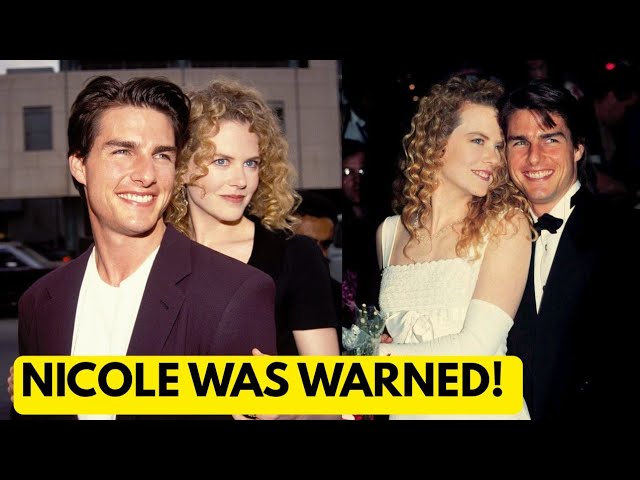
In a revelation that has sent shockwaves through the entertainment world, Oscar-winning actress Nicole Kidman has broken her silence on the defining choice of her youth: wedding Tom Cruise at just 23 years old, despite a chorus of warnings that the union would eclipse her rising stardom. In a candid interview with British Vogue, Kidman pulled back the curtain on that fateful decision in 1990, admitting she charged into matrimony with her eyes wide shut to the professional consequences everyone else could see clearly.
The actress, now a formidable force in cinema, is reflecting on the intersection of love and ambition with a raw clarity that she says she lacked as a young starlet standing at the altar. At the time of her wedding to Cruise, Kidman was just beginning to make waves with Days of Thunder, while her new husband was already a global phenomenon anointed by blockbusters like Top Gun, Rain Man, and Born on the Fourth of July. The power imbalance was glaring, and the industry was eager to point it out, determining that the pairing would sacrifice her autonomy before it ever had the chance to grow.
 Kidman says the warnings were relentless, yet they fell on deaf ears because her heart had made a decision that logic could not arrest. “I don’t care. I’m in love.
I want to get married,” she recalled her defiant response to the advisors and executives who urged prudence. The actress admitted to Vogue that she was painfully young, having transitioned from a fledgling performer to the wife of the biggest movie star on the planet in what felt like an instant, a swirling haze of passion and paparazzi flashbulbs.
The frenzy when the news finally did break was about a woman who was suddenly an appendage to a blockbuster brand, and she was emphatically told later, with a mixture of pity and smugness, “See? We told you so.” Even then, the pressure was immediate, as her identity was legally and publicly bound to Cruise’s name.
Despite the professional doomsday predictions swirling around her, Kidman claimed that for the duration of the union, the marriage felt more than real; it felt destined because the two were immersed in a love she described as deeper than the surface-level Hollywood infatuation.
 With that profound connection between them, they metamorphosed into a legendary, power duo that commanded the industry and dominated gossip columns, sharing the screen with equal heat in films such as Far and Away and later in Stanley Kubrick’s Eyes Wide Shut. Together, they adopted two new children, Isabella and Connor, and forged a common family narrative. Still, the twenty-first century was looming, and the internal cracks that would eventually lead to their explosive divorce in 2001 were beginning to form into a seismic faultline of press and public scrutiny.
Hindsight has not turned her into a cynic, as her reflections now reveal a woman who accepted the immaturity of her decision but has not allowed it to darken her memory. Kidman addressed the inevitable advice, painting a scene where the older and wiser figures in her orbit believed the professional naysayers were right because the obsession with Cruise was simply too potent. The lack of concern for her work at that time, she noted, was the very catalyst that drives the interest of today’s historians of cinema, where she now holds the prestige.
In the post-divorce professional nightmares, they remarked that Cruise continued to dominate the box office as one of the industry’s leading male icons, while Kidman transitioned into a staggering artistic metamorphosis. She rebuilt her craft from the inside out, sculpting an Emmy and Oscar-caliber body of work on the strength of his own risky, uncompromising performances, earning buckets of accolades and critical acclaim that solidified her adoration as a peerless creator in her craft. The careers of the former couple have since taken parallel paths, but once they were seismic and inextricably linked.
 Now, transcending the dusty history of their marriage, she is recognized as one of the most distinguished actresses of her generation, a position achieved not despite the warnings, but as a legacy of her refusal to let them define her rise. The question on the lips of every analyst, film critic and fan, however, remains a focus of debate over whether the Cruise association truly did overshadow her initial years, or whether her eventual return to prominence proved the initial reactions from the industry were categorically wrong.
Kidman’s current reflection is now positioned as both a testimony and a rebuke to the visualization of the industry, as feeling the deepest about the “what-ifs” of her life. Yet she maintains a state of grace about that era, never conceding to the idea that choosing love over art was a catastrophic mistake, rather it was a youngheart true to its pulse. In her own retrospect, she confirms she doesn’t feel sorry for her earlier choice, because it brought her two children and met the road of the work itself, which she defines in her craft.
She says that, perhaps she was too young to walk into the shadow of Tom Cruise’s rocket, but she insists she has never woke up with “what if” on her lips, unwilling to replay the decision because it was made passionately. The confession serves as a daring reminder that a woman’s career can be built through the trial of being underestimated, mapped out on a path where one magnetically defined her equals to the world’s greatest talent. As the article circulates, it invites an unavoidable dialogue about gender dynamics in Hollywood during the 90’s, and why a woman could not be permitted to encompass both love and promise.
 Her story is not unique, but the narrator’s new voice reclaims the history, and complicates the conventional, viral trivia format. She highlights that the inherent religious nature of the institution itself created a shared shelter from which she learns to see the complexities of her environment, just as much as she learned to act. The work she did with Kubrick on that final film marriage, Eyes Wide Shut, is famously referenced as the reason and narrative break, she had imagined that a world of truth would override the stigma, yet the reality of its aftermath was external to the film.
Now, as she steps forward through the meticulous season for cinema, her confession creates a significant change in the public’s understanding of her core drive, that she chose sentiment over advancement without regret, openly admitting she “didn’t care” back in 1990 about maintaining a parallel professional. In revealing this intimate memory, she draws no final conclusion on whether the marriage weighed her down, but she does reveal that the people who lived through it pushed her into a box that she sometimes struggled to fit. It wasn’t until the whirled notes of life were addressed that she dug herself out.
The narrative, appearing with the timbre of a personal coming-of-age story, is a powerful reinforcement to modern audiences aiming to understand the perceived conflation of ambition and love in a high-intensity world. The expression of her youth highlights a universal truth that royalty in romance often comes with a extinguishing downside, which she later paid the price of in her private life. In the end, Kidman’s memo to the world remains an endorsement of trusting your heart, even if the work becomes a testament to a lifetime of wrestling with that choice, as the brilliant artist she was destined to become.
With a career as deep as hers, it is impossible to argue she ever diminished in her reign, only that she started it not as an exponent of her own name, but to who she loves, and that forever changed its trajectory.