The legendary Marlene Dietrich, the sultry siren of the silver screen whose very name defined an era of cinematic glamour, is being remembered not just for her iconic roles, but for a private life so turbulent and scandalous that it threatened to eclipse her professional triumphs. Newly surfaced accounts and biographical revelations have peeled back the layers of her carefully constructed “ice queen” persona, exposing a woman of immense passion, fierce loyalty, and a capacity for heartbreak that she fought desperately to conceal from the world.
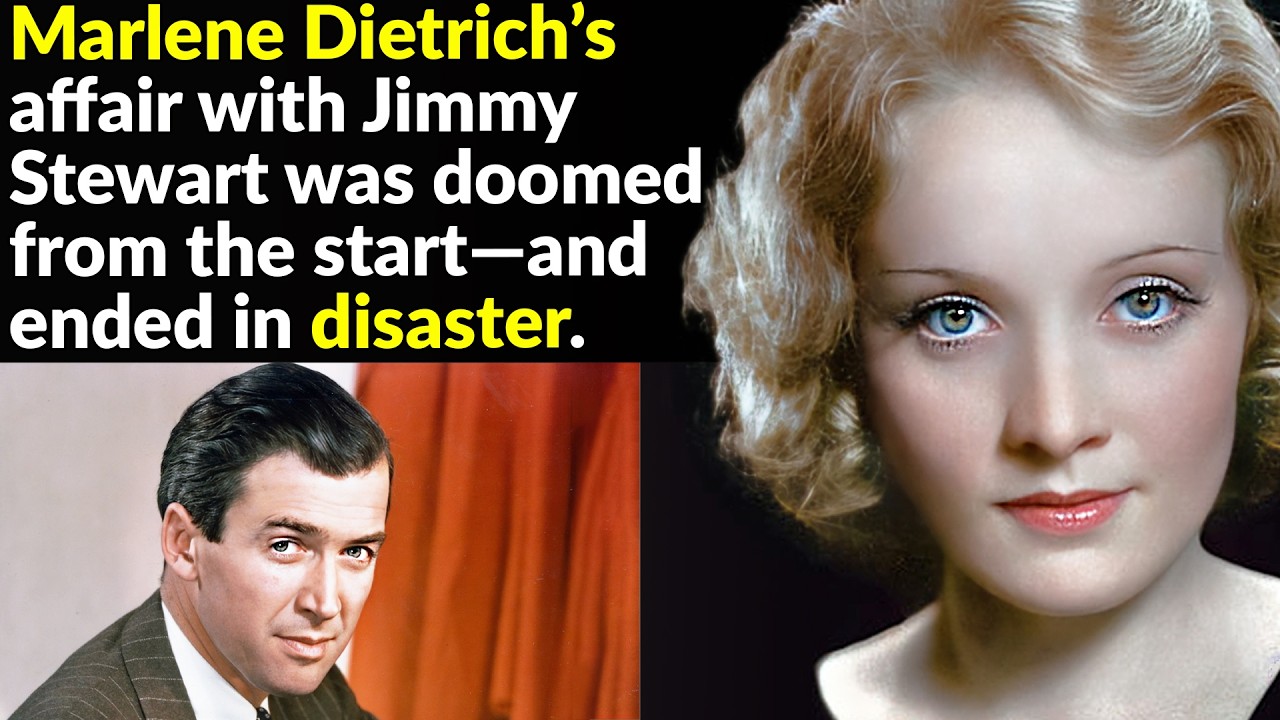
At the heart of these revelations is a torrid and ultimately devastating affair with Hollywood everyman James Stewart, a romance that began with fiery passion on a film set and ended in a secret pregnancy, a forced termination, and a brutal abandonment that left Dietrich shattered. This relationship, which she kept hidden for decades, is now being cited as one of the most explosive and painful episodes in a life that was already riddled with unconventional choices and dark secrets.
 Born into a prosperous family in Berlin in 1902, Dietrich’s early life was marked by tragedy when her father was killed in a riding accident when she was just five years old. The outbreak of World War I further destabilized her family, but her mother encouraged her daughter’s musical ambitions. Dietrich, however, was not content with mere competence; she aspired to be the greatest violinist of her generation, practicing for six hours at a time until her body betrayed her.
The diagnosis was devastating. She had damaged the bones in her wrist, and her musical career was over before it had truly begun. This crushing blow forced her to pivot to acting, where she found moderate success on the German silent screen.
Yet, even before her fame, she was a regular at gay bars and drag balls in Weimar-era Berlin, engaging in passionate affairs with both men and women, a “devil-may-care” attitude that propelled her through her early twenties.
In 1924, at the age of 22, she married assistant director Rudolf Sieber, a decision she attributed to being “madly in love” and the fact that she was pregnant. The marriage, however, was unconventional from the start. When Sieber fell for another woman, Tamara, Dietrich did not object.
Instead, she supported the affair, giving gifts to her husband’s mistress and allowing her to spend time with their daughter, Maria. This arrangement blossomed into one of Hollywood’s longest-running open marriages.
Dietrich’s cinematic breakthrough came when director Josef von Sternberg cast her in Germany’s first full sound film, The Blue Angel. Her performance made her an instant star, and Paramount signed her to a two-picture deal. Her arrival in New York, however, was met with immediate scandal.
 Von Sternberg’s wife sued her for $600,000 for alienation of affection, a case that was eventually dropped but set the tone for the controversy that would follow her throughout her career.
Her professional collaboration with von Sternberg was intense, but it was her affair with co-star Gary Cooper on the set of Morocco that truly stirred the pot. Cooper was already involved with Mexican star Lupe Velez, who was so enraged she threatened to tear out Dietrich’s eyes. The film itself also caused a firestorm when Dietrich, in a scene she conceived, kissed another woman, a moment that sent censors into a frenzy but which she managed to keep in the final cut.
Her personal life continued to be a whirlwind of scandal. She had an affair with John Gilbert, who was on a downward spiral after being left at the altar by Greta Garbo. Dietrich tried to save him, but he suffered a series of fatal heart attacks.
At his funeral, she collapsed with grief. She then rebounded with Douglas Fairbanks Jr. , who was married to Joan Crawford.
Even Adolf Hitler was reportedly obsessed with her, sending her messages to return to Germany, which she defiantly rejected, applying for US citizenship instead.
 When World War II broke out, Dietrich became a tireless advocate for the Allied cause, selling war bonds and entertaining troops near the front lines. She even worked with the OSS to make demoralizing recordings for German soldiers. Despite her efforts, J.
Edgar Hoover, head of the FBI, distrusted her and ordered her to be followed, suspecting her of being a German spy. She was ultimately awarded the US Medal of Freedom for her service, but her career suffered, and she was labeled “box office poison” in the late ’40s.
Her love life continued at a rapid pace well into her later years, with affairs involving Yul Brynner, John Wayne, Kirk Douglas, and Frank Sinatra. She remained married to Sieber throughout, supporting him and his mistress Tamara for decades. The unconventional family unit was shattered when Tamara, suffering from severe mental decline, was committed to a hospital where she was attacked and killed by another inmate.
The tragedy was a dark omen for the decade to come.
In 1976, Dietrich faced the most excruciating heartbreak of her life when her husband of 53 years, Rudolf Sieber, died of cancer. Despite their open marriage, he was the love of her life, and she mourned his loss deeply. She retreated from public view, becoming a recluse for over a decade before succumbing to kidney failure at the age of 90 in 1992.
 She was buried in her hometown of Berlin, which was newly unified.
It was only after her death that the full extent of her secrets was revealed, particularly in a biography written by her own daughter, Maria. The most shocking revelation was the affair with James Stewart. While making Destry Rides Again in the late ’30s, the glamorous Dietrich fell deeply for the actor.
The affair was passionate but tumultuous, and within weeks, she discovered she was pregnant. Terrified of the consequences and feeling she had no choice, she terminated the pregnancy.
Stewart, according to these accounts, ended the affair as soon as filming wrapped. Dietrich was utterly heartbroken, but as always, she could not let it show. She buried the pain beneath her icy facade, continuing her career and her many other romances.
The story of her affair with Stewart, marked by such a profound personal sacrifice and subsequent rejection, adds a tragic dimension to her legacy, revealing that even the most powerful and glamorous stars are not immune to the deepest forms of human suffering.