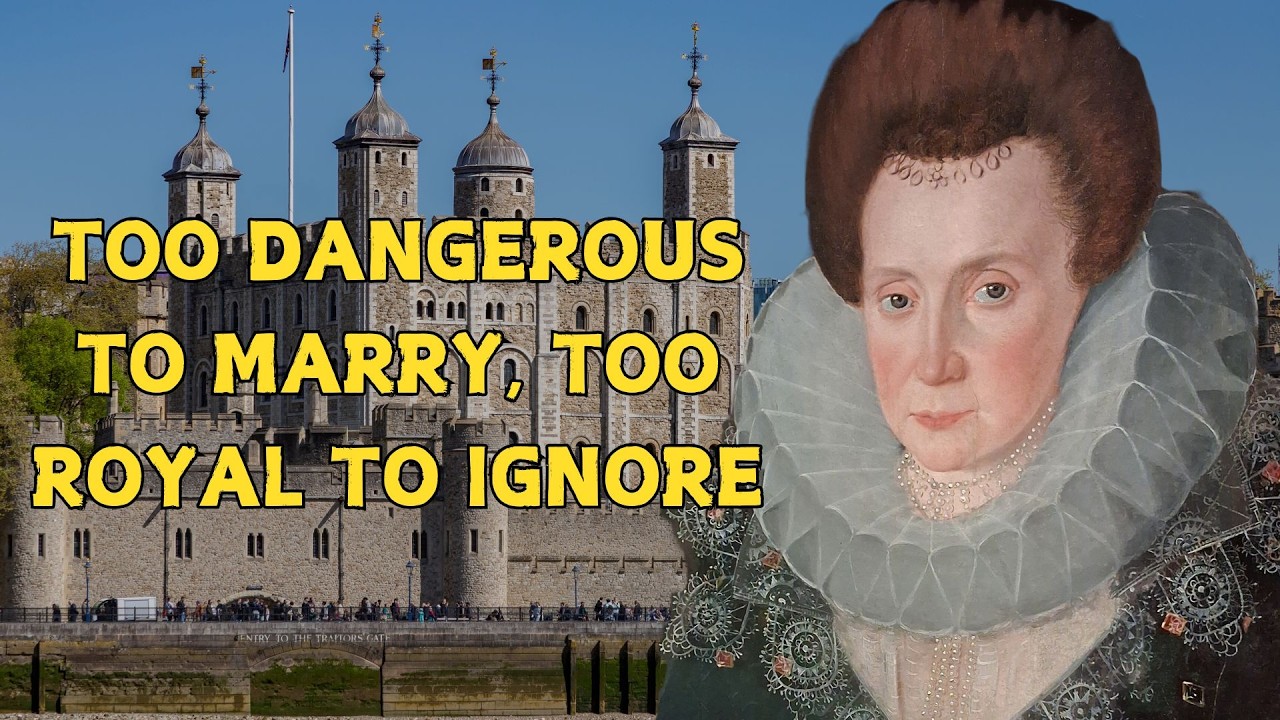
The blood that flowed through Lady Arbella Stuart’s veins was both her greatest inheritance and her most lethal curse. Born in 1575, she was a living embodiment of the dynastic chaos that gripped England and Scotland, a woman whose very existence threatened the thrones of two kingdoms. While she never wore a crown, her proximity to power made her a perpetual pawn in a deadly game of succession, a game she ultimately lost with her life in the Tower of London.
Her lineage was a complex tapestry woven from the threads of the Tudor and Stewart royal houses. She was the granddaughter of Margaret Tudor, sister of Henry VIII, making her a first cousin to James VI of Scotland, who would later become James I of England. On her father’s side, she was the niece of Henry Stuart, Lord Darnley, and Mary, Queen of Scots.
 This placed her directly in the line of succession, a fact that made her both a valuable asset and a terrifying threat to the aging, childless Queen Elizabeth I.
The circumstances of her birth were shrouded in 𝒔𝒄𝒂𝓃𝒹𝒶𝓁 from the very beginning. Her parents, Charles Stuart, Earl of Lennox, and Elizabeth Cavendish, married in secret in 1574, a union that lasted only a matter of days before it was discovered. The marriage was a political bombshell, as it united two powerful families with claims to the English throne.
Charles’s mother, Margaret Douglas, was briefly imprisoned for her role in the match, while Arbella’s maternal grandmother, the formidable Bess of Hardwick, escaped punishment. Arbella was born into this world of intrigue and suspicion, her very conception a perceived act of defiance against the crown.
Orphaned by the age of seven, Arbella was placed in the care of her grandmother, Bess of Hardwick, at the grand Hardwick Hall. Bess was a woman of immense wealth and ambition, but she was also a harsh and controlling guardian. Arbella was given an exceptional education, becoming fluent in Latin, Italian, French, and Spanish, and reading Greek and Hebrew.
The Venetian ambassador later described her as “not very beautiful but highly accomplished,” a woman of refined manners and constant study. Yet, this intellectual brilliance was confined within the walls of a gilded cage.
As she grew into adulthood, Arbella’s position became increasingly precarious. With Mary, Queen of Scots, imprisoned and executed in 1587, Arbella’s claim to the English throne grew stronger. She was now second in line, after her cousin James, and she was English-born, a significant advantage over the Scottish king.
This made her a focal point for plots and conspiracies, and it made Queen Elizabeth deeply suspicious of her. The queen, who had refused to name an heir, was determined to keep Arbella unmarried and powerless, lest she produce a rival claimant.
Arbella’s life at Hardwick became a form of house arrest. Bess controlled her every move, forbidding her from visiting neighbors and monitoring her daily activities. The young woman, now in her twenties, was treated like a child, and the relationship between grandmother and granddaughter deteriorated into mutual hatred.
 Arbella began to describe Hardwick as her prison, and her desperation grew with each passing year. She was a woman of royal blood, trapped in a rural manor, denied the freedom and marriage that her status demanded.
In a desperate attempt to escape her gilded cage, Arbella began to contemplate a marriage that would change her life forever. In 1602, she attempted to arrange a match with Edward Seymour, the grandson of Lady Katherine Grey, another woman whose royal blood had led to her downfall. The plan was discovered, and Arbella was interrogated.
In a bizarre turn of events, she claimed to have a secret lover, whom she named as King James of Scotland, a complete fabrication that suggested she was cracking under the immense strain of her confinement. She even began to refuse food, a desperate act of defiance that hinted at a deep psychological turmoil.
The death of Queen Elizabeth in March 1603 brought a dramatic shift in Arbella’s fortunes. James VI of Scotland ascended to the English throne as James I, and Arbella, his first cousin, was finally freed from Bess’s custody. She was welcomed at court, given apartments in Sheen Palace, and treated with the respect due to a princess of the blood.
She dined with the royal couple, was given precedence over all other women, and enjoyed a period of relative freedom and intellectual stimulation. It was a brief golden age in a life marked by tragedy.
However, her very existence remained a threat to the new king. In 1603, a plot known as the “Main Plot” aimed to 𝓀𝒾𝓁𝓁 James and place Arbella on the throne. Though she was seemingly not involved, the conspiracy highlighted the danger she posed.
James, like Elizabeth before him, was determined to control her future. He refused to allow her to marry, fearing that any children she produced would create a rival dynasty. Arbella was once again a pawn, her personal happiness sacrificed for the stability of the crown.
 In February 1610, Arbella made a decision that would seal her fate. She became betrothed to William Seymour, the younger brother of Edward Seymour, the man she had tried to marry years earlier. The Seymour family had a strong claim to the throne through their descent from Mary Tudor, Henry VIII’s sister, and their legitimacy had recently been restored.
This union was a direct challenge to James I, uniting two rival claims to his crown. The king was furious, and the couple was separated and interrogated.
Despite the warning, Arbella and William were married in secret in June 1610, in a small ceremony at Greenwich. The marriage was a declaration of love and defiance, but it was also an act of political suicide. When the news 𝓵𝓮𝓪𝓴𝓮𝓭, William was sent to the Tower of London, and Arbella was placed under house arrest.
She soon believed herself to be pregnant, a scenario that was a nightmare for the king. The couple’s imprisonment continued, and Arbella’s pleas for mercy fell on deaf ears.
In March 1611, Arbella was ordered to be moved to Durham, a fate she saw as a life sentence. Desperate to escape, she feigned illness and planned a daring escape to France with her husband. On June 3, 1611, she dressed as a man and slipped out of her lodgings, riding for the coast to meet William, who had managed to bribe his way out of the Tower.
The plan was audacious, but it was doomed from the start. William was delayed, and Arbella’s boat waited in the English Channel for him, a fatal hesitation. She was spotted, boarded, and captured before she could reach the safety of the French coast.
William, however, made it to Calais.
 Arbella was taken to the Tower of London, the very prison her husband had just escaped. She was held in close confinement, denied the comforts she had previously enjoyed. She was never formally charged or tried, but she was a prisoner nonetheless.
Her health deteriorated rapidly, exacerbated by her refusal to eat and her refusal to leave her bed. She suffered from bouts of illness and mental anguish, and her letters to the king begging for mercy went unanswered. She was a ghost in the Tower, a forgotten princess whose only crime was being born too close to the throne.
On September 25, 1615, at the age of 39 or 40, Lady Arbella Stuart died in the Tower of London. The post-mortem listed her cause of death as a combination of starvation and bedsores, a tragic end for a woman of such intellect and royal blood. She was buried in Westminster Abbey, in the vault of her aunt, Mary, Queen of Scots, her coffin placed on top of the queen’s.
Her story is a cautionary tale of the dangers of royal proximity, a life destroyed by the very blood that made her a potential queen.
Her husband, William Seymour, survived her by 45 years. He was pardoned after her death, allowed to remarry, and eventually became the Duke of Somerset. He lived a long and successful life, a stark contrast to the tragic fate of his first wife.
Arbella’s story is one of ambition, love, and desperation, a woman caught in the machinery of monarchy, crushed by the weight of her own lineage. She was a pawn in a game she could never win, a princess who was never allowed to be a queen.