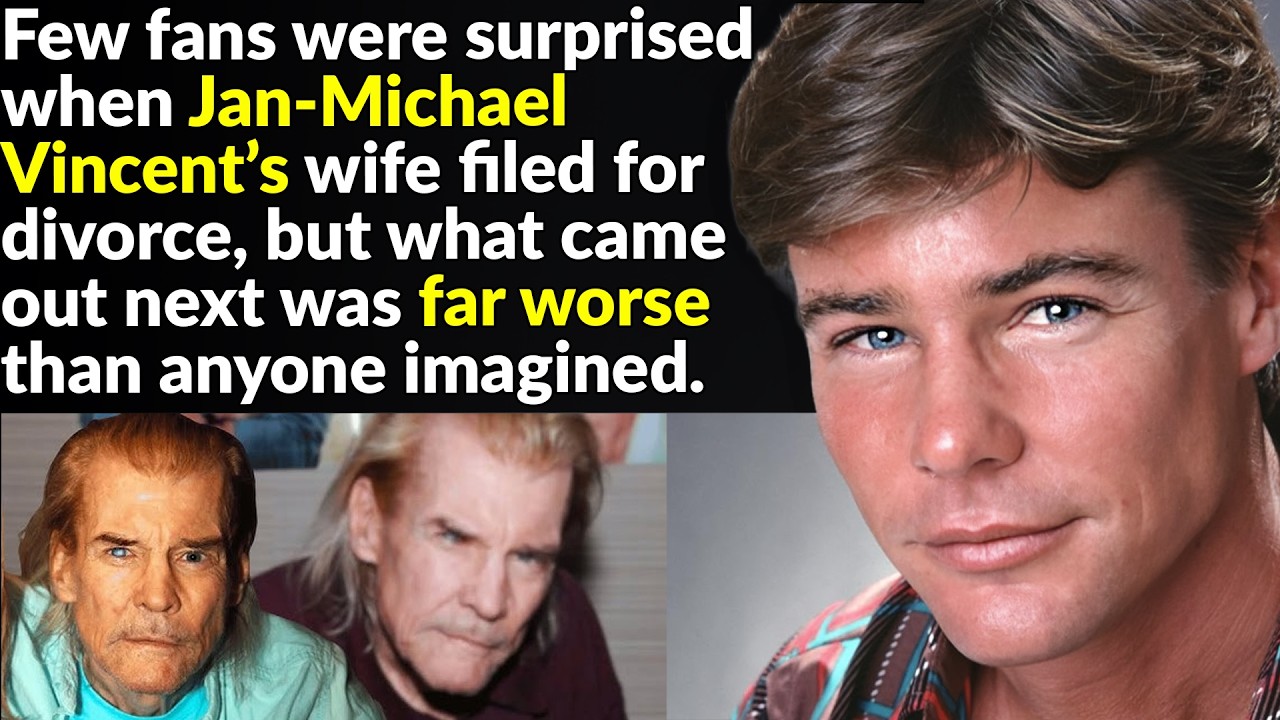
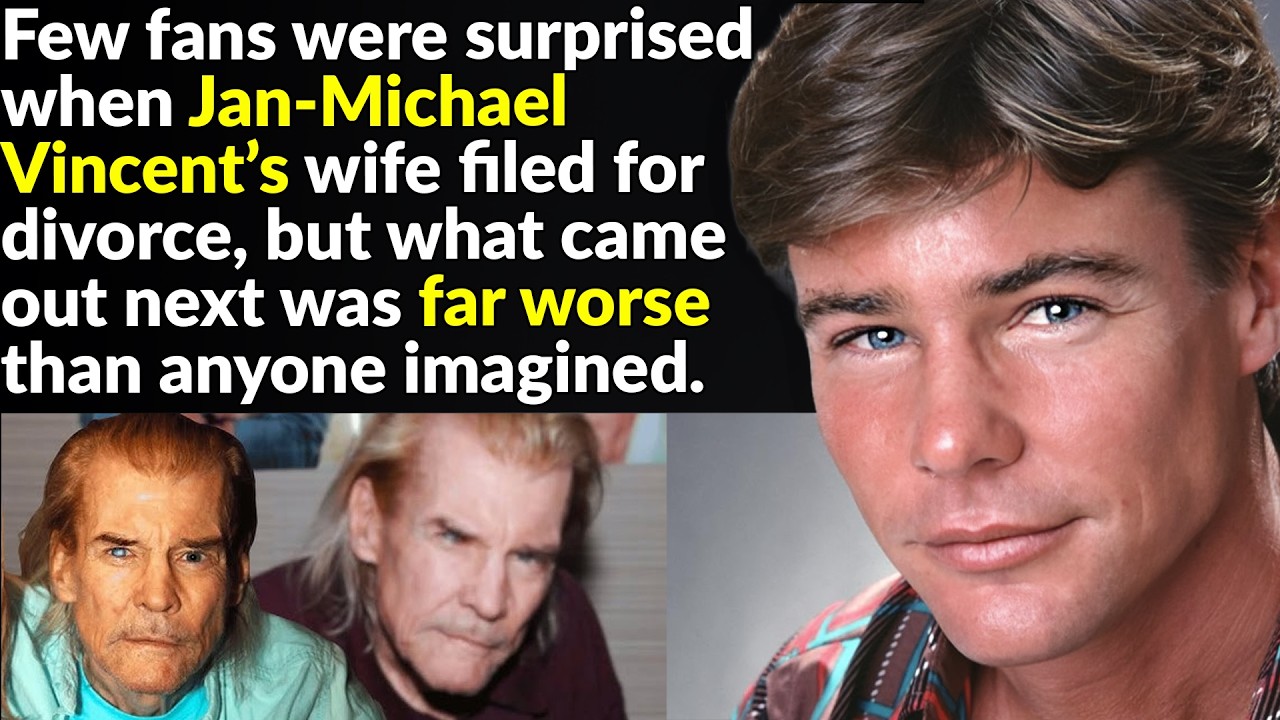
The blinding California sun did little to illuminate the dark corners of Jan-Michael Vincent’s soul, a man whose chiseled features once launched a thousand magazine covers but whose life spiraled into a vortex of addiction, violence, and tragic disfigurement. The final chapter of his sordid tale, however, was written not in the glitz of Hollywood but in the quiet desperation of a Mississippi home, where the former “Airwolf” star spent his last days as a shadow of the Adonis he once was. His death in February 2019 passed with barely a whisper, a stark and haunting testament to how completely the industry that once worshipped him had turned its back.
The story of Jan-Michael Vincent is not merely a tale of faded fame; it is a harrowing case study in the destructive power of unchecked excess and the cruel indifference of time. Born in Denver, Colorado in July 1944, Vincent seemed destined for a life of turbulence from the very beginning. His family tree was rooted in criminality, with his grandfather and uncles having staged numerous bank heists during the 1920s and 1930s, meeting bloody ends at the hands of law enforcement.
 This legacy of rebellion would prove to be a defining thread in his own life, as he consistently rejected the discipline his father, a decorated US Army pilot, represented. The resentment he felt toward authority figures was palpable, and it manifested in a lifelong refusal to conform to societal expectations, a trait that would both catapult him to stardom and ultimately destroy him
Vincent’s ascent to fame was as meteoric as it was improbable. After famously abandoning his father’s sign shop with nothing but a surfboard, he drifted through college and a stint in the California Army National Guard before fate intervened on a sun-drenched beach. His impossibly good looks, a combination of rugged masculinity and all-American charm, caught the eye of a Hollywood talent scout, propelling him into the spotlight without a single acting class to his name.
By 1968, he was booking roles in iconic series like “Dragnet” and “Bonanza,” his chiseled jawline and lean physique making him an instant sensation. His rise was so rapid that he bypassed the grueling audition process that most actors endure, a fact that bred resentment among his peers but solidified his status as a golden boy of the silver screen
The 1970s saw Vincent solidify his reputation as a leading man, though his choices were often as unconventional as his personal life. He famously turned down lucrative offers in favor of projects he believed in, such as the 1974 film “Buster and Billie,” where he stunned audiences by appearing fully nude, a move he defended with characteristic bravado, quipping that the scene was in good taste and that he was simply showing “standard equipment.” His willingness to take risks extended beyond the screen, as he frequently performed his own death-defying stunts, expecting his paychecks to match his fearlessness.
By 1977, he was commanding a cool $1 million for his role in “Damnation Alley,” a testament to his box office draw. Yet, beneath this veneer of success, the seeds of his destruction were already being sown, as his appetite for alcohol and other substances began to grow insatiably
 The turning point, the moment when the handsome began his slow, agonizing transformation into the horrifying, came with his casting in the 1980s television phenomenon “Airwolf.” As the high-flying pilot Stringfellow Hawke, Vincent became a household name, earning a staggering $200,000 per episode, making him the highest-paid TV actor of his time. It was an ironic twist for a man who had rebelled against his father’s military discipline, as he embodied the very archetype of the stoic, heroic aviator.
But the pressures of fame, coupled with his escalating substance abuse, soon turned the set into a battlefield. By the third season, Vincent was a shell of his former self, frequently showing up unable to remember his lines, barely able to stand, his co-stars and studio executives watching in horror as the production crumbled around him. The show’s producers, having had enough, fired him, replacing the heartthrob with a new cast, a decision that sent him into a tailspin from which he would never fully recover
The tragedy of Vincent’s life extended beyond his own personal demons, touching those around him in devastating ways. During filming of an “Airwolf” episode, his stunt double crashed a helicopter, burning alive in an inferno so intense that rescue crews could not reach him in time. This incident, horrific as it was, was not an isolated one, as one of the show’s helicopters later crashed in Germany, killing all three ambulance pilots aboard.
It seemed as though a curse hung over the production, a dark cloud that followed Vincent throughout his career. His behavior on other sets became increasingly erratic and dangerous, with directors like William Lustig recounting near-fatal incidents. During filming of 1989’s “Hit List,” a clearly inebriated Vincent slipped and fell while running from a speeding vehicle, narrowly escaping being flattened by the stunt car.
 His co-stars bore the brunt of his volatility, with Ray Parker Jr. revealing that Vincent had hit him with a wheelchair during filming of “Enemy Territory,” describing the former star as “crazy.”
His personal life was a mirror image of his professional chaos. His first marriage to Bonnie Porman, which began in 1968 and produced a daughter, Amber, was fraught with estrangement, with Vincent reportedly alienated from his child for most of her life. His second marriage, to Joanne Robinson in 1986, proved to be even more disastrous.
When Robinson finally filed for divorce in 1998, her allegations were nothing short of horrifying. She accused Vincent of being a monster, detailing a pattern of physical abuse that included black eyes, broken bones, and forcing her into non-consensual group encounters with his friends. The judge, upon hearing these disturbing claims, not only granted the divorce but issued a restraining order, prohibiting Vincent from coming within 300 yards of their Malibu home.
These accusations, while shocking, were consistent with a rap sheet that included a 1986 charge for an assault on a woman at his home, a charge he narrowly avoided conviction on after his lawyer argued she had tripped over a telephone cord. In 2000, a judge ordered him to pay an ex-girlfriend $374,000 after she alleged he attacked her while she was pregnant, causing a miscarriage
 The final, cruelest blow to Vincent’s physical appearance came in 1996, when a horrific car crash shattered his neck and severely damaged his face. The accident, which also injured his housekeeper, required paramedics to perform an emergency tracheotomy on the scene to save his life, a procedure that permanently damaged his vocal cords, leaving him with a raspy, barely recognizable voice. His once-handsome face was left swollen, scarred, and disfigured, a transformation so complete that he was barely recognizable as the man who had once graced the covers of teen magazines.
He leaned into his new appearance, using his real hospital ID bracelet as a prop in the film “Redline,” which he was shooting at the time, and even referencing his Frankenstein-like visage in the script. Appearing on the Howard Stern Show shortly after, his face still a mess of stitches and scabs, he insisted his performance in “Redline” was his best yet, a claim his audience roundly rejected, voting him the most incoherent guest of the year
With his looks gone, his career evaporated. He retreated from public life, moving to Mississippi with his third wife, Patricia Krist, where he lived in relative obscurity. When tracked down by a reporter, he offered only a simple, resigned explanation: “I’m just laying low.”
But his body, ravaged by decades of abuse, continued to betray him. In 2012, an infection stemming from peripheral artery disease forced the amputation of his right leg, consigning the former beach god to a wheelchair for the remainder of his life. He spent his final years as a broken, hollowed-out figure, a living cautionary tale about the fleeting nature of beauty and the devastating consequences of addiction.
When he finally succumbed in February 2019, the news of his death did not break until a month later, via TMZ, in a report that underscored just how far he had fallen from the heights of his fame. The man who once had the world at his feet died with barely a whisper, his legacy forever tainted by the violence, the excess, and the tragedy that defined his life off-screen. His story serves as a grim reminder that in Hollywood, the spotlight is fleeting, and the fall from grace can be as swift as it is brutal.