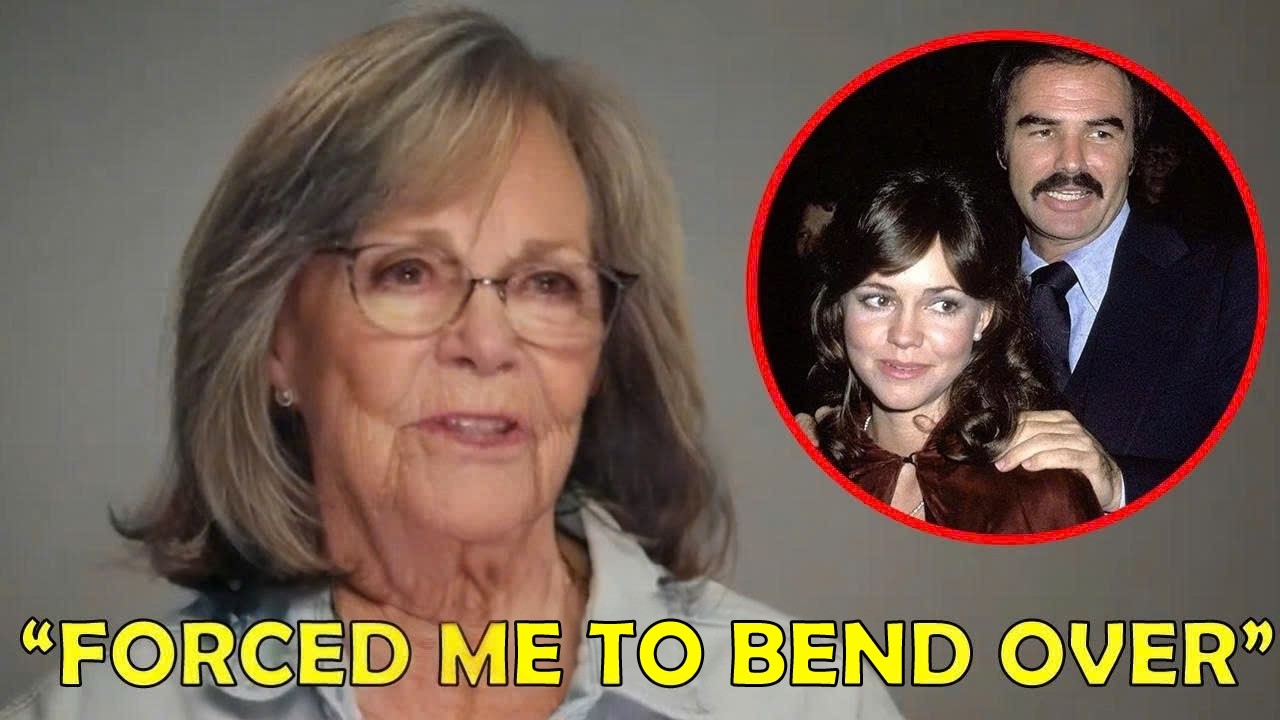
Sally Field has finally broken her decades-long silence about her relationship with Burt Reynolds, revealing that the golden romance Hollywood adored was shadowed by control, fear, and a painful choice that ultimately saved her career and her sense of self. In candid recollections that have stunned the entertainment world, the two-time Oscar winner admits the man she loved was also the man she had to escape.
The story begins in 1976, when Reynolds, already a towering box-office force, called Field to offer her a role in Smokey and the Bandit. She was still fighting to shed her image as the wholesome television girl from Gidget and The Flying Nun, despite her acclaimed dramatic turn in Sybil. Reynolds, however, admitted he had never seen that performance, instead confessing, “I always liked you in Gidget.”
 It was a telling start to a relationship that would blur love with control.
Field has never sugarcoated the script’s quality, calling it “really, really bad,” but the chance to work with Reynolds overshadowed her doubts. Their first date left her so nervous she feared she might faint, with his bodyguard escorting her to dinner. She spent the evening hiding her terror behind a clownish persona, a defense mechanism she had perfected long before meeting him.
To the public, they were Hollywood’s unstoppable couple, starring in four films together between 1977 and 1980. Their on-screen chemistry seemed effortless, but Field now reveals the illusion masked a far darker dynamic. She recognized that Reynolds mirrored her stepfather, a man who was both “wonderful and evil,” teaching her that love could feel beautiful and dangerous at the same time.
That childhood blueprint, she explains, made her unconsciously drawn to a partner who could be both charming and intimidating. “It doesn’t mean there wasn’t a part of me that loved Burt to pieces,” she said, “but then, I loved my stepfather, too.” The admission is one of the most painful truths she has ever shared, revealing how her past shaped her romantic choices.
As Reynolds’ fame exploded, the imbalance in their relationship grew. Field has written that his enormous celebrity became a means of controlling those around him, and she walked directly into that dynamic without recognizing it. She described them as “a perfect match of flaws,” not a union of equals, but a collision of unresolved emotional wounds.
The breaking point came in 1978 when the screenplay for Norma Rae landed in her hands. It was the serious, demanding role she had craved, but Reynolds dismissed it, reportedly calling the character a derogatory name and questioning her judgment. When he threw the script at her, the argument became about who controlled her future.
Field’s response was defiant: “This is the better of me.” She took the role despite knowing it would fracture their relationship, and the character’s journey to self-empowerment transformed her personally. “I could feel my own legs,” she later reflected, describing the moment she stopped seeking approval and began trusting her own instincts.
The success of Norma Rae in 1979 earned her critical acclaim and an Academy Award nomination, but Reynolds’ reaction was cold. He discouraged her from attending the Cannes Film Festival and questioned her chances of winning. On Oscar night in 1980, he refused to accompany her, leaving her to be escorted by friends David Steinberg and his wife Judy.
When her name was called for Best Actress, the triumph was bittersweet. The people celebrating her were not the man she loved, but the friends who believed in her. Author Dave Karger, who interviewed Field, concluded that this lack of support showed her the relationship could never be the partnership she deserved.
Field and Reynolds officially ended their romance in 1982, and for nearly three decades, they barely spoke. In 2015, Reynolds publicly called her “the love of my life,” admitting he missed her terribly and regretted his mistakes. His words made headlines, but Field’s response, revealed after his death in 2018, was far more measured and revealing.
In her memoir In Pieces, released just days after Reynolds died, Field chose honesty over bitterness. She acknowledged his importance but revealed they had not spoken in 30 years. She wrote that his fame had become a tool of control, and that their flaws matched in unhealthy ways, mistaking familiarity for love.
What surprised many was her compassion. Field admitted she was relieved Reynolds never read her memoir, believing it would have hurt him deeply. She had no desire to humiliate him, offering a final farewell: “There are times in your life that are so indelible, they never fade away.
My years with Burt never leave my mind. Rest, buddy.”
The long-kept secret, she suggests, is that real love should never require surrendering one’s voice. The moment she found the courage to protect her work and walk away, she was not ending a relationship, but finally becoming the woman she was meant to be. Her story is not defined by resentment, but by hard-earned wisdom.
Reynolds spent his final years calling Field the greatest love he ever lost, but she revealed a different truth. Sometimes real strength is not in holding on, but in knowing when to let go. Her decision to leave was not a failure, but the most important role she ever played, the role of her own life.