For more than fifty years, one question has haunted humanity.
If we landed on the Moon in 1969, why did we stop going?
The official explanation has always been simple. Funding cuts. Political priorities. The end of the Space Race.
But that answer has never fully satisfied people.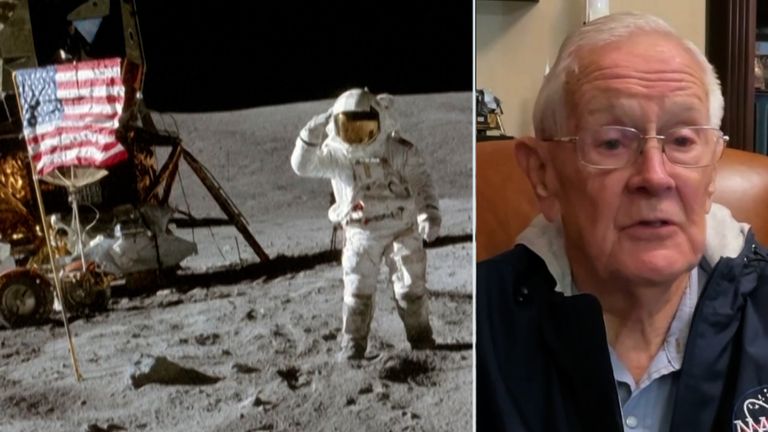
After all, money never stopped us from launching billion-dollar space telescopes. It didn’t stop us from sending rovers to Mars, building the International Space Station, or exploring the farthest reaches of our solar system.
So why did the Moon—our closest neighbor in space—suddenly become a place we no longer visited?
According to Apollo astronaut Charles Duke, the answer may be far more complicated than most people realize.
For decades, Duke rarely spoke about what happened during his mission. He wasn’t just another astronaut. He was one of only twelve human beings in history to walk on the Moon.
And before he ever set foot there, he had already witnessed how close NASA came to disaster.
During Apollo 11, Duke served as CapCom, the only person allowed to communicate directly with Neil Armstrong and Buzz Aldrin as they attempted humanity’s first lunar landing.
When Armstrong famously announced, “The Eagle has landed,” the world celebrated.
Inside Mission Control, however, terror had nearly turned into tragedy.
The lunar module was dangerously low on fuel. Warning alarms were flashing. Armstrong had been forced to take manual control to avoid a field of boulders that threatened to destroy the spacecraft during landing.
With less than thirty seconds of fuel remaining, one mistake could have ended the mission forever.
When Duke responded, “You got a bunch of guys about to turn blue. We’re breathing again,” he wasn’t joking.
Everyone in Mission Control had been holding their breath.
That experience left a lasting impression on him.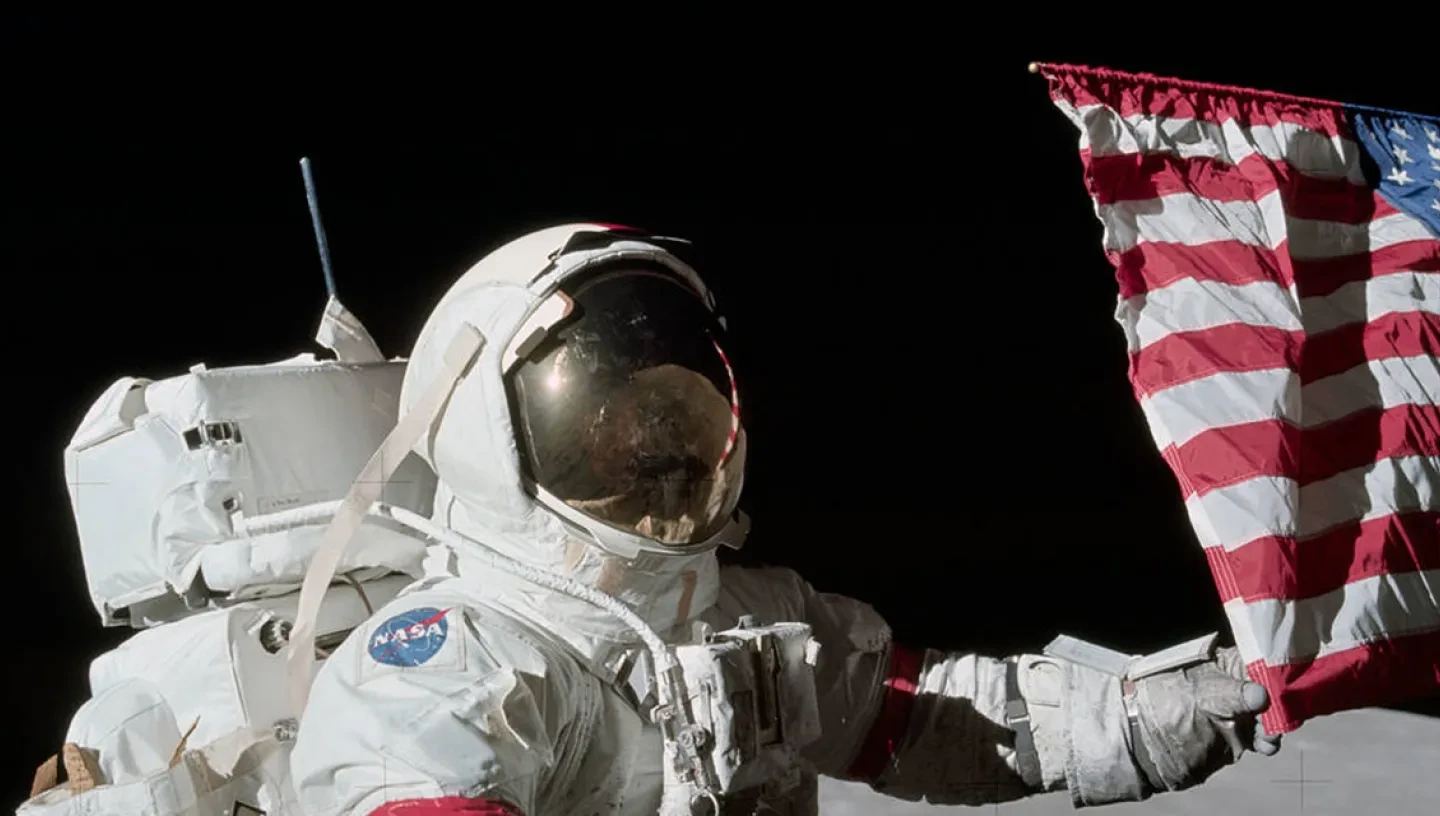
Then came Apollo 13.
Although Duke wasn’t aboard the spacecraft, he had trained for the mission and understood exactly how quickly things could go wrong. When an oxygen tank exploded on the journey to the Moon, the crew found themselves trapped in a dying spacecraft with failing systems, freezing temperatures, and dwindling supplies.
Against all odds, they survived.
But the lesson was clear.
Space wasn’t an adventure.
Space was a constant fight for survival.
By the time Apollo 16 launched in April 1972, Charles Duke already understood that every mission balanced on the edge of catastrophe.
Apollo 16 was supposed to be routine.
Commander John Young, Command Module Pilot Ken Mattingly, and Lunar Module Pilot Charles Duke were assigned one of the most scientifically ambitious missions in the Apollo program.
Their destination was the Descartes Highlands, a rugged region believed to contain some of the Moon’s oldest geological formations.
Scientists hoped the mission would unlock secrets dating back billions of years, revealing clues about the formation of the Moon and even the early history of Earth itself.
Everything about the mission appeared carefully planned.
The astronauts would deploy scientific instruments, collect lunar samples, study moonquakes, measure solar radiation, and drive the Lunar Rover farther than any crew before them.
Nothing unusual was expected.
And for a while, everything went exactly according to plan.
Apollo 16 landed successfully on April 21, 1972.
Over the next three days, Duke and Young spent more than twenty hours exploring the lunar surface. They drove over sixteen miles across the Highlands and collected more than 200 pounds of rocks and soil.
Mission Control monitored every movement.
Every heartbeat.
Every oxygen reading.
Every word.
Apollo 16 quickly became one of the smoothest and most successful missions NASA had ever conducted.
There were no emergencies.
No equipment failures.
No life-threatening crises.
Yet somewhere in the middle of that mission, Duke noticed something that didn’t make sense.
Something that would stay with him long after he returned to Earth.
The Moon has no atmosphere.
No clouds.
No wind.
No haze.
Nothing exists to scatter sunlight.
As a result, lunar lighting behaves in an extremely predictable way. Sunlit areas are brilliantly bright, while shadows become pitch black. Colors are muted. The landscape appears almost entirely gray.
Astronauts trained extensively for these conditions.
They knew exactly what to expect.
But while exploring a region known as the Cayley Plains, Duke began noticing subtle colors appearing across the landscape.
Soft blues.
Faint greens.
Hints of color that seemed impossible in an environment where no atmosphere existed to create them.
At first, he dismissed it.
Perhaps it was exhaustion.
Perhaps sunlight reflecting inside his visor.
Perhaps his eyes were playing tricks on him after hours under intense solar glare.
But the phenomenon continued.
The colors appeared again and again across the distant terrain.
Not vivid.
Not dramatic.
Just enough to feel wrong.
Enough to create a lingering sense that something about the environment wasn’t behaving exactly as expected.
Years later, stories began circulating about the psychological impact the Moon had on astronauts.
Some struggled to describe what they felt.
Others returned home deeply changed.
Charles Duke himself later admitted that achieving one of humanity’s greatest accomplishments did not bring the fulfillment he expected.
Instead, he experienced a profound sense of emptiness.
Imagine spending your entire life chasing the impossible.
Imagine reaching another world.
And then discovering that the journey hadn’t answered the questions you carried inside.
For Duke, the greatest challenge wasn’t surviving the Moon.
It was understanding what the experience meant afterward.
This is where many conspiracy theories begin.
Some claim astronauts witnessed things they were ordered never to discuss.
Others insist there are secrets hidden within NASA archives.
But Duke’s own reflections point toward something far less sensational—and perhaps far more powerful.
The Moon is not a place humanity abandoned because of aliens, hidden structures, or mysterious forces.
We stopped going because it is extraordinarily difficult.
Every lunar mission pushed technology, engineering, and human endurance to their limits.
Radiation exposure remained a constant threat.
Lunar dust damaged equipment and posed serious health concerns.
Communication delays complicated decision-making.
And every launch carried the possibility of disaster.
Apollo succeeded during a unique moment in history when geopolitical competition justified enormous risks and enormous costs.
Once that moment passed, the willingness to accept those risks faded as well.
The truth Charles Duke eventually came to understand wasn’t that the Moon was hiding secrets.
The truth was that reaching it had always been far more dangerous than the public realized.
Yet despite the risks, one memory never left him.
Looking back at Earth.
From the Moon, national borders disappear.

Politics disappears.
Conflict disappears.
What remains is a fragile blue sphere floating alone in an endless sea of darkness.
Every person who has ever lived.
Every war.
Every dream.
Every triumph.
Every heartbreak.
All of it exists on that distant world hanging silently in space.
Perhaps that is the real reason Apollo astronauts seemed different when they returned.
They had seen humanity from the outside.
And once you’ve stood on another world and looked back at Earth, you can never see home the same way again.
Maybe that was the secret Charles Duke carried for fifty years.
Not a hidden conspiracy.
Not an unsolved mystery.
But a realization so profound that words could never fully capture it.
The Moon didn’t change humanity.
It changed the people who went there.
And perhaps that’s why their stories still fascinate us today.