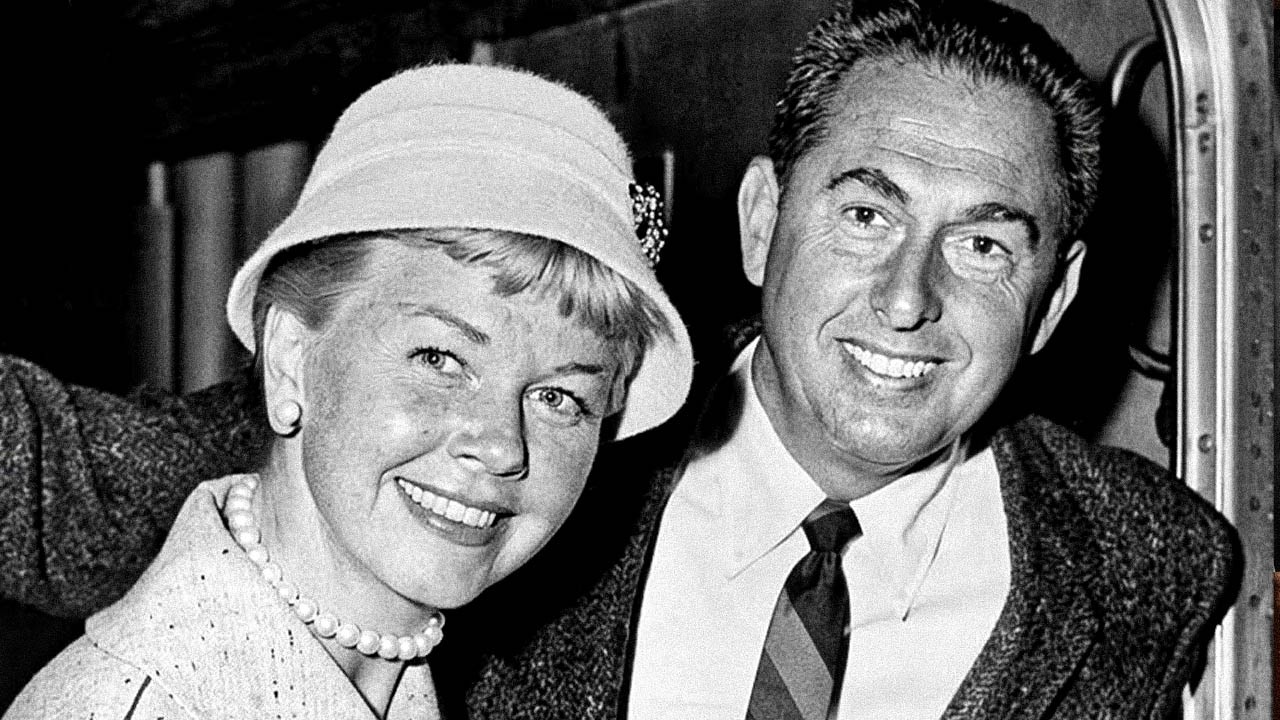
The smile that lit up television screens across America in September 1968 was one of the most recognizable in the world, yet it masked a reality so devastating that its full scope would not be understood for years.
Doris Day, the girl next door who had charmed audiences for two decades, stepped onto a CBS sound stage to begin filming a television series bearing her name, projecting the warmth and resilience that had made her a global icon. But behind that beaming facade lay a financial catastrophe of staggering proportions, a secret so well-guarded that even the star herself had only just discovered its true extent.
 Five months earlier, her husband of seventeen years, Marty Melcher, had died at the age of 52. In the weeks that followed his passing, Day learned that the estimated $20 million fortune she believed she had accumulated through one of Hollywood’s most successful careers was gone, replaced by a mountain of debt totaling roughly half a million dollars.
The discovery was not merely a financial shock; it was a profound betrayal that unraveled the very fabric of her professional and personal life. Melcher, who served as her manager, her producer, and her husband, had held her power of attorney for years, a legal authority that allowed him to sign documents and make decisions without her knowledge or consent.
Among the documents he had signed was a contract committing her to star in a weekly television series for CBS, an agreement she had never seen, never negotiated, and never agreed to make. She was bound by law to honor a commitment she had no knowledge of, forced to walk onto a sound stage and perform while grappling with the twin devastations of grief and financial ruin.
The public saw a beloved star bravely returning to work, a picture of resilience in the face of loss. In reality, Day was a woman navigating the largest crisis of her life, carrying the weight of a secret she and her son, Terry, had decided to keep private to protect her negotiating position in the legal battles that were sure to follow.
This was not the first time Day’s life had been shaped by the decisions of others, nor would it be the last. Born Doris Mary Ann Kappelhoff on April 3rd, 1922, in Cincinnati, Ohio, her path to stardom was paved with both ambition and tragedy. As a child, she trained as a dancer, dreaming of a career on stage until a devastating car accident in October 1937 shattered her leg and ended those aspirations forever.
Recovering in a body cast, she discovered her voice, singing along to the radio to fill the long hours of her interrupted childhood. This accidental discovery would become her lifeline, leading her to front big bands and eventually catch the attention of bandleader Les Brown, with whom she toured the country as a vocalist.
It was during this period that Doris Kappelhoff became Doris Day, a stage name chosen for her as she began her ascent in the entertainment world. Her personal life, however, was marked by instability and hardship from the start. In 1941, she married trombonist Al Jordan, a union she would later describe as violent and abusive, which ended in divorce in 1943, leaving her a young single mother supporting her son, Terry, on a band singer’s income.
Her second marriage, to saxophonist George Weidler, lasted from 1946 to 1949 and introduced her to Christian Science, a faith that would profoundly shape her life and, tragically, the circumstances of her husband’s death. It was through this faith that Melcher, a devoted practitioner, would delay seeking conventional medical treatment for an enlarged heart, a decision that Day believed contributed to his premature death.
Day’s career continued its meteoric rise throughout this period. In 1948, she was cast in “Romance on the High Seas” almost by accident, after another actress dropped out. The film made her an overnight movie star, and she quickly became one of the most talked-about new faces in Hollywood, a Warner Bros.
contract player on the fast track to superstardom.
By the end of the 1940s, she was one of the most in-demand performers in American entertainment, a young woman supporting a child essentially on her own while her career climbed faster than almost anyone could have predicted. Yet, a pattern had already established itself: nearly every major turn in her life, professional or personal, arrived through a man who held some form of authority over its terms.
This pattern would reach its full, destructive culmination with Martin Melcher. Born August 1st, 1915, Melcher was a talent agent with Century Artists, the firm that represented Day. Their professional relationship blossomed into romance, and on April 3rd, 1951, her 29th birthday, they were married.
The wedding did not simply add a husband to her life; it restructured the entire architecture of her career. Melcher formally adopted her son, Terry, and became her personal manager, her producer, and eventually the sole gatekeeper of her professional and financial life. He formed Arwin Productions with her, a company that would produce many of her film and television projects, weaving their names together in a business entanglement that left no room for independent oversight.
Where another star might have had an agent, a business manager, and a spouse occupying three separate roles, each answerable to outside scrutiny, Day increasingly had one man occupying all three at once. There was no outside party positioned to check his decisions against her interests. This arrangement, which looked like a convenient partnership on the surface, was a powder keg waiting to explode.
 Under this new arrangement, Day’s career did not slow; it accelerated. In 1953, she starred in “Calamity Jane,” and a year later in “Young at Heart,” cementing her position as one of the era’s most bankable stars. In 1956, she worked with Alfred Hitchcock on “The Man Who Knew Too Much,” and in 1959, she starred in “Pillow Talk” opposite Rock Hudson, a romantic comedy that became one of the defining hits of her filmography and earned her an Academy Award nomination.
The success continued into the new decade with hits like “Please Don’t Eat the Daisies,” “Lover Come Back,” and “That Touch of Mink” opposite Cary Grant. By this point, Day was not simply a popular actress; she was regularly ranked among the very top box office draws in the entire industry, a position she held for years at a scale few of her contemporaries could match.
It is crucial to pause on the size of this success because it is easy, looking backward from what would eventually be revealed about her finances, to imagine her career must have been modest. Neither was true. She was one of the biggest stars in the world at a moment when Hollywood’s box office numbers were staggering, and the earnings tied to her films and recordings were substantial by any measure.
That scale matters because it is precisely what made the eventual discovery of her financial situation so devastating to absorb. The bigger the earnings, the more there was to manage, to move, to invest, and eventually to lose. Behind this run of hits, the apparatus managing that money was also expanding, and a new name entered the story: Jerome B.
Rosenthal.
Rosenthal, an attorney, came to represent both Doris Day and Marty Melcher, and through that dual representation, he became deeply involved in decisions concerning their earnings. He did not simply advise on contracts; over time, he took on a far broader role in managing where the couple’s money went, positioning himself at the center of decisions that reached well beyond ordinary legal representation and into the territory of financial management.
Under Rosenthal’s guidance, Day and Melcher’s money was channeled into an increasingly complicated web of business ventures, including investments in oil, hotel properties, and cattle operations. These were ventures with little connection to the entertainment industry that had generated the money in the first place, and they were, as the courts would later find, riddled with conflicts of interest and amateurishly structured.
The same lawyer represented both husband and wife. The same manager negotiated both her contracts and the decisions about where her money went. No independent check existed anywhere inside that system.
For the better part of two decades, this arrangement was entirely hidden from her fans and largely hidden from her as well.
One incident from this period illustrates how completely her husband had come to control decisions made in her name. In the mid-1960s, the producer behind a film adaptation of a novel called “The Graduate” sent a copy of the book to Melcher, hoping to interest Day in the role that would become Mrs. Robinson.
According to Day’s own later account, Melcher found the material offensive and never passed the book along to her at all. The role went instead to Anne Bancroft, and the film, released in 1967, became one of the defining pictures of its era. Day would later say she never had the chance to accept or decline the part because she was never told it existed.
It was turned down for her, quietly, by a husband who decided on her behalf that the material was unsuitable without ever putting the choice in front of her. It stands as one small, specific example of a much larger condition inside her marriage: decisions shaping her career, including decisions with real consequences for how her later work would be remembered, were being made in her name without her knowledge or consent.
Through these same years, Melcher’s health was quietly declining. Both he and Day were devoted Christian Scientists, a faith that led him to delay seeking conventional medical treatment as his condition worsened. Day later wrote that his physician eventually told her Melcher had been suffering from an enlarged heart, a condition whose severity he had allowed to progress without earlier intervention.
 On April 20th, 1968, Marty Melcher died. He was 52 years old. What followed in the days and weeks after his death was not simply grief; it was a slow and devastating discovery.
Her son Terry was the one who eventually told her the truth about her finances: the money she believed she had earned across a 20-year film career was gone, replaced by debt.
It was, by her own telling, an almost incomprehensible reversal to absorb in the same season she was burying her husband. Learning within weeks that the two decades of work behind her name had left her not wealthy, but owing money she did not have. Melcher had held her power of attorney for years, and using that authority, he had signed her to star in a new weekly television series for CBS.
She learned that she was contractually obligated to appear in a network television show she had never read, never negotiated, and never agreed to make, at the exact moment she was also learning that the fortune she assumed was supporting her had already disappeared. Rather than fight the contract or attempt to escape it, she honored it.
Production was set to begin within roughly six weeks of Melcher’s death, an impossibly short window for anyone absorbing the loss of a spouse, let alone someone who had just learned the full extent of her own financial exposure. She reported to work anyway. This is the moment the story returns to where it began, on that sound stage in September 1968.
The smile the country saw was real in the sense that it belonged to her, and the professionalism behind it was real, too. But it existed alongside a set of facts the audience knew nothing about: a power of attorney that had been used to bind her to a contract she never saw, a financial catastrophe she had only just discovered, and a legal reckoning that had not yet even begun.
It did not take long for the legal reckoning to arrive. In 1968, Jerome Rosenthal sued Doris Day, asserting a claim to an interest in the business empire built around the Day and Melcher partnership. Day answered with a cross-complaint of her own, turning the lawsuit into an examination not of what she owed Rosenthal, but of what Rosenthal and the arrangement he had helped construct had actually cost her.
The case did not move quickly. It would be nearly six years before it reached trial, and once it did, the proceedings became a marathon in their own right. The trial began on March 4th, 1974, in a Los Angeles courtroom presided over by Judge Lester E.
Olson, sitting without a jury. For 99 trial days spanning nearly six months, the court heard testimony and reviewed records concerning the business dealings that had consumed Day’s earnings for more than a decade.
On September 18th, 1974, Judge Olson issued an oral decision, finding fraud and malpractice on Rosenthal’s part and awarding Doris Day $22,835,646, a judgment that stood at the time as one of the largest malpractice verdicts ever rendered against an individual attorney. The written judgment followed on March 31st, 1975, formalizing an award of $26,396,511, which included $1 million in punitive damages.
The court’s findings addressed the very conflicts of interest that had shaped the Day and Melcher business affairs for years: the dual representation of husband and wife by the same attorney, the undisclosed benefits Rosenthal had received from ventures he steered them toward, and the prolonged absence of independent advice protecting Day’s interests specifically.
Rosenthal did not simply pay the judgment. He filed for bankruptcy in its wake, a move that meant the enormous figure the court had awarded would not translate directly into an equivalent payment. The practical recovery Day ultimately received came through a settlement reached with insurers in August 1977, amounting to $6 million, a fraction of the judgment itself, paid out over a period stretching across 23 years.
Rosenthal appealed the underlying judgment, and the case wound its way through the California court system for another decade before the court of appeal affirmed the ruling on August 8th, 1985, 17 years after Melcher’s death had first set the discovery of the financial situation in motion. The distance between the judgment and its eventual partial payment says as much about the case as the verdict itself.
 Winning in court did not mean an immediate or complete restoration of what had been lost. It meant a legal record finally of what had happened, and a long slow process of collecting whatever could still be recovered from a man who no longer had it to give. The scale of the verdict mattered, but so did what it represented.
For years, one of the largest and most successful careers in American entertainment had been managed through an arrangement with no independent oversight built into it at all. The court’s ruling did not simply return money to Doris Day; it formally confirmed, through the machinery of the legal system, that the arrangement she had lived inside for the better part of two decades had failed to protect her in exactly the ways such an arrangement was supposed to.
Day did not wait for the appellate process to finish before she began telling her own version of events. In 1975, while the legal case was still working its way toward its written judgment, she published her autobiography, “Doris Day: Her Own Story,” written with A. E.
Hotchner. The book gave her the chance to describe, in her own words, what the marriage had actually felt like from the inside.
For the first time in more than two decades, the account of Doris Day’s life reaching the public was one she had authored herself, rather than one shaped by a husband, a manager, or a producer standing between her and her own story. Her life after the courtroom and the book continued to move forward. From 1976 to 1981, she was married to restaurateur Barry Comden, her fourth and final marriage.
In the years that followed, she gradually stepped back from Hollywood altogether, relocating to Carmel, California, a small coastal town that offered a different rhythm of life. There she devoted much of the rest of her life to animal welfare, founding organizations dedicated to the humane treatment of animals, and becoming one of the industry’s most visible and persistent advocates for the cause.
She largely withdrew from public life as an actress, choosing instead to be known in her later decades for the causes she championed, rather than the pictures she had once starred in. She lived a long life after the events that once threatened to define her, and she died on May 13th, 2019, in Carmel Valley at the age of 97, having outlived the husband whose decisions had once put her finances at risk by more than 50 years.
Return one final time to September 1968. On that CBS sound stage, a woman the country believed was simply picking up her career again stood in front of the cameras five months after burying her husband and only weeks after discovering what his management of her finances had actually cost her. She did not know that month how the lawsuit would resolve, or how long it would take, or what a courtroom eight years later would eventually find.
She knew only that a contract existed bearing her name that she had not agreed to in the way audiences assumed, and that she intended to honor it anyway. She went on to complete five seasons of “The Doris Day Show.” She fought a legal battle that outlasted the series itself by more than a decade, and won.
She wrote a book that let her describe her own life in her own words, closing out decades in which other people had so often spoken for her instead.
She eventually left the industry that made her famous and built a quieter life around the causes she cared about, a life that lasted another four decades beyond the year that nearly broke her finances in half. None of it unfolded the way a simpler story might suggest. There was no single moment of rescue, no outside figure who arrived to set things right on her behalf, no dramatic reversal compressed into a single afternoon.
The recovery came slowly, through years of litigation stretched across the better part of a decade, through a cross-complaint she chose to file rather than simply defend against, through 99 days of trial testimony, and through a decision made while the case was still unresolved to sit down with a writer and describe plainly and at length what the previous two decades had actually been like. Each of those choices belonged to her.
Each one moved the story forward in a way that no one else’s decisions had for years beforehand, and each one stands in direct contrast to the years in which contracts were signed, roles were declined, and money was moved, all without her knowledge or her consent. The image that opened this story, the smiling star returning to television as though nothing unusual had happened, was never false. It was simply incomplete.
Marty Melcher had signed her name to a contract she never saw, to business ventures she never chose, and to a version of her own life that had been shaped for years by someone else’s judgment. Years later, Doris Day sat down and wrote her own story in her own words under her own name and let a courtroom establish in exacting detail exactly what had gone wrong before that.
The woman audiences once assumed needed looking after, the sunny presence who seemed almost too gentle for the harder edges of the business she worked in, turned out to be the same woman who cross-complained against a powerful attorney, sat through 99 days of trial, and later put her own account of the marriage into print for anyone to read. That, in the end, is the difference between the two of them, and it is the note her story actually ends on. Not as a woman who needed protecting, but as a woman who eventually took hold of the record herself.