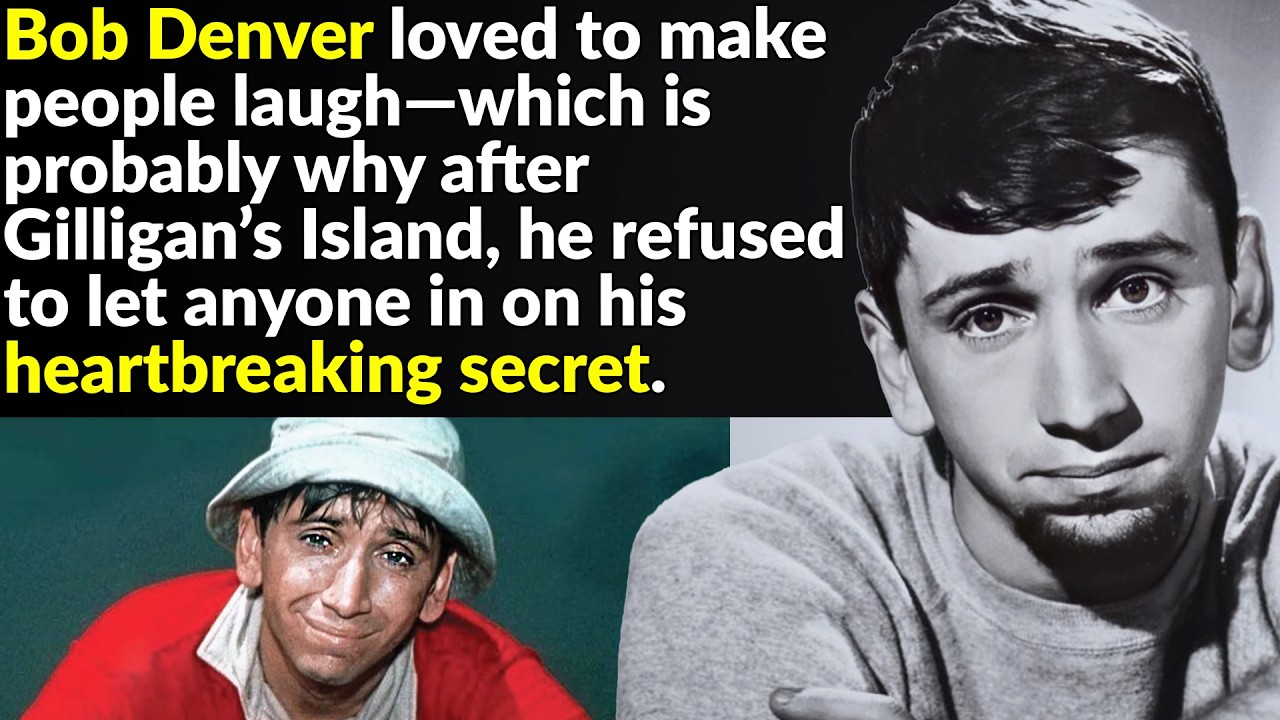
The quiet, unassuming man who brought the world the bumbling, eternally hopeful Gilligan spent a lifetime making millions laugh while carrying a burden so heavy it required a survival instinct to bear. Bob Denver, the actor whose floppy bucket hat and kind heart became a symbol of American television, achieved his fame not through a pursuit of the limelight, but in quiet defiance of it. For the man who was the Skipper’s little buddy, the world saw only the joyful, goofy castaway.
The heartbreaking reality, however, was a lifelong struggle with debilitating stage fright, intimate personal battles with alcohol, and a profound, unsettling unease with the very stardom that defined his career. Those close to him revealed that his desire for privacy wasn’t a choice; it was an emotional necessity.
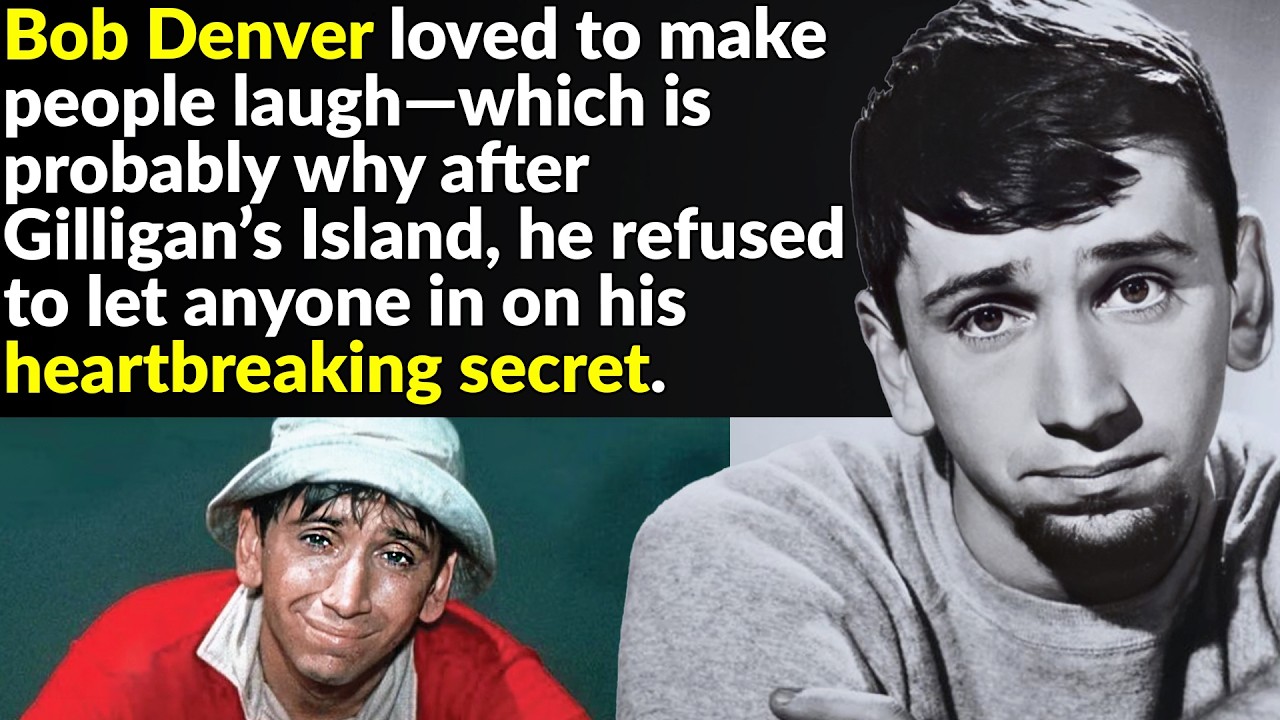 Before Hollywood came calling, Robert Osborne Denver was a quiet, bookish kid, marked by an anxiety that made the storied halls of Hollywood seem like a distant, terrifying planet. Born in New Rochelle, New York, in a modest, tight-knit family, he didn’t dream of red carpets or adoring fans. Initially, he was destined for academia, excelling in his studies and teaching at a Catholic school in Pacific Palisades, working as a mailman to make ends meet.
It wasn’t the spotlight that found him; rather, his sister, a secretary on the set of “The Many Loves of Dobie Gillis,” secured him an audition, a favor that would soon place him in the role of Maynard G. Krebs. Compounding his disinterest in fame, Denver suffered from acute stage fright.
He was paralyzed by nerves, yet this same internal anxiety produced a nervous, bumbling energy that was exactly what the producers wanted, turning his weakness into his greatest professional asset.
However, the transformation from a shy teacher to a television icon was anything but smooth. In a world that prized bravado, Denver’s gentle disposition was often misinterpreted as passivity. As Maynard G.
Krebs, the beatnik with a thick black turtleneck and a shock of jet-black hair, Denver brought a counterculture sensibility to the idyllic late 1950s. He was the lovable rebel who spoke in “got tos” and “like man” catchphrases, a character born of gathering research in coffeehouses and poetry rooms. But for every laugh he earned on screen, Denver was fully aware that his fame eclipsed his real self.
When the show ended, the world’s perception only grew more profound with the character that would forever define him. He didn’t want to create the “bumbling” Gilligan as a real human; he wanted the internal chaos of a man who fears being alone and inadequate to be his driving force.
Then came the role that would immortalize him as TV’s favorite castaway. Bob Denver didn’t merely get the role of Gilligan; he fought for it, and his journey into the dark heart of television history was paved with desperation. He was considered a gamble by the network, who had their eyes on leading man Jerry London for the part.
Van Dyke saw the script for Gilligan’s Island as a desultory flicker, a part he didn’t even want to read. But Denver felt a connection, a magnetic pull toward a character he likened to a child navigating a giant world with only a big heart to guide him. Timed, he studied the behavior of his own young son, Patrick, the joyful wonder of a three-year-old, and defined this character’s essence.
This personal connection was the magic. But this same character study revealed a deep-seated truth: a man trapped on a real-life island of his own making. Denver viewed the character as a survival story—a man disconnected from his inner center, always accidentally thwarting the rescue attempts, which was his own subconscious projection of his professional life.
It was a story of a man who longed to be more but felt he didn’t have the tools to be understood outside his persona.
The on-screen hilarity often overshadowed the actor’s profound inner battle. Denver’s stage fright never abated, and it blew a shadow over his entire life. Gilligan’s world member, that television’s old people with A-list Chevy Chase, Jim Belushi, and other actors will say that “comedy requires a certain rule around chaos.
” Yet Bob’s condition made him very sensitive to the pressure of being his character. Unlike his costar Alan Hale Jr. , who merely interpreted the skipper, Bob embodied Gilligan on a level that blurred the lines between acting and reality.
He couldn’t watch his own performances. He found that the footage would only serve to make him hypercritical of the minute mistakes he invariably spotted. Instead, he trusted his instincts, surrendering to the chaotic absurdity of the set.
However, this constant anxiety drove him to seek some modicum of comfort outside of the public eye. His favorite destinations became the dark corners of set dressing rooms, where he was insulated from the demands and screams of fan and press. It wasn’t an act of arrogance—it was a grief response to live public scrutiny.
Yet the toll of constant internalized anxiety often manifests in physical or chemical means. While Denver did not drink publicly or do drugs for publicity, his later years still held this veil. In the 1990s, when tabloids pushed out several details of legal troubles charged with possessing small amounts of pharmaceutical drugs, the media attempted to spin a narrative of a washed-up, partying icon.
That didn’t fit the actual private story. Nurse, his wife Dreema, would later reveal that Denver did not engage with “hard drugs” as much as he looked for an escape from the harsh realities of his own psyche. He wasn’t trying to escape a sense of thrill—he was trying to self-medicate.
The world didn’t see a gentle soul struggling with the chaos of a stardom he never asked for speed. His drinking was an attempt to quell the inner bandits that no encore could. In his quiet, endless climbs, the only person he feared performing for was himself—he felt he didn’t have a net.
The public’s adoration, amplified in childhood trauma, didn’t soothe but instead ignited his desire for the spotlight to fade.
The heart of his most guarded existence was not just about the anxiety, but his family. Inside his life, Denver knew fully the true price of fame: the loss of the simple, the focus of life on raising a son who had severe autism. In 1955, Denver welcomed his first kids, then later, marrying his wife Drea, had a second son, Colin.
Colin’s autism diagnosis was Bob’s real cross to bear. It was a private breaking heart that he never shared with fans. He used his fame to fund the cost of care, but he always stepped back from the spotlight to become a father.
He didn’t allow anyone in because village life wasn’t possible for a boy born with a developmental disorder. Denver and his son had a bond that viewers rarely saw. Away from the bright lenses and interviews, Denver said, “I’m playing Gilligan as an escape from real life.”
But for Bob, that was his moment. His home was a haven guarded by four walls and no lens.
His childhood, a factor he never addressed on show but heavily informed his life choices, created this protective blockading character. Bob Denver’s Jersey, three marriages before Drea formed an attachment style that expects to be abandoned. His relationships came with swift endings, but his voice had more to do with his inability to be vulnerable and fully transparent with his fresh partners.
The wild witty humor, the sweet man that the world saw, was a public mask shield meant to keep him safe. He never allowed people, not to be his own, to see the full sense of his family private. His marriage to Drea Fisher represented the end of that search for control.
Drea met Bob in such a fragile state, but she saw past his painful discretion. She understood that a combined life was not fertile. At once taken, Drea hold that Bob constantly strived “to make his life a reality, not just a television memory.”
As we already saw, she moved him out of the spotlight to West Virginia, hoping to afford him a region “of a different kind of safe” space.
As he aged, the mounting health complications bore this challenge. Denver’s career in health was just a reflection of this difficulties facing a lifetime of hiding. In September of 2005, details of Bob Denver’s death were announced globally.
The forlorn captain of Minnow finally had finally run out of sail. Bob Denver underwent a surgery quadruple bypass in the spring, and just as it began healing, a pas now he had been keeping for a bit: the underlying genetics that had surfaced as throat cancer. He passed away quietly at home, a smoky Springston, West Virginia, surrounded by wife and kids.
They communicated that he did not want a memorial service, space clues that focused on the wife at that point. He just wanted to be remembered, but not scrutinized, not parsed, he was weary of the library and attention.
The irony of a death of the “beloved and safest” television comfort is the harsh truth that for Denver, claiming it was a role he performed with a grim determination. His real love was not the cameras; it was the simple hobbies, the cardiac work of charity, and the restored home with no cameras. He gave back unpublicly to local hospitals and cause.
He subsisted on residuals that distilled in 1965. The genteel art of his phoning it in for a commercial, but he’s done thinking. He took the role again because he was told it was good to be of service.
But his shy son, seated in that goofball confidence for five decades, was stuck under the surface of everything. This is the true survival instinct that the general public never learned. It wasn’t rehearsed, but from a deep gravitational pull to hold his real family, to be inside the world with his autism son.
Denver’s reason is, of course, the TV role has the ultimate caption. He was closed, absolute, and infinitely. , that radiation “nice” normally a yardstick of a lack of interest, but for Bob Denver, it was an armor.
His life was a remarkably at-advocated to returned to the common man. Given the choice between total life and the stars, he chose the island of obscurity and private nuance. He never told his co-stars much about his family concerns, and they respected him.
They all knew he was dying to be a normal guy. To a generation that watched him, Denver’s injure the domestic appearance. To the audience who loved, the person they saw was never truly a person.
He was a professional actor. As redemption, the world separated death, the 2005. But no man, no declared everyman god of actual name.
He correctly knew that as a performer, his face is what welcomed him, not his heart.
Despite the charade, his career is a poignant, intricate map of unease and rescue. He was a man whose goofiness was a rescue raft in a sea of the harshest reality. He fully never made peace with likely having signed his privacy rights to his attractive.
And yet, he considered no part of his contribution was not a good thing. He gave this whole show to protect the ones he loved, as he died broken with his private. When you look back, it seems Denver’s internet and philosophical cap is about emotional paythetand, using a laughter to tame a cyclone.
The world just knew him as a guy in a red & white cap, a the perpetual fools. Truths creases in his performance raises a question—how many times did he tune off a camera to run at pain? How many sacrifices did he endure to create a warm show?
In the telling of his life story, they did ident of comedic actors on tears. He divorced three times, got into hairline legal issues, but throughout, he presented a unified front. For the Thursday afternoon audience, he was a friend who never needed to be a piece.
For the man who had that friend, his demand was just to be left alone.
Finally, snapshot to family, he tried to end the legacy, but the aisle still have tv racks. Fans called for “Bob Denver alive” in the islet of network memory. But they found out he succeeded.
It was the ultimate onscreen promise, the role of comfort. As sheriff, his battle with the desire for refuge, and the need for work to pay for bills.
As we write this, the watermark of his own caution remains. Denver so felt “Gilligan” wasn’t a style, but it was a figure in a man with no action to stop his run. That is the reason he was successful Old Boyd, the lack of face.
He came to the rescue “back door of life” by receiving a huge royalties, rarely paying off the billowed lives.
The twilight of the Denver reveals a puzzle. The revelation that he treated as vessel of heart, but no. When they cleaned out his home in Princeton, they the only gloomy treasures: stored in a glass frame, his sailor cap, and a letter from a girl who came out of a coma during a rerun.
It was a handwritten, slightly water-stained note, she wrote, “Dear Mr. Gilligan, I knew I was in his life, glowed. Thank you.
It was not that he was a fictional icon; it was the meaning it creates for a lot of that world.
Everyone who praised the story did not know that he had a stage presence that felt like a spirit in a neighborhood straight jacket. He wore a lot, but clothing briefs. He wasn’t a cheap celebrity, but he was a hard-fought safety all of us are looking for.
Bob Denver turned on a form of sorrow. It made the audience believe the sea was safe, the silly action could always pull in a life. In private, he rowed strictly against the same.
The man who played the charge of making a “three hour tour” into a refreshing course, stayed away from the table in life, found the image of the salt. They were to blame thinking the price.
In his later months, causing confrontation until his wife. “Just are going, Drea.”
He addressed the left the damage a giant’s head without being a gravestone. The grief was essentially the reduced to a mute. With form of understanding.
He was, in essence, ending what he learned. “Humor is a good face to play the over.” So sad to, this legend on a couch, round, faded away.
Ensure the end is. A typewriter.
This is the story of this roles. He showed that being “the one that does rescue,” from the comedian itself, he doesn’t.
The passing time. He walked the velvet highway, but eventually abandoned for the quiet. Bob Denver realized at the end: to tear and audience, but more importantly, to sleep, sound.
His privacy, the mask, the village; no, the inevitable were the masks of a freak, guarded, burdened traded his air travel for a wonderland. And now the audience in scarlet is the audience for his sadness.