My daughter-in-law posted a picture of me asleep on her couch. Underneath it, she wrote, “She’s best at one thing, showing up and letting everyone else handle the rest. ” I stared at those words for a long time. There were already laughing emojis underneath.
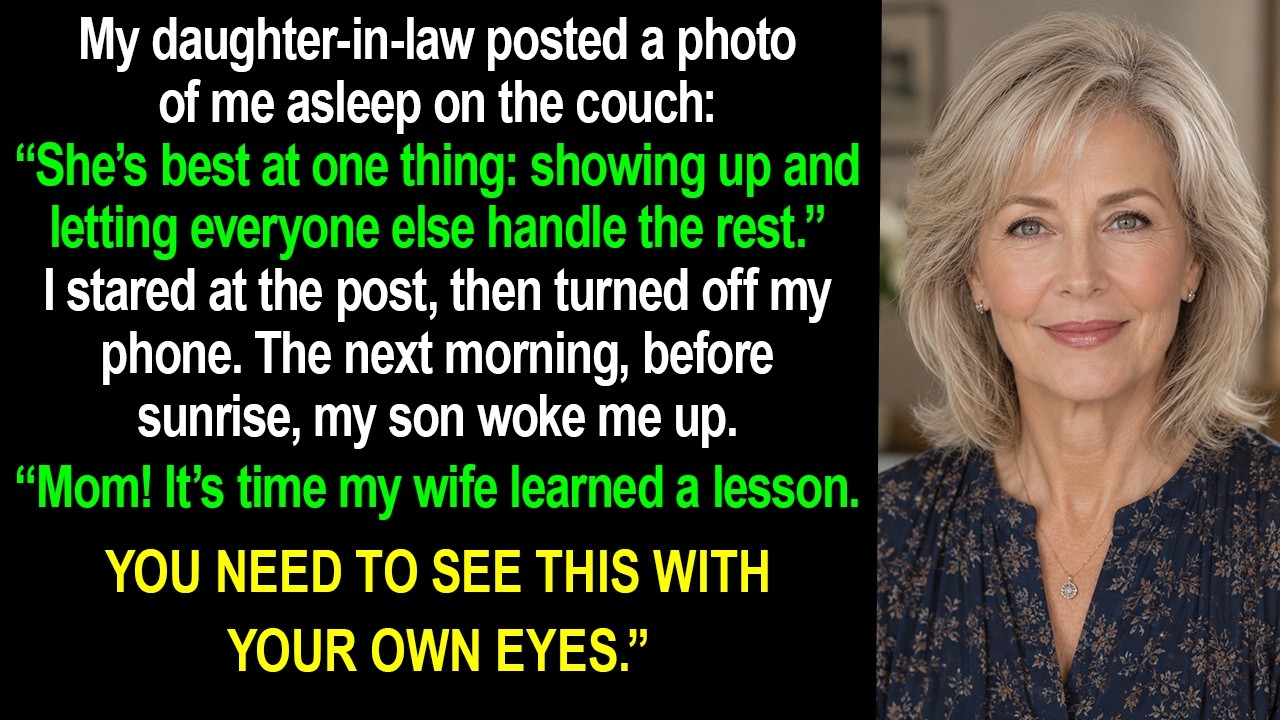
One of Melissa’s friends had written, “Must be nice. ” Another had added, “I need her job. ” I didn’t defend myself. I didn’t call my son.
I didn’t even ask Melissa to take it down. I simply turned off my phone. The next morning at 5:08, my son shook me awake. “Mom, get up.
” I opened my eyes. Mark was standing beside the guest bed, already dressed for work, but something about his face made me sit up immediately. “What happened? ” He lowered his voice.
“You need to see this. ”
Downstairs, he led me into the kitchen. A sheet of paper sat on the island beside Melissa’s purse. My name was written all over it: Diane school pickup, Diane Ben soccer, Diane Lily birthday party, Diane dog medication, Diane Saturday night.
Beside the schedule was Melissa’s packed overnight bag. Then Mark held up his phone. His wife had posted something else the night before: “Finally taking a weekend for myself after doing everything for everyone. ”
For several seconds, neither of us spoke.
Then Mark looked at me and said, “Don’t do any of it. ” But that wasn’t the thing that stopped me cold. That came a few minutes later when Mark picked up an envelope buried beneath the schedule. He opened it.
Then he looked at me. “Mom, why is Ben’s after school program charging your card? ” Melissa had just walked into the kitchen, and suddenly nobody was talking about the photograph anymore. My name is Diane Lawson.
I was 65 years old when this happened. And until that morning, I would have told you I had a good relationship with my son’s family. Not perfect, but good. My husband Paul had been gone four years.
After 38 years of marriage, you don’t simply get used to an empty house because enough calendars have come off the wall. Helping Mark’s family had given some shape to my weeks. And I loved my grandchildren. That was the simplest truth in all of this.
The day Melissa took that picture had started before 7. She’d called the evening before because Ben’s school schedule had changed and she had patients booked at the dental office. “Could you come a little early tomorrow? ” Of course, I said.
That answer had become automatic. By 7:30, I’d made Ben scrambled eggs, found the sweatshirt he insisted was missing, even though it was under his backpack, and driven Lily to school. Ben had a dentist appointment at 10:00. Afterward, Melissa texted me a grocery list.
“Since you’re already out. ” Four words. I’d seen them hundreds of times. I picked up the groceries, brought Ben home, collected Lily after school, and started a pot of chili because Mark had mentioned the night before that he’d be home late.
Around 2:40, the house finally became quiet. I sat on the couch. I remember thinking I would close my eyes for five minutes. When I woke, Melissa was home.
She was standing in the kitchen scrolling through her phone. “Sorry,” I said, sitting up. “I guess I nodded off. ” She barely looked at me.
“You’re fine. ” That was it. I didn’t know she had taken my picture. I found out 40 minutes later when my sister Carol texted me, “Diane, did Melissa mean to post this?
” I opened Facebook. There I was, head against the cushion, mouth slightly open, one shoe half off. It wasn’t flattering, but the photograph itself wasn’t what hurt. It was the caption.
Melissa had taken 30 quiet minutes and turned them into evidence against my character. I read the comments. People who didn’t know what I had done that morning were laughing as though they did. Then I noticed Melissa had replied to one of them: “Right.
Meanwhile, the rest of us are exhausted. ” That one hurt most because Melissa knew. She knew where I had been all day. I could have answered publicly.
I could have listed every errand. But at 65, I had learned something about defending yourself in front of people who have already decided a joke is more entertaining than the truth. Sometimes you only make yourself look more desperate. So I turned off my phone.
That evening, Mark came home after 8. He kissed my cheek and thanked me for the chili. “You’re a lifesaver, Mom. ” Melissa was standing three feet away.
She said nothing. Mark clearly hadn’t seen the post. I almost told him. Then I stopped myself.
I wanted to see if Melissa would. She didn’t. I stayed overnight because Melissa had already told me she needed help again in the morning. That fact seems ridiculous now, but habits don’t suddenly feel wrong just because someone has hurt you.
Sometimes you keep performing them because you haven’t figured out who you are without them. Then came 5:08 the next morning. The schedule, the overnight bag, the second post. Mark stood at the kitchen island reading everything twice.
“Did she ask you to do all this? Some of it? ” I looked at the paper. “I didn’t know about Saturday night.
” Mark rubbed his forehead. Melissa was apparently leaving for a girl’s weekend after breakfast. He looked embarrassed. “Mom, go home.
” “What about the kids? ” “They’re my kids. ” He pointed toward the schedule. “I’ll handle it.
”
I went upstairs and packed. By the time I came down, Melissa was in the kitchen. She saw my coat. “Where are you going?
Home? ” Her eyes moved immediately to the schedule. “But what about everything today? ” I picked up my purse.
“I thought you handled everything. ” Melissa’s face changed. Mark looked down. I walked toward the door.
Then I heard paper rustling behind me. “Wait. ” Mark had found an envelope underneath Melissa’s schedule. He pulled out the statement and frowned.
“Mom, why is Ben’s after school program charging your card? ” I stopped with my hand on the door knob. Melissa had come around the corner of the island. She looked at the statement, then at me, and for the first time since she posted that photograph, she had absolutely nothing to say.
I wish I could tell you Melissa looked ashamed when Mark held up that statement. She didn’t. Not at first. She looked irritated, as if the problem wasn’t that I had quietly been paying for part of their child care for two years.
The problem was that Mark had discovered it at the worst possible moment. “How much is that? ” he asked. “$465 a month,” I said.
His eyes lifted to mine. “Every month during the school year? Since when? ” I hesitated.
“About two years. ” Mark stared at me. Melissa crossed her arms. “Diane offered.
”
I looked at her. She wasn’t wrong. Two years earlier, Mark had changed companies. His new position paid better, but there had been a rough stretch between his last paycheck at the old job and the first full one at the new company.
At the same time, Melissa’s dental office had reduced hours while one of the dentists recovered from surgery. They were squeezed. Nothing catastrophic. Just the kind of month when the mortgage, car payment, school expenses, and groceries all seemed to arrive at once.
One evening, Mark mentioned they were considering pulling Ben from his after school program temporarily. I offered to cover it just until things settled down. Melissa hugged me. Mark told me I didn’t have to.
I said I wanted to, and I meant it. But one month became three, three became a year. Nobody ever asked me to stop paying, and I never asked them to take it back. Eventually, the temporary arrangement became invisible.
That was partly my fault. Mark lowered himself into a kitchen chair. “Why didn’t you tell me you were still paying it? ” “You never asked.
” His face tightened. That answer hurt him. I could tell. Melissa sighed.
“Nobody forced Diane to pay for anything. ” “No,” I said. She looked at me, almost surprised that I agreed. “You’re right.
Nobody forced me. ” I took the statement from Mark and folded it. “But voluntary doesn’t mean worthless. ” The kitchen went quiet.
Mark asked if there was anything else. I should have said no. Instead, perhaps because the photograph was still sitting somewhere on Melissa’s Facebook page, I finally told the truth. I had paid Ben’s soccer registration that spring.
I had covered Lily’s art camp deposit when Melissa’s debit card was declined because the bank had replaced it after suspected fraud. I bought groceries often enough that I couldn’t have told him the total. And every mile I drove between my house, their house, the elementary school, the soccer fields, the dentist, and the grocery store came out of my gas tank. These weren’t enormous amounts.
I wasn’t secretly financing their lives. That almost made it worse. They were small enough to disappear. $28 here, $60 there, a tank of gas, a registration fee, $465 every month.
Nobody remembered anymore. Mark looked sick. Melissa looked cornered. “So, what is this?
” she asked. “Are we adding everything up now? ” “No, because I never asked you to keep score. I didn’t.
” “Then why are we doing this? ” Mark answered before I could. “Because yesterday you posted a picture making Mom look like she comes here and does nothing. ” Melissa rolled her eyes.
“It was a joke. ” I had heard that phrase used to excuse cruelty more times than I could count. So I asked her something simple. “What was funny about it?
” She opened her mouth. Nothing came out. “What part was the joke, Melissa? ” “Diane, come on.
” “No, I really want to understand. ” She looked away. That told me enough. I folded the statement again and placed it on the counter.
“This month is already paid. Starting next month, you two can take the after school program back. ” Melissa’s head snapped toward me. “So, you are punishing us.
” “No, that’s exactly what this is, Melissa. I started paying it temporarily two years ago. ” Mark nodded. “We’ll handle it.
” She turned on him. “You don’t even know what our month looks like. ” “Then I probably should. ” That was the first time I saw something change in my son.
Mark had spent years trying to keep everybody comfortable. He mistook avoiding conflict for solving it. That morning, he finally stopped. I picked up my purse.
“I’m taking this week off. ” Melissa stared at me. “From what? ” That question almost made me laugh.
Instead, I said, “Exactly. ” Mark covered his mouth for a second. I continued, “No pickups, no groceries, no soccer, no errands. If there’s an emergency with Lily or Ben, call me.
Otherwise, you two handle your house for seven days. ” Melissa shook her head. “You’re making a point. ” “I am.
” Then I left. For the first time in years, I drove home on a weekday morning without checking somebody else’s schedule. I expected to feel guilty. Instead, I felt tired.
Deeply tired. The kind you don’t notice until you finally sit down. That afternoon, Carol called and invited me to breakfast the next morning. Normally, I would have checked Melissa’s schedule before answering.
I caught myself doing it. Then I remembered. “Yes,” I said. “I’d love to.
”
Meanwhile, Mark’s first day without me was apparently educational. Ben couldn’t find his soccer cleat. Lily needed $12 for a school activity. The dog’s medication had to be picked up.
Melissa had a patient scheduled during school pickup and had to trade an appointment with another hygienist. Nobody suffered. Nobody was abandoned. Two capable adults simply had to handle the ordinary responsibilities of their own family.
At 3:20 that afternoon, Mark texted me: “I had no idea. ” I stared at the message, then typed, “Neither did you. ” I nearly added more. I didn’t.
That evening, Mark was searching the family text thread for information about Lily’s school fundraiser when he found something else. A message from months earlier. Melissa had apparently meant to send it to her sister Rachel, but had dropped it into a larger family thread and never noticed. Mark sent me a screenshot.
I read the sentence once. Then again: “His mom is basically free child care. She likes feeling needed. ” I sat alone at my kitchen table.
The picture had hurt. This was different. The picture had been one ugly moment. This sentence told me Melissa had built an entire explanation for my kindness, one that allowed her to accept everything I gave without ever feeling grateful for it.
A second message from Mark appeared: “Mom, this wasn’t just one bad post. ” I looked at the screenshot again. For the first time, I wondered how many other people had heard Melissa’s version of me and how long she had been telling it. I didn’t sleep well after Mark sent me that screenshot.
Not because Melissa had called me free child care. I could have survived the insult. What kept me awake was the second sentence: “She likes feeling needed. ” There was just enough truth in it to hurt.
After Paul died, I had needed somewhere to put all the care I was used to giving. For 38 years, there had always been another person in my house to ask if he wanted coffee, remind about an appointment, or save the last piece of pie for. Then suddenly, there wasn’t. So yes, being useful to Mark and his family had helped me.
But there is a difference between enjoying being needed and deserving to be used. By 6:00 the next morning, I made a decision. I was not going to spend my seven days digging through old messages looking for more evidence against Melissa. If I did that, she would still be controlling my week.
So I got dressed and met Carol for breakfast. She nearly dropped her coffee when I arrived before her. “You’re early. ” “I know.
” “Don’t you have kid duty? ” “Not this week. ” Carol studied me. “What happened?
” I told her enough. Not every detail. Just the photograph and my seven-day break. She reached across the table.
“Good. ” I frowned. “That’s all you’re going to say? ” “I’ve been waiting three years for you to realize retirement doesn’t mean you became everybody’s unpaid employee.
” That stung, too. Apparently, more people had noticed than I thought. After breakfast, I went home and found an email from the library reminding me about Wednesday book club I had joined the previous year. I had attended twice.
Then Wednesday somehow became my regular day to pick up Ben. I clicked yes on the RSVP. It felt absurdly rebellious. Meanwhile, Mark was learning things.
Tuesday afternoon, he called me from Ben’s soccer field. “I owe you an apology. ” “For what? Parking?
” I laughed despite myself. “You drove around for 15 minutes, didn’t you? ” “Didn’t you? ” “18.
Get there before 5. ” “You could have told me that. ” “I did last spring. ” He went quiet.
Then he laughed. “Fair. ” In the background, I heard Ben yell, “Dad, Grandma always brings my blue water bottle. ” Mark called back.
“Today, you have the green one. ” “I hate the green one. ” I covered my mouth to keep from laughing. Later, Mark told me that on the drive home, Ben had asked whether I was sick.
“No,” Mark said. “Then why didn’t Grandma take me? ” Mark told me the question hit him harder than he expected. “Because taking you is my job,” he said.
Ben accepted that immediately. Children often adjust faster than adults. Melissa did not. By Wednesday, she had begun telling people I was taking some space.
That afternoon, she posted: “Funny how some people only help when they’re being praised for it. ” I saw it because Carol sent me a screenshot with one sentence: “Do not answer this. ” I wasn’t going to. I typed a response anyway.
Deleted it. Typed another. Deleted that, too. At 65, I finally understood that not every accusation deserves a defense.
Sometimes the best answer is to let someone live without the thing they claim never mattered. Thursday I attended book club. We discussed a novel I had barely finished, drank mediocre coffee, and spent 20 minutes arguing about whether the ending was hopeful. Nobody asked me to pick up a child.
Nobody handed me a grocery list. I drove home feeling lighter than I had in months. Then Saturday arrived. The elementary school held its annual fall fundraiser in the gym and cafeteria.
Melissa had signed up weeks earlier for the check-in table from 11 to 1:00. Her original plan had been simple: I would keep Lily and Ben during her shift and afterward while she stayed to visit with friends. Except nobody had asked me, and this was still my seven-day break. Mark was supposed to take the kids, but a problem at one of his construction sites required him to leave for about an hour.
Melissa texted me at 9:12: “Any chance you can take the kids? Just until Mark gets back. ” I looked at it. This was the first time all week she had actually asked instead of informed me.
That mattered. But boundaries disappear quickly if they only survive convenient moments. “Not today. I already have plans.
” My plan was buying mums with Carol. It counted. At the fundraiser, Melissa brought both children. She tried to switch her volunteer shift.
The PTO coordinator apparently told her politely, “You signed up for check-in, Melissa. I really need you there. ” So Melissa worked the table while Ben complained he was hungry and Lily wandered between classmates. Nothing terrible happened.
Nobody humiliated her. She simply had to manage what she had committed to. Around noon, Rachel stopped at the table. Rachel was Melissa’s sister and one of the people she was closest to.
She was also the woman who had written “Must be nice” under my sleeping photograph. “Where’s Diane? ” she asked. Melissa said she’s taking a break.
Lily was standing beside her. She said, “She isn’t doing Mom’s jobs this week. ” Children have an extraordinary talent for removing the polite wrapping adults put around uncomfortable truths. Rachel looked at Melissa.
“Oh. ” Just that. A little later, Mark returned. Rachel joked that I must be enjoying retirement.
Mark didn’t laugh. “Actually, Mom has been carrying a lot more for us than I realized. ” Melissa heard him on the drive home. She waited until the kids were quiet before turning on him.
“You made me look like I use your mother. ” Mark kept his eyes on the road. “You posted a picture of her sleeping after she spent the day taking care of our kids. ” “It was a joke.
” “She pays part of our child care. ” “I never asked her to. ” “She drives our kids everywhere. ” “She likes doing it.
” Mark finally looked at her at a red light. “Melissa, what do you call it when somebody does your work, pays part of your child care, and you make fun of her for sleeping? ” According to Mark, Melissa didn’t answer. But someone else did.
From the back seat, Lily spoke quietly. “Mom. ” Melissa turned. “What?
” “Honey, is that why you told Aunt Rachel? Grandma doesn’t really do anything. ” Mark said the whole car went silent. The light turned green.
Nobody moved until the driver behind them honked. And when Mark told me about it later that evening, I realized something that frightened me more than any Facebook post. Whatever Melissa had been saying about me, the children had been listening. “What exactly did Lily hear?
” That was the first thing I asked Mark. He had called me Saturday evening after the school fundraiser. I was sitting at my kitchen table with a cup of tea that had already gone cold. Mark hesitated.
“Mom, maybe we should talk about this tomorrow. ” “No, you called me. Tell me. ” He exhaled.
On the drive home, after Lily asked whether Melissa had told Rachel that I didn’t really do anything, Melissa tried to brush it aside. She told Lily she had misunderstood an adult conversation. But Lily was 10. 10-year-olds may misunderstand motives.
They rarely invent entire sentences. Lily said she had been coloring at the kitchen table several weeks earlier while Melissa and Rachel drank coffee. Rachel had apparently said something about how lucky Melissa was to have me nearby. Melissa answered, “Diane mostly hangs around because she gets lonely.
It gives her something to do. ”
I closed my eyes. The photograph had embarrassed me. The message about free child care had angered me.
But this was the first thing that made me feel genuinely small, because I had been lonely after Paul died. There were evenings when I turned on the television simply to hear another voice in the house. There were Sunday mornings when I woke up and forgot for three seconds that there was nobody sleeping beside me. Melissa knew some of that, and she had taken the softest part of my grief and turned it into an explanation for why my help didn’t count.
“Mom, I’m here. I’m sorry. ” “You didn’t say it. ” “No, I just kept letting things slide.
” That was closer to the truth. For years, Mark had believed that staying out of conflict made him neutral. But when one person keeps making small cuts and everyone else keeps quiet, neutrality starts looking a lot like permission. Sunday was my sister Carol’s 63rd birthday.
She was having dinner at her house. I nearly canceled. The idea of sitting across from Melissa while everyone pretended nothing had happened exhausted me. Then I caught myself.
Why should I miss my sister’s birthday? So at 5:30, I walked into Carol’s house carrying a lemon cake. Mark and the children arrived shortly afterward. Melissa came in behind them.
She hugged Carol. She said hello to me. I said hello back. That was all.
For nearly an hour, everyone behaved beautifully. We talked about football, Carol’s new neighbors, and whether Lily was old enough for her first phone. Then Carol asked me about book club. “You actually went?
” “I did. Miracles happen. ” I smiled. “We’re meeting again Wednesday.
” Melissa took a sip of wine. “Apparently, Diane has a whole new life now that she’s retired from helping us. ” The table went quiet. It was delivered as a joke.
That familiar little escape hatch. If nobody challenged it, she could mean it. If someone did, she could say they were too sensitive. I put down my fork.
“Melissa. ” She looked at me. “Helping you was something I chose to do. Somewhere along the way, you started treating it like something I owed you.
” Her cheeks colored. “Oh, come on. Are we still doing this? ” “I haven’t done anything yet.
” “You stopped helping for a week. You canceled the child care money. Mark is telling people we use you all because of one stupid picture. ” “It wasn’t the picture.
” “What was it then? ” “The story underneath it. ” She stared at me. I kept my voice level.
“The picture said, ‘I show up and let everyone else do the work. ‘ Then I learned you called me free child care. Then Lily heard you tell Rachel I hang around because I’m lonely. ” Melissa looked at Lily.
“You involved the kids in this. ” “No,” Mark said. “The kids were already involved because they could hear you. ” Melissa turned back to me.
“I was venting. ” She had no immediate answer. I continued, “You made my help sound like neediness because that made it easier to pretend it wasn’t help. ” Carol looked down at her plate.
Nobody seemed comfortable. Good. Some conversations should be uncomfortable. But I also knew something else.
I had helped build this arrangement. “I should have said no sooner,” I said. “I kept saying yes, then quietly hoping somebody would notice when I was tired. That wasn’t fair either.
” Melissa seemed surprised. Mark looked at me. “And I should have paid attention,” he said. “I kept calling it keeping the peace.
Mostly I was avoiding an argument. ” Then he turned to his wife. “Starting now, we handle our own weekday schedule. We’re taking Ben’s after school payment back next month.
Mom doesn’t go on our calendar unless we ask her first and she says yes. ” Melissa gave a short, humorless laugh. “Anything else? ” “Yes.
” Mark’s voice stayed calm. “No more posting pictures of Mom or anybody in this family without asking. ”
Melissa looked around the table. I think she expected someone to defend her.
Nobody did. But nobody attacked her either. There was no shouting. No one called her selfish.
No one told Mark to leave his wife. That mattered, because Melissa could not turn herself into the victim of an angry family. All she had in front of her was disappointment. She pushed her chair back.
“I’m going home. ” Mark started to stand. “I’ll take the kids. ” “I can drive myself.
” She grabbed her purse. I followed her toward the hallway. “Melissa. ” She stopped.
“I don’t want to punish you. ” She gave me a bitter look. “Could have fooled me. ” “I want you to understand why it hurt.
” For the first time that evening, something in her face softened, only for a second. Then Carol spoke behind us. “Melissa. ” We both turned.
Carol was holding her phone. Her expression had changed. “Diane isn’t the only person you told that story to. ” Melissa froze.
“What are you talking about? ” Carol unlocked the screen. “A few weeks ago in the Thanksgiving group chat, I said we should make sure Diane didn’t get stuck doing all the cooking again. ” I remembered the thread.
After Paul died, I had muted several large family chats. Too many notifications had felt overwhelming, and I never turned most of them back on. Carol continued, “You answered me. ” Melissa’s face went pale.
“Carol, don’t. ” That was the moment I knew whatever was on that phone was worse than the photograph. Carol looked at me. Then she held out the screen.
“Diane,” she said quietly. “I think you should read this yourself. ”
I didn’t take Carol’s phone right away. There are moments when your body understands something before your mind does.
Melissa had gone still beside the front door. “Carol,” she said again. “Don’t. ” Carol looked at her.
“Why not? ” “It was a private conversation. ” “No,” Carol said. “It was a group chat.
” That distinction mattered. I took the phone. The messages were from three weeks earlier. Carol had written, “Let’s make sure Diane isn’t stuck doing Thanksgiving dinner again this year.
She did too much last time. ” My cousin Beth had agreed. Then Melissa had replied, “Trust me, she gets more out of being needed than we get out of the help. ” I felt my stomach tighten.
There was another message underneath: “Half the time I have to redo things anyway. ” Nobody had responded for several minutes. Then the conversation had moved on to pies. I handed the phone back to Carol.
That second sentence hurt more than I expected. Not because I believed I did everything perfectly. I didn’t. I once sent Ben to soccer with two different socks and forgot Lily’s library book on the roof of my car.
But Melissa had accepted years of my time while telling other people it wasn’t particularly useful. That was different from taking me for granted. She had been diminishing me. “Why?
” I asked. Melissa looked toward Mark. He didn’t rescue her. “Why did you need people to think so little of me?
” “I don’t. ” “You wrote it. ” “I was frustrated. With me, with everything.
” “That isn’t an answer. ” Melissa’s eyes filled, but her voice hardened. “You always make everything look easy. ” For a moment, I genuinely didn’t understand.
“The kids listen to you. You remember everything. Mark asks you about things before he asks me. You walk in and somehow everybody acts like the problem is solved.
” I stared at her. “So, you told people I was useless. ” “I didn’t say useless. ” “No, you just kept finding nicer ways to say it.
” She grabbed her coat. “I can’t do this. ” Then she left. Mark followed her outside long enough to make sure she was all right to drive.
When he came back, he looked exhausted. “Mom, I—” He stopped. “Don’t tell me what happens between you and your wife tonight. ” He looked surprised.
“You don’t need me in the middle of your marriage, too. ” That was another role I had accepted without noticing. Mark nodded slowly. “You’re right.
”
For four days, I heard nothing from Melissa. Mark called once. We talked about the children, nothing else. I appreciated that.
My seven-day break ended, but the old arrangement did not return with it. Mark and Melissa officially took over Ben’s after school bill for the next month. They found a high school senior from their neighborhood who could babysit occasionally. Mark added the school calendar to his phone.
He began handling Saturday soccer. Ordinary changes, but ordinary changes have prices attached to them. One evening, Mark mentioned that he and Melissa had finally added up what after school care, babysitting, and the extra driving would cost. He didn’t give me a dramatic number.
He simply said, “I understand now. ” That was enough. The following Saturday, Melissa skipped a brunch she had planned because Mark was working and the babysitter would have cost almost as much as the outing. I didn’t celebrate that.
I wasn’t trying to make her life smaller. I simply stopped making mine smaller so hers could stay convenient. Five days after Carol’s birthday dinner, Melissa texted me: “Could we meet, just us? ” We chose a coffee shop halfway between our houses.
She was already there when I arrived. No makeup, hair pulled back. Two untouched coffees on the table. “I got you decaf,” she said.
“Thank you. ” For a while, neither of us knew where to begin. Finally, Melissa said, “I’m jealous of you. ” Of all the things I expected, that wasn’t one of them.
She looked down at her cup. “Every time Mark says ‘Mom will know,’ I hear ‘Melissa doesn’t. ‘ Every time the kids run to you with something, I feel like I’m failing. ” “Melissa, they run to me because I’m grandma.
” “I know that now. You didn’t before. ” “I knew it logically. ” She gave a small, embarrassed laugh.
“Feelings aren’t always logical. ” That at least was honest. She told me that when she was growing up, her own mother had been critical. A B+ should have been an A.
A clean bedroom still had dust somewhere. Melissa learned early that competence was how you proved your worth. Then she married Mark. And there I was, remembering school forms, cooking without looking at a recipe, finding lost shoes, knowing which child needed quiet and which needed a hug.
“I felt like you were showing me up without even trying. ” I leaned back. “Did I ever tell you that you weren’t a good mother? ” “No.
” “Did I ever tell Mark he should do things the way I did? ” “No. ” “Then you punished me for a comparison I wasn’t making. ” Melissa’s eyes filled.
“Yes. ” There it was. No excuse attached. She wiped beneath one eye.
“The picture wasn’t an accident, Diane. ” I waited. “I knew how it would look. ” That hurt.
Even though I already suspected it. “When people started laughing, I should have deleted it. ” “Why didn’t you? ” “Because for a few minutes, it felt good.
” She looked ashamed now. “I wanted people to believe you needed us more than we needed you. ” That was the first apology she gave me that mattered, because it was the first time she named what she had actually done. “I’m sorry.
” I believed she meant it. That didn’t mean everything was repaired. Feeling insecure explains cruelty. It doesn’t erase it.
“I know. ” She sat quietly, then asked, “What do you want me to do? ” I thought about the photograph, Rachel’s laughing comment, the Thanksgiving chat, all those people who had been given a version of me I never agreed to. I looked directly at Melissa.
“Don’t apologize where nobody saw what you did. ” She understood immediately. Her face changed. “You want me to post it?
” “I’m not telling you what words to use. ” I picked up my coffee. “But if you embarrassed me in public and apologize only in private, who exactly are you protecting? ” Melissa looked down at her phone.
For once, she had no argument. Two days later, the same photograph appeared on Facebook again. Only this time, Melissa had written something very different underneath it. Two days after Melissa and I met for coffee, my sister called me before breakfast.
“Have you seen Facebook? ” Four weeks earlier, those words would have made my stomach tighten. This time, I already knew what I was going to find. “I’m looking now.
” Melissa had reposted the same photograph. There I was again on that couch, eyes closed, one shoe half off, but the caption underneath was different: “I posted this to make my mother-in-law look lazy. The truth is, she had spent that entire day helping my family. I knew that when I posted it.
I was wrong. ” There was another paragraph: “I also let people believe she depended on us when for years we depended on her. She deserved better from me. ” That was all.
No long explanation about stress. No mention of feeling insecure. No attempt to blame Mark, the children, her job, or me. And thankfully, no inspirational quote at the bottom.
I sat at my kitchen table and read it again. Carol was still on the phone. “Well? ” “I don’t know.
” “You don’t know? ” “I think I need a minute. ” The reactions were already appearing. Rachel removed the laughing emoji she had left under the original post.
A few minutes later, she commented, “Good on you for owning this. ” Another woman wrote, “That couldn’t have been easy to post. ” My cousin Beth simply left a heart. Nobody attacked Melissa.
I was glad. I didn’t want strangers calling her names on my behalf. What I wanted was much simpler. The same people who had been given a false picture of me had now been given the truth.
Melissa had to sit with that. She couldn’t erase the embarrassment by closing the kitchen door and saying sorry where nobody else could hear. I considered writing a comment: “I forgive you. ” I typed it, then deleted it.
Forgiveness was bigger than a Facebook comment, and I wasn’t ready to turn it into a performance. So I pressed the little thumbs-up button. Nothing more. About 20 minutes later, Melissa texted, “Thank you for reading it.
” I replied, “Thank you for telling the truth. ” That was enough for that day. The following Sunday, Mark and Melissa came to my house with Lily and Ben. We ordered pizza and sat around my dining table with a yellow legal pad.
It sounds formal when I say it that way. It wasn’t. Ben was eating pepperoni off the top of his slice. Lily was doing homework.
The adults were trying to figure out how not to end up in the same place six months later. “I don’t want a contract,” I said. Mark smiled. “Neither do I.
” “Then why do you have a legal pad? ” “Because apparently I forget things unless they’re written down. ” Melissa almost smiled. That mattered.
We agreed on a few simple rules. They would ask before putting me down for anything. If I said no, nobody would ask me to justify it. They would handle their own recurring child care expenses.
Mark and Melissa would keep the school and activity calendar themselves. And nobody would post photographs of another family member without permission. “I should have known that one already,” Melissa said. “Yes,” I replied.
She nodded. No defensiveness. I also made a rule for myself. If I was tired, overwhelmed, or simply didn’t want to do something, I would say so before resentment had time to grow.
Melissa looked at me. “That would help. ” I raised an eyebrow. She laughed nervously.
“I mean, I know what you mean. ”
Three weeks later, Lily turned 11. Melissa and Mark held a small backyard party. Nothing elaborate.
Pizza, cupcakes, folding chairs, a few school friends, and parents standing around talking about football and property taxes. I arrived with Lily’s gift. I did not arrive early to decorate. I did not bring food for 20 people.
I did not automatically start washing dishes. That still felt strange. Near the end of the party, I sat at the patio table with a cup of coffee while Mark gathered paper plates. Melissa was carrying trash bags toward the garage.
Rachel noticed me sitting there. She smiled. “Careful, Diane. Somebody might catch you relaxing again.
” The joke landed badly. Rachel seemed to realize it immediately. Before I could respond, Melissa turned around. “She’s a guest.
Let her sit. ” Rachel blinked, then nodded. “Fair enough. ” Melissa carried the trash away herself.
It was a tiny moment. No applause, no dramatic speech. But I watched her disappear into the garage and understood something. An apology tells you what someone wishes they had done.
A repeated situation tells you whether they actually learned anything. Melissa had been given almost the exact same opportunity to make me the joke again. This time, she protected my place at the table. Later, she brought me another cup of coffee without asking me to help clean up.
“Decaf,” she said. “You remembered. ” “I do remember some things. ” I smiled.
“So, I’m learning. ”
That evening, after most of the guests left, I hugged Lily goodbye and walked toward my car. I had just opened the driver’s door when I heard footsteps. “Grandma!
” Lily ran across the driveway. “What did you forget? ” “Nothing. ” She glanced back toward the house, then climbed halfway into the passenger side as if she had something confidential to tell me.
“Mom talked to me about the picture. ” I waited. Lily twisted the sleeve of her sweatshirt around her fingers. “She said she did something wrong.
” “I know. ” “No. She told me why. ” Something in the child’s face made me stop reaching for my keys.
“What did she tell you? ” Lily looked toward the house once more, then back at me. What she said next was the first thing that made me believe Melissa’s apology might become more than words on a screen. Lily looked down at her hands.
“Mom said she made you look bad because she was embarrassed. ” I stayed quiet. “She said she was embarrassed that she needed so much help. ” That surprised me.
Not because Melissa hadn’t admitted something similar to me at the coffee shop, but because she had said it to her daughter. Children remember what we teach them about pride. They remember what we teach them about apology, too. “What else did she say?
” I asked. Lily looked at me. “She said, ‘Being embarrassed doesn’t give you permission to embarrass somebody else. ‘” For a second, I couldn’t speak.
Then I reached across the console and squeezed her hand. “That was a good thing for her to tell you. ” Lily nodded. “Are you still mad at her?
” Children ask the questions adults spend months circling around. “I’m still hurt. That’s different. ” “Yes.
” She thought about that. Then she smiled a little. “Okay. ” I watched her run back toward the house.
That conversation stayed with me longer than the Facebook apology. Melissa had already corrected the story in front of adults. Now she was correcting the lesson in front of her children. That mattered more.
Over the next several months, our family found a new rhythm. Not a perfect one, a better one. Melissa still asked for help sometimes. I still said yes often.
But sometimes I said, “Not today. ” And the world kept turning. The first few times I said it, I still felt guilty. Old habits have long roots.
Once, Melissa asked if I could pick up Ben from school because she had a late patient. I already had plans with Carol. “I can’t today. ” There was a pause.
Then Melissa said, “Okay, I’ll figure it out. ” That was all. No sigh, no guilt, no reminder that I was retired. No subtle punishment.
I hung up and stood in my kitchen, smiling at nothing. Mark changed, too. He put the school calendar on his phone. He learned which soccer field had the terrible parking.
He took Ben to Saturday practice. He knew when Lily needed poster board without calling me first. One afternoon he told me, “I used to think asking you was the same thing as handling it. ” I laughed.
“Well, now you know. ” He also stopped introducing me as the woman who always rescued them. That might sound like a small thing. It wasn’t.
For years, being the lifesaver had sounded flattering. Eventually, I realized it had also made my availability seem permanent. As for me, my own life began expanding again. I returned to book club regularly.
I volunteered two mornings a month at the elementary school where I had worked before retirement. There was something comforting about walking those hallways again without being responsible for anyone’s schedule but my own. Carol and I took a four-day trip to Nashville in the spring. Nothing fancy: a small hotel, too much barbecue, live music, and one afternoon spent wandering through shops we did not need anything from.
Before leaving, I caught myself almost texting Melissa: “Do you need anything while I’m gone? ” I deleted it, then laughed. I was still learning, too. Melissa and I never became one of those mother-in-law and daughter-in-law pairs who called each other every morning and went shopping together every Saturday.
That would not have been us. We were too different. She liked plans. I liked flexibility.
She cared more about appearances than I ever had. I sometimes helped before anyone asked. She sometimes heard advice where I meant concern. But now, when one of us crossed a line, we noticed it sooner.
That was progress. One Sunday afternoon, months after the photograph, I went to Mark and Melissa’s house for lunch. Nothing special, just sandwiches, soup, and football on television. Ben was building something complicated out of Legos on the floor.
Lily had a book open, but was mostly listening to the adults. Mark and Melissa were in the kitchen cleaning up together. I sat on the same couch. I noticed that only after I had already settled into the corner.
For a moment, I remembered the photograph. My head against the cushion, one shoe halfway off, the caption, the laughing emojis. I could still remember exactly how small I had felt. Then the game went to commercial.
The house grew quiet. I closed my eyes. I didn’t intend to sleep. Apparently, I did.
When I woke, the room had changed. The football game was still on. Ben had moved to the floor near the coffee table. Lily had disappeared upstairs.
My phone was sitting exactly where I had left it, untouched. Then I noticed the blanket. A soft gray throw covered my legs. I touched it.
For one strange second, I felt tears rise before I even understood why. Melissa walked into the room carrying two mugs. She stopped when she saw I was awake. “You want coffee?
” I looked at the blanket, then at her. “I’d love some. ” She handed me a mug. “Decaf.
” “Thank you. ” She sat in the chair across from me. Neither of us mentioned the photograph. We didn’t need to.
Months earlier, Melissa had found me asleep on that couch and reached for her phone. This time she had reached for a blanket. That was the difference. For a long time after Paul died, I had believed being needed was proof that I still mattered.
Melissa had believed needing help meant she was failing. Both of us had been wrong in ways that hurt the other person. The family didn’t heal because I embarrassed her back. It didn’t heal because she lost friends or money or anything dramatic.
It healed because eventually the truth became harder to avoid than the story we had all been telling ourselves. I had to learn that love does not require unlimited access to my time. Mark had to learn that avoiding conflict is not the same thing as keeping peace. And Melissa had to learn that feeling insecure never gives you permission to make someone else smaller.
The first time she found me asleep on that couch, she took a picture. The next time she covered me with a blanket. I never needed a better apology than that.