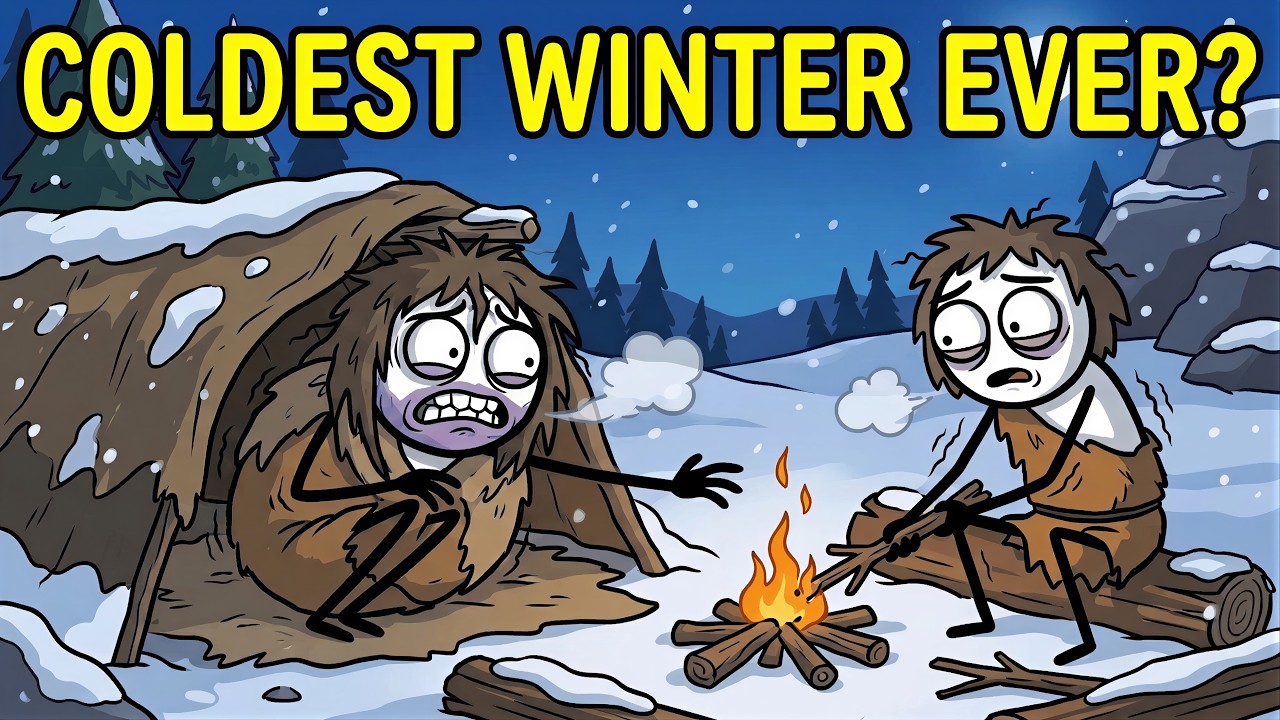
Winter did not kill ancient humans only with cold. It killed with time, with the slow shrinking of food stores, with the question that followed every frozen night: how many more are coming? Prehistoric people had no phone telling them when spring would arrive. A wrong guess about the depth of winter could starve an entire group.
So they built survival technology from what they had: memory, stone, bone, shadow, stars, animal behavior, and the slow return of the sun. The popular image of ancient calendars is that they were purely religious. Many were wrapped in ritual, and the sky carried sacred meaning. But underneath the ceremony was a sharper purpose.
A calendar was a rationing engine. A group entering winter with stored meat, roots, fat, and frozen carcasses had to decide how much to eat each day. Eat too much too early, and they starve before spring. Eat too little, and the group weakens.
Weak hunters fail, weak mothers cannot nurse, weak children get sick. The problem was not simply saving food; it was knowing when to save it and when to ease up. That required knowing where they were inside the year. The critical moment was the winter solstice, the point when the sun reaches its lowest arc and days begin to lengthen.
The solstice did not mean winter was over. The coldest days often came after it, and food remained scarce. But it delivered a vital piece of information: the group was no longer moving deeper into darkness. That changed decisions.
It could determine whether people kept strict rationing, whether they risked a journey, whether they burned extra fuel for the sick. For this reason, ancient people tracked the sun seriously. A shadow falling in the same place, a sunrise between stones, light entering a chamber for a brief period, these were not just beautiful moments. They were information, and information meant survival.
Across the ancient world, people built structures aligned with the sun, stone circles, passage tombs, hill markers, posts, rock carvings. A stone marker does not forget. A sunrise point does not argue. When the sun rose in the right place, the whole group could see it, and the message became shared.
That trust mattered because humans are social animals. A leader can be doubted, an elder can be wrong, but a stone alignment makes the sky speak to everyone at once. Coordination kept people alive. Ancient timekeeping was not limited to the sun.
People read entire landscapes. They watched stars, frost, plants, insects, and the movement of animals. Birds altered their calls, herds changed their paths, small mammals appeared near snow edges. To modern eyes these are random details.
To ancient eyes, they were messages. A person who recognized them was valuable, not because of magic, but because of memory. An elder who had seen thirty winters knew which signs lied and which ones mattered. They remembered the year the birds came early but the cold stayed.
They carried a lifetime of data inside their body. Winter selection shaped the human brain around pattern recognition under pressure. Getting a deer wrong cost a meal. Getting winter wrong cost the future.
This is why seasonal knowledge was not separate from human evolution. It trained memory, rewarded attention, and gave status to experience. It turned elders into living weather archives. The strongest person was not always the most important person in winter.
The most valuable might be the old woman who knew when the ice became unsafe, the tracker who noticed the herd shifted, or the storyteller who encoded seasonal rules into myth. Survival was not just muscle; it was memory shared across generations. That is why stories mattered. A story is a calendar that can walk.
A myth carries instructions. A ritual makes children remember timing. A song preserves migration knowledge. Modern people often separate science from story, but ancient people fused them.
A tale about the sun being reborn after the longest night may sound spiritual, but it also made everyone remember the turning point. Facts die if nobody remembers them. Ritual, fear, music, and repetition made knowledge sticky, and in a world without writing, sticky knowledge was priceless. Deep winter created pressure on the group.
Hunger caused anger, cold reduced patience, and fear could split people apart. If nobody knew how much winter remained, some demanded strict rationing while others wanted immediate feeding. Some wanted to travel, some wanted to stay. A trusted seasonal system reduced the chaos.
The stones said the turning point had passed. The moon count said the herd should return soon. The elder recognized the frost texture from earlier thaws. Now the group could act, not perfectly, but together.
That togetherness was not trivial. A single human freezes quickly. A group shares heat, food, and the watching of children. A group remembers more signs than one mind can hold.
Calendar knowledge gave everyone a shared map of time. Ancient timekeeping was intensely physical. People carved marks into bone, tracked moon phases, and noticed where sunlight entered a cave. Our modern calendar tells us meetings and holidays.
Their calendar told them risk and hunger. It told them whether to move camp before snow trapped them. A modern calendar is mostly social. An ancient winter calendar was biological, tied to fat reserves, sleep, migration, firewood, hunting, and death.
Winter also attacked the mind. Long darkness changed mood, and hunger increased anger. When the sun finally began to return, the psychological effect was enormous. The group could see that darkness had a limit.
The world still had a rhythm, and that rhythm was emotionally protective. It gave people something to endure toward. This is why solstice moments became so powerful across cultures. They were proof that the cycle still worked, that the old knowledge was reliable, that the future had not disappeared.
The modern human body still carries pieces of that world. People feel seasonal changes, want heavier food in cold months, sleep differently when days shorten, and feel relief when days lengthen. That is inheritance. Ancestors survived by tracking change.
Their brains paid attention to light because light meant life. Their communities honored seasonal knowledge because it kept children breathing. Their rituals marked winter because winter was the enemy that always returned. When looking at an ancient stone circle, the reality includes hunger, smoke, and frozen hands.
People stood in the dark before sunrise, waiting for the first beam of light to land exactly where their grandparents said it would. When it happened, it meant the system still worked. It meant they had not lost track of time. It meant the world was turning back.
It meant the worst may still hurt, but it was no longer endless. Ancient winter calendars did not control nature. They listened to it. They did not defeat winter with one invention.
They survived it with attention. They turned sky patterns into decisions, animal movement into warnings, shadow into memory, and stone into a clock. The people who came before were observers, engineers of attention, and readers of time. Winter has killed more humans than any war, but it also built sharp minds, because the humans who survived were not merely the ones who stayed warm.
They were the ones who knew how long the cold would last.


