For generations, astronomers have dreamed of creating a complete map of the universe—not just a catalog of stars and galaxies, but a detailed record of how cosmic structures formed, evolved, and continue to shape the cosmos. That dream took a major step forward when the European Space Agency’s Euclid Space Telescope began sending back its first scientific images.
What Euclid has revealed is both breathtaking and deeply unsettling.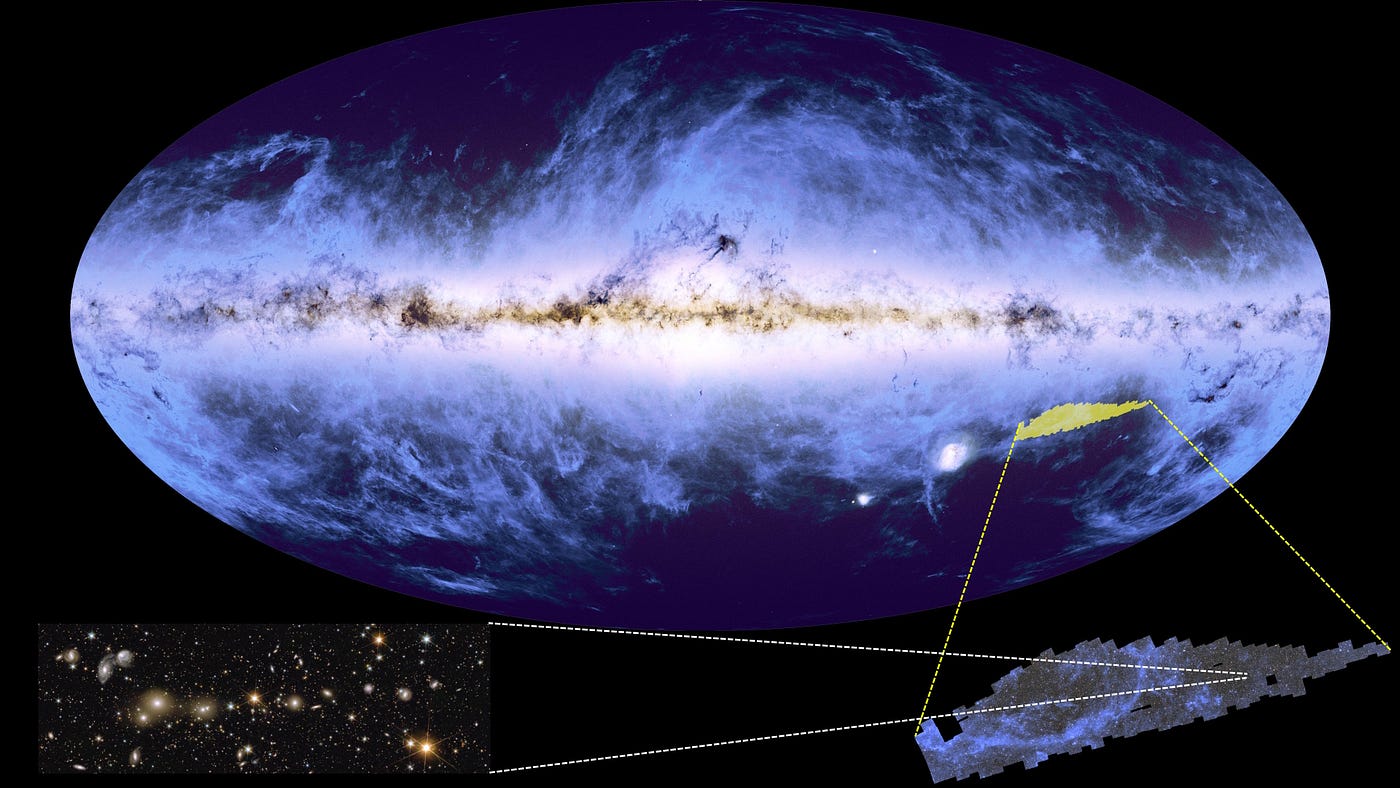
The telescope’s latest observations expose a universe far more complex than previously imagined. Vast galactic structures stretch across unimaginable distances, dark matter appears to sculpt cosmic architecture on scales never directly observed before, and billions of galaxies emerge from the darkness like scattered islands in an endless cosmic ocean.
Unlike Hubble or James Webb, which focus on individual targets in extraordinary detail, Euclid was designed to do something different. Its mission is to survey enormous portions of the sky and create the largest three-dimensional map of the universe ever attempted.
Launched by the European Space Agency in July 2023, Euclid operates from the Sun-Earth L2 point, approximately 1.5 million kilometers from Earth. From this stable location, the telescope can continuously observe deep space without interference from Earth’s atmosphere or reflected light.
Its primary goal is one of the greatest scientific challenges of modern astronomy: understanding dark matter and dark energy.
Together, these mysterious components make up approximately 95 percent of the universe. Yet neither has ever been directly observed. Scientists know they exist only through their gravitational effects and their influence on the expansion of space itself.
Euclid was built to investigate this cosmic mystery.
Using a 1.2-meter telescope and two highly sophisticated instruments, Euclid measures both the shapes and distances of galaxies across billions of light-years. By studying how gravity subtly distorts light—a phenomenon known as gravitational lensing—the spacecraft can effectively map the invisible distribution of dark matter throughout the universe.
Its first large-scale images immediately demonstrated the telescope’s extraordinary capabilities.
One image revealed thousands of galaxies packed into a single field of view. Some appeared relatively nearby, while others emitted light that began its journey billions of years before Earth even existed. Every faint point of light represented an entire galaxy containing millions or even billions of stars.
The sheer scale is difficult to comprehend.
Where Hubble might focus on a tiny region of space and reveal a few thousand galaxies, Euclid can capture enormous areas while still preserving remarkable detail. Over its planned six-year mission, it is expected to observe more than 1.5 billion galaxies and create a three-dimensional map covering roughly one-third of the entire sky.
Among the most significant early discoveries are detailed observations of galaxy clusters—the largest gravitationally bound structures in the universe. These colossal assemblies contain hundreds or thousands of galaxies linked together by vast halos of dark matter.
By measuring how light bends around these clusters, Euclid allows astronomers to “see” the otherwise invisible framework that holds the cosmos together.
Scientists often describe dark matter as the universe’s hidden skeleton. Galaxies form and evolve within this invisible scaffolding, but until now, mapping that structure on cosmic scales has been extraordinarily difficult.
Euclid is changing that.
The telescope is also providing new insights into dark energy, the mysterious force responsible for the accelerating expansion of the universe. Since the late 1990s, astronomers have known that cosmic expansion is speeding up rather than slowing down, but the cause remains one of science’s greatest unsolved mysteries.
By tracking the distribution of galaxies across billions of years of cosmic history, Euclid may help determine whether dark energy is truly a constant force or something far more complex.
What makes these images so remarkable is that they are only the beginning.
The data collected so far represents a tiny fraction of the observations Euclid will gather during its mission. Every new survey adds millions of galaxies to the growing cosmic map, revealing patterns and structures that were previously hidden from view.
Astronomers expect the telescope to generate an unprecedented dataset capable of reshaping our understanding of cosmic evolution, gravity, and the large-scale structure of the universe itself.
Far from being merely beautiful pictures, Euclid’s images represent a new way of seeing the cosmos. They reveal a universe woven together by forces we still do not fully understand, where visible matter is only a small part of a much larger and more mysterious reality.
The most unsettling aspect of Euclid’s discoveries may not be what it has already found, but what it is likely to uncover next. Every image brings scientists closer to answering some of the biggest questions in physics—and raises entirely new ones along the way.
For the first time in human history, we are beginning to map the invisible architecture of the universe. And the deeper Euclid looks, the stranger that universe appears.