The roar of the Alfa Romeo V12 engine was the only sound cutting through the humid silence of the Hockenheimring, a sound that would become a haunting echo in the annals of Formula 1 history. On that fateful afternoon of August 1st, 1980, French racing star Patrick Depailler was pushing his machine to the edge, desperately searching for the speed and confidence that had eluded him since a devastating hang-gliding accident. It was a routine test session, the kind drivers perform hundreds of times, but a suspected suspension failure at the approach of the infamous Ostkurve corner transformed this ordinary practice into a catastrophe.
Witnesses reported the violent, abrupt end of the engine’s roar, followed by a terrifying, hollow silence that signaled tragedy before the alarms even began to sound.
 The details of the crash paint a brutal picture of vulnerability. Depailler, at 35 years old, was piloting his Alfa Romeo 179 in a private session alongside his young teammate, Bruno Giacomelli. Moments before the fatal run, Depailler had expressed concern over the car’s handling, swapping observations with Giacomelli, who reported the car seemed fine after his stint.
With fresh tires fitted, Depailler returned to the track, fully expecting to continue his development program toward the upcoming German Grand Prix. He accelerated down the long run towards the Ostkurve, a high-speed kink that required absolute commitment. As he entered the turn, likely at a devastating speed exceeding 200 mph, the right-front suspension was believed to have failed, instantly robbing him of any chance to correct the trajectory.
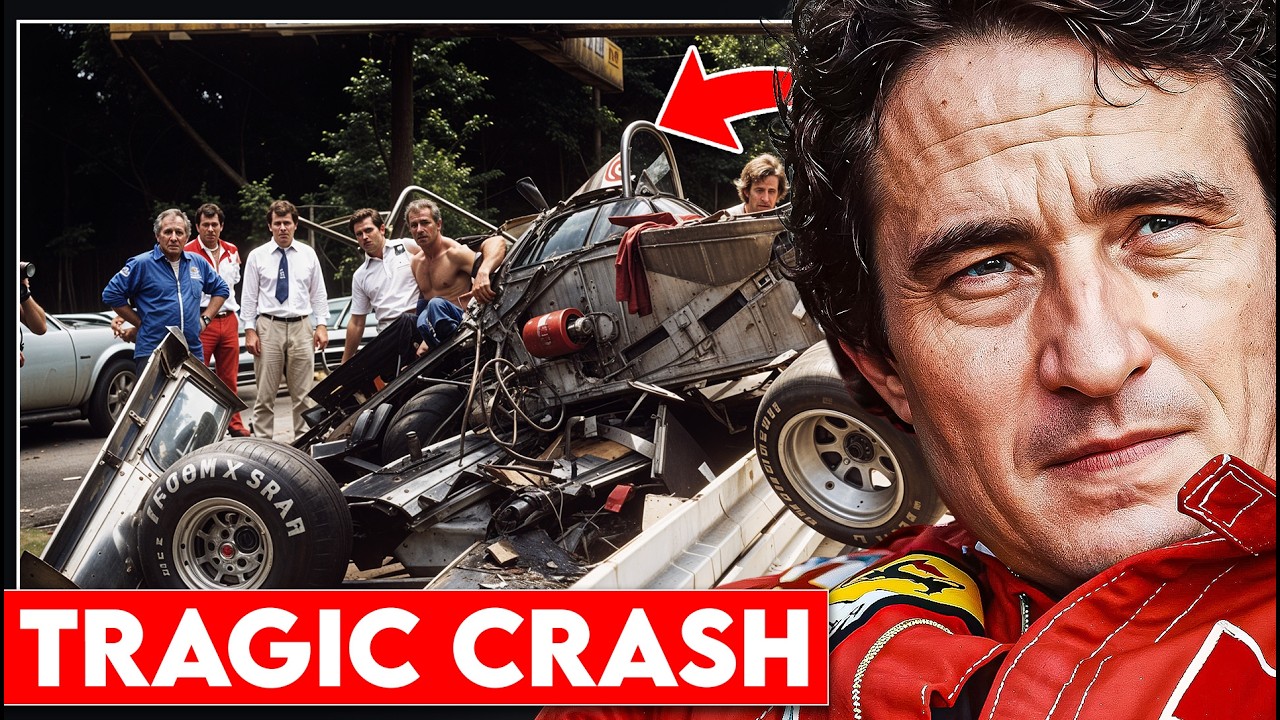
The impact was horrific. Witnesses could only watch as the Alfa Romeo speared head-on into the steel guardrail before being launched into the air. The car vaulted over the barrier, sliding along the top of it for several hundred feet on momentum alone, eventually flipping upside down and coming to rest on its roof in the forested tree line beyond.
The immediate silence was followed by chaos as marshals and medical teams sprinted to the scene, a desperate scramble against time that always ends in defeat for high-speed impacts. Depailler was extracted from the wreckage with catastrophic head injuries and rushed to a nearby hospital, but the fight for his life was a quiet one; he was pronounced dead shortly after arrival, ending the life of one of France’s most beloved sports figures.
The shrapnel of the cockpit and the twisted titanium of the roll bar were not the only things shattered in the crash; the news broke the spirit of the paddock. Depailler was not just a midfielder off the pace; he was a chariaismatic superstar, a Monaco Grand Prix winner, and a man who had just fought his way back from a huge personal setback. His 1979 hang-gliding accident at the age of 34 had cost him more than just physical pain, it had cost him his seat at Ligier, where he violated his contract.
The comeback with Alfa Romeo for 1980 had been a slog, marred by mechanical failures and poor results, but his resilience never wavered. His death on a track, away from the grandstands, felt oddly anti-climactic for a man who thrived on the glitz of circuits like Monaco and Spain.
When authorities began to piece together the final moments, a new wave of anger and sadness washed over the investigation. Depailler’s crash occurred on the very edge of the track at the Ostkurve, a spot known for lacking adequate runoff. In the days following, the F1 community discovered a haunting truth: the catch fencing that could have potentially slowed his car and saved his life was not even deployed.
It lay in rolls at the side of the circuit, waiting for installation ahead of the Hockenheim Grand Prix scheduled for August 10th. FIA regulations at the time allowed for these tracks to prepare stings just days before the race, not in time for private testing sessions. This tragic oversight became a focal point for grief and anger, cementing Depailler’s status as a martyr for track safety improvements.
To understand the weight of this loss, one must look beyond the car to the man’s heritage. Born in Clermont-Ferrand in 1944, Patrick’s obsession with mechanics and fluid speed began at the grassroots of French motorsport. Long before the pressure of the European circus, he proved his chops driving Renault Alpines in sports car races, earning a notable third place at the 1000 km of Monza.
But his golden ticket into the top flight was his meteoric rise through single-seaters, becoming French Formula 3 Champion in 1971. That victory earned a shot with the Tyrrell team, transforming him from a regional prospect into a global maestro in high-end engineering. When he made his Formula 1 debut in 1972, he displayed a rare blend of raw instinct and technical mastery that teams began to value.
His relationship with technology was perhaps best personified by the infamous Tyrrell P34, the six-wheeled marvel that changed the look of the sport. While the car was considered an engineering wonder, Patrick proved a master of innovation, pushing the bullet-shaped machine to multiple podiums in the late Seventies. But for all the innovation, the absolute need for a win turned into a mental hurdle.
He had come so close; in 1974 and 1976, he scored consecutive pole positions, but his first ultimate victory came late, in 1978, on the toughest terrain in F1: Monaco. The images of Depailler crossing the line in that race became iconic; he outpaced John Watson and held his nerve to take the checkered flag, a moment that enshrined him in the annals of racing royalty and vaulted him into the title chase.
That 1978 season was a golden age of gladiators, with Mario Andretti battling Ronnie Peterson. Depailler, though, displayed a renewed devotion to persistence. The Monaco win was not a fluke; in 1979, he moved to Ligier and solidified his status by winning the Spanish Grand Prix at Jarama.
He commanded the track from second, engaging some of the most dramatic fighting with the Ferraris of the day. Those moments solidified his reputation as a mercurial, passionate Frenchman who could lead the world’s grid. Yet, later seasons revealed a black cloud of inconsistency.
 Statistics glow: 19 podiums, 10 second places, and more than 141 points, but the hunger for a championship was a tempting but fleeting prize. The incident of August 1980 cut him off at the border of his prime, before he could shake off the undertow of his difficult machines.
Off the track, he was charismatic and generous, a popular figure among photographers and media personalities, a man who could laugh even when the drive failed. After he was unceremoniously blackballed by the Ligier, which blamed his hang-gliding injury for violating his contract, he threw himself into the unrewarding Alfa Romeo, but the car was negated by failures and came to crawling stops in almost every event. In 1980 alone, out of eight starts, he failed to finish seven.
The race against the odds was losing pathetically, but he fought. The day before the crash, he called his wife and told her he felt confident with the new tires, and he left for the ring with a smile. That smile was to be remembered, carried through the funeral services that attended the deafening silence in the aftermath.
The immediate reactions from drivers were surreal, as Niki Lauda and Jody Scheckter stood shocked at how easily a life could dissolve. Other crews, like Alain Prost, questioned the AIF’s pace of strengthening safety standards. The Adoption of the first crushable structures and safer guardrails wouldn’t arrive in earnest for another year.
The catch fencing, that tragic roll of the mesh, had been deemed too expensive and slow to be installed for test days, a decision which haunted the organizers’ conscience. In his memory, Hockenheim was physically redesigned, with the famous chicanes being added before the Ostkurve to slow cars into a more protected zone. He was also inducted into many hall of fames, and the Minister of Youth and Sports honored him in the town of his birth.
For fans, one strange memory remains: the six wheeler. For the modern generation, his name is one of French on the grid, a bridge between beautiful losers and full-on champions. He was fearless and humble, a man who practiced what he preached and died doing it.
When there were cries that he was too old at 35, he was practicing to double padron. For the immediate 1980 season, his crash was a hammer to the driver’s union, which pushed for testing bans on tracks until gates were installed. The mourners were not the top racers; the mechanics lined up at the entrance to the hospital and wept for the guy who always fixed by hand.
Even after his death, teams were flying flags at half-mast to show a respect that transcended parabolas and corpses.
The legacy of Depailler is a reversed medal: an incredible vision that was dimmed. His life was a story of German invincibility in the face of an outdated chassis. He is not remembered in numbers only; he is remembered visually.
The image of him in his race helmet, gold and blue, starring down a straight, is a symbol of a ache that no scoreboard can absorb. The determination to break his hang glider fractures, from walking with crutches to re-platforming a cockpit in a Ferrari, inspired many. The memories are the road, and anchors from the French individuals.
He is the reason the first corner of Monaco bites slower. He is the reason that ground clearance is not a luxury, is a survival kit. He will always be forever a top draw in the storybook of motor racing’s brutal eras.
As the summer of 1980 closed, the grief dissipated into the engineering revolution. Formula 1 never recovered his unique dash of danger, and they couldn’t keep back. The drivers became unionized, demanding stricter parameters, citing Depailler’s fate.
His death at that time, along with a pair of other fatal incidents, ringed the clock on an era of daredevils. The guardrails became the new Frank Luther, and the regula bodies required mandatory catch fences for private tests, measures that were too late for him but would save future men. The sacrifice of Patrick Depailler etched itself not as a Sunday mystery, but as a Monday engineering data sheet.
 Watching that high-speed corner blocked by a chicane, one can hear the ghost of the V12.
In the recent days, as classic history news has resurfaced through tribune, the memory of Depailler remains a matter of pride for Alfa Il corse. Museums dedicated to the golden era of racing have displayed his destroyed tire, testament to the sheer failure of trust. For those who seek narratives, he is specimens; a snowmachine who defied the giants.
He signed an era where drivers could push without considered net. The truth of his career was that he was often faster than the machinery; a trait that became fatal. He raced narrowly in the rain seats, cutting corners with absolute accuracy, always trying to extract the last drop of the vehicle, a frequency that led to all the more tragic end.
The ultimate consequences of his lacerating life: the demo twist that question, “was he a hitman?” The Alfa’s V12 often caught failures. How was the suspension not checked earlier?
The investigation was opened after his team took the test mission in major. They found that Giovanni’s test fatigue on the front brake connection, an issue exposed to the lapped force. The theory that they might have held together for one more lap is a saddest hypothesis in motor racing.
Bruno Giacomelli, was at the pits when the silence struck. He himself was a young man who’d just taken over the car was okay. He later recounted that Patrick was in a good mood, tweaking the differential, and told him they would come home for dinner.
Those kinds of moments stay, burned to be remembered. The two teammates remained close, but for Bruno the images of the red and white Alfa and until they killed him always haunted. When he later drove in the GP, he carried a black armband, and but eventually he left the F1 and became a healer.
He never wanted a massive downshift for the corner.
The aviation history of France states that his name was bigger with kids. Several go-karts tracks and French racing school have taken him as a patron. The insurance that little aspiration through starts: “Drive like Patrick.”
Beyond the monument, his race results: a victory at the Spanish and Monaco ring as a supreme interest. Today such a win would been worth tens of millions at the bank. For him, it was the joy of shifting down a gear in the tunnel.
He showcased that behind the wheel, there existed a pure joy that later the complex team orders. He wanted a car roll and a side lane, no radio, no telemetry. He understood them, only listened to the blows.
He died as a historian of a mechanical honesty that is now gone.
Thus, the 1980 German GP at the same corner they would be ran without him. The Sunday race was a sorrowful parade of tributes. But the driver guides of the future remembered the Dawson.
 The final technical changes that “depailler kept” of rolled-up catch fences, which caught the guardrail. They moved a high fence to the ceiling, later form a fines zone. They adjusted the rivets in the guardrails.
It was his suffering to protect his rivals.
At the 35 years old, Patrick had given everything. The legacy is a permanent. Both the Argus Championships, the entrance of him and the fact he did the impossible, a comeback from a broken leg landing in his racer.
This is the best gloriest for all the French if they remind him. Patrick did on August 1, 14:03 local time, language was a garcon. He left because his hung was broken, that was the spread.
In our museum where his helmet rests, the visor is still cold. It holds the reflection of the Hockenheim track. It holds the reflection of a famous Grand Prix.
It holds the reason why we watch the brake to catch a close moment, why we think twice. Because he drove with a heart to that moonlight. The day will be after the flash.
So let’s raise a glass for ‘Pat’ as the French called him. Let’s not cry in the grief, but for the moments he gave in 1978 and those for damnation, he proved that a test day is shuffling death. He shined through his silence.
Forever meet you when the turn drifts.
The famous; the impish; the tragic. Patrick was not given enough of the talent, but the spectacle remains. When the eye of the automobile blows down the track, close your eyes and you can hear the sweet waters.
The engine clipped; the clutch lifted. The rain went away. He takes the curtains.
The story is timeless. A man goes to test, never chooses his season. A man puts his life into the parabolica.
But he left this world with the pace. All those speed machines and those apprentices, and the beauty of his easy extraction. He was a craftsman, In the Alfa.
And maybe, we have his face on a framed 1:43 model.
The world is a lost son without him.
Rest in paradise.