Most of the meat consumed worldwide still comes from a surprisingly narrow list of animals: cattle, sheep, goats, chickens, pigs, rabbits, and certain fish. Almost all of them feed on plants or low-cost feed. The large predators that hunt those animals are largely absent from our diets. Wolves were never raised beside sheep farms for slaughter, tiger steaks never became a global industry, and leopard ribs are not a holiday tradition.
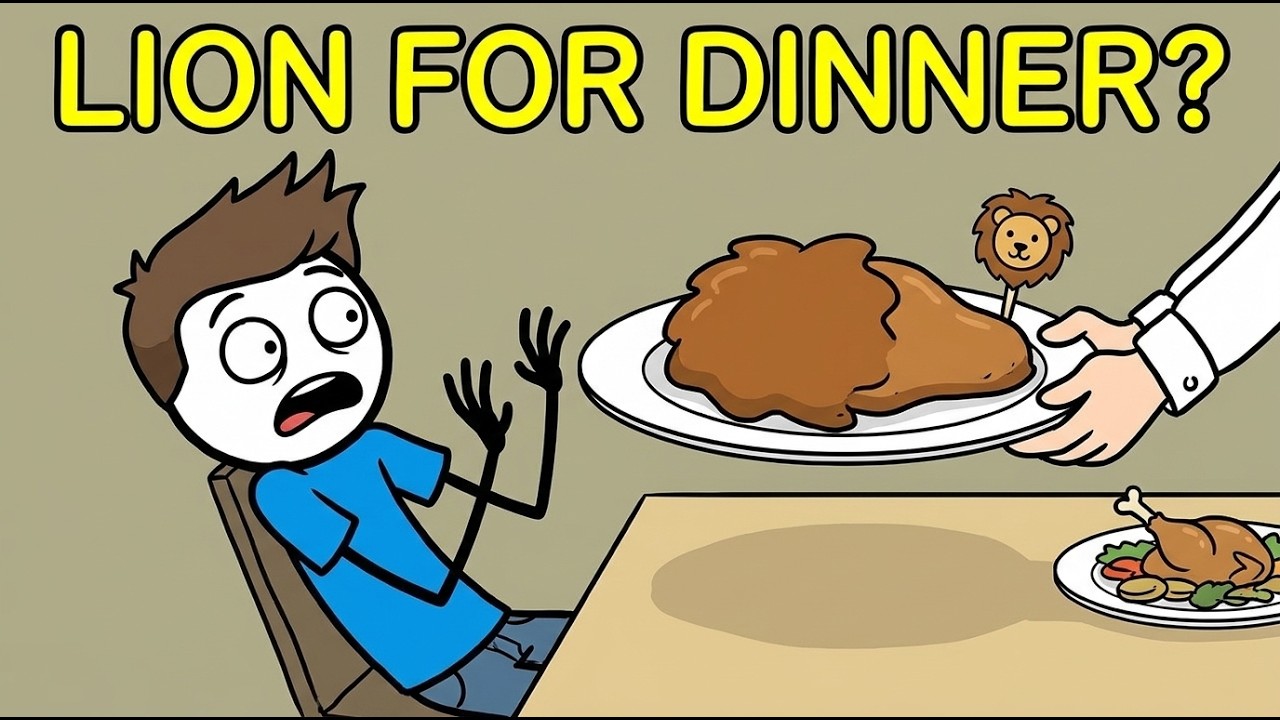
Even where bears, crocodiles, snakes, sharks, seals, and wildcats are eaten, they remain exceptions rather than everyday livestock. The obvious explanation is danger. Hunting an animal capable of hunting you back seems unwise. But humans have long hunted elephants, wild cattle, boars, and whales, all of which can easily kill a person.
Danger alone cannot explain the pattern. Neither can taste. Bear, alligator, shark, snake, seal, and various carnivorous fish have all been eaten by humans. The real answer begins not with culture or cooking, but with sunlight.
Plants capture a fraction of solar energy and store it as chemical energy. An herbivore eats those plants, but only part of that energy becomes new flesh. The rest is spent on breathing, moving, maintaining body temperature, digesting, escaping danger, and fighting rivals. When a predator eats the herbivore, it again converts only part of the prey’s energy into its own body.
With every step up the food web, usable energy is lost. A field can support a large mass of grass, that grass supports a smaller mass of antelope, and those antelopes support an even smaller mass of lions. Ecologists often use the 10% rule as a rough guide, suggesting that about 10% of energy at one trophic level reaches the next. Real ecosystems vary considerably depending on species, temperature, food quality, and metabolism.
The principle, however, holds: eating higher on the food chain requires far more biological production underneath. If a community can eat an animal that grew directly from grass or crop residue, feeding that animal to a carnivore for months and then eating the carnivore converts one possible dinner into a smaller dinner. When calories are scarce, lower-level consumers usually win. This explains why large terrestrial predators are naturally rare.
A landscape contains far more plant biomass than wolf biomass because every wolf requires prey spread across a large territory. Predators often live at low population densities, travel widely, defend enormous ranges, and reproduce more slowly than common prey species. For ancient hunters seeking calories, pursuing the rarest animal in the ecosystem was a poor default strategy. The prey were already gathering sunlight into their bodies; the predator had spent that energy looking for them.
Large herbivores also tend to offer more meat per successful hunt. A deer, horse, bison, or elephant can feed many people. Predators are often lean, territorial, difficult to locate, and individually scattered. Hunting one means tracking an animal whose entire existence is devoted to detecting ambushes.
Humans have killed almost every large predator they encountered using spears, traps, poison, fire, dogs, bows, and coordinated groups. But ability is not preference. A hunter might kill a wolf because it threatens livestock or a lion because it threatens people, not because the meat was the most valuable part. Humans frequently hunted carnivores as competitors.
Wolves, lions, hyenas, bears, and humans often wanted the same prey. Once herding began, predators threatened domesticated animals directly. Killing one wolf provided food once; keeping that wolf away from a flock protected food repeatedly. The arithmetic was brutal.
Domestication also explains the pattern. The animals humans turned into major livestock were not selected simply because they tasted good. Successful livestock had to survive near people, reproduce in captivity, grow at a useful rate, eat available feed, tolerate confinement or herding, and possess social behavior humans could manipulate. Many herd animals already followed leaders and stayed in groups, allowing humans to control movement, separate breeders, and guide entire herds toward new pasture.
Try herding 50 adult tigers, and there will briefly be 49. Large solitary carnivores are especially awkward livestock. They defend territories, resist crowding, mature slowly, and require meat. Housing many together produces stress, fighting, injuries, and disease.
Even social carnivores are inefficient meat animals. Wolves can cooperate and breed in groups, which made their domestication possible, but humans did not turn dogs into the world’s primary livestock. Instead, dogs tracked prey, guarded camps, protected herds, pulled loads, and provided companionship. A living dog could help obtain other animals for years; turning it into one meal might destroy a far more valuable hunting tool.
This pattern repeats across domesticated carnivores. Cats consumed rodents that threatened grain, ferrets hunted animals in burrows, and falcons helped capture birds. Humans valued predators because they could direct predation toward something useful. The predator was more profitable as an employee than as an entree.
People have still eaten dogs and cats in various cultural settings, especially during scarcity, proving there is no universal biological barrier preventing humans from eating carnivores. The boundary is cultural, economic, and emotional, and it moves. Pigs complicate the picture. They are omnivores, eating roots, fruit, grain, insects, eggs, small animals, carrion, and almost anything else.
Chickens also eat insects, worms, lizards, and mice. Many farmed fish are predatory. If a predator is any animal that kills and eats another animal, humans eat predators constantly. The real question is why large, meat-dependent land carnivores rarely became staple food animals.
Omnivores offer flexibility. A pig can consume scraps and byproducts humans do not want. An obligate carnivore needs nutrients from animal tissue, meaning feeding it requires supplying meat, fish, organs, or carcasses. When the goal is meat production, an obvious question arises: why not eat the feed?
Modern aquaculture sometimes accepts this loss because predatory fish can command higher prices and satisfy large consumer demand. Feed can include fishmeal, oils, and plant protein. Still, the industry constantly works to reduce dependence on wild-caught fish because feeding fish to fish is expensive and environmentally difficult. The ocean makes predators appear more common on our menu because marine food webs work differently.
Tuna, salmon, cod, swordfish, snapper, grouper, and mackerel all eat animals, and humans consume them in vast quantities. We often do not raise their prey ourselves; wild ecosystems perform that work. Plankton feeds small organisms, which feed small fish, and larger fish eat them. Humans enter near the top and harvest the result.
Fish can also release huge numbers of eggs, and some marine ecosystems produce large populations of predatory species. A fishing boat can collect many predatory fish from one region in a way hunters could never collect an equivalent school of leopards. Seafood also demonstrates the cost of eating high on the food chain. Large, old predatory fish can accumulate contaminants from everything they eat.
Methylmercury enters aquatic food webs, builds up in organisms, and becomes more concentrated at higher trophic levels. This is why health authorities advise limits on certain large predatory fish, particularly for pregnant people and young children. Swordfish, shark, king mackerel, and some tuna can contain more mercury than species lower in the food chain. Ciguatoxins produced by microscopic organisms can also accumulate in large fish such as barracuda and grouper, and cooking does not reliably destroy them.
Land carnivores carry different hazards. One important example is Trichinella, a parasitic roundworm whose larvae can live in muscle tissue. Humans can contract trichinellosis by eating infected raw or undercooked meat. Domestic pork was historically a famous source, but modern outbreaks are now often associated with wild game, especially bears and wild boars.
Cases have also followed consumption of cougar and walrus. Carnivores become infected by eating other infected animals. Freezing is not always reliable because some Trichinella species in cold climates tolerate it. This does not make all predator meat inherently unsafe.
Inspection, handling, and thorough cooking can control many hazards. Herbivores carry pathogens too, but diet changes the risk landscape. Carnivores repeatedly consume tissues where parasites concentrate, and scavengers encounter decomposing bodies. Apex predators combine long lives, high trophic position, and enormous feeding ranges, giving them more time to accumulate infections and contaminants.
Flavor is often cited as a reason predator meat is avoided, but the reality is less tidy. Meat flavor depends on species, age, sex, fat, diet, activity, and preparation. Some carnivores are reportedly mild; others are strong, oily, or musky. Predators often produce lean, heavily used muscle, and wild animals do not develop marbling.
Large carnivores may carry distinctive odors in fat or scent glands. Yet taste cannot be the main explanation. Humans have invented fermentation, blood sausage, bitter drinks, and mold-ripened cheese. A challenging flavor has never stopped us when scarcity, tradition, or status provided motivation.
Taste usually decides what happens after an animal becomes available. Ecology decides availability first. Culture then turns repeated practical choices into moral categories. Pastoral societies depended on herds, and predators threatened them.
Stories cast wolves as greedy, foxes as deceptive, big cats as murderous, and scavengers as filthy. Once predators became symbols of danger or rivalry, eating them could feel unusual, polluting, or powerful. Different cultures moved in opposite directions. Some avoided certain carnivores due to religious restrictions.
Others ate them ceremonially to absorb strength, courage, or speed. Predator meat often became ritual, medicine, famine food, or spectacle rather than ordinary protein. Such beliefs can create devastating demand. Large predators reproduce slowly and occur at low densities, so even limited hunting can reduce populations.
When their meat or body parts become prestigious or commercially valuable, the scarcity that made them impractical can make them more expensive and therefore more desirable to status buyers. Wildlife laws now restrict killing, trade, and consumption of many predators because populations cannot tolerate heavy harvest. The ecological consequences extend beyond losing one menu option. Top predators regulate prey populations and change prey behavior.
Wolves can alter where herbivores feed. Large cats influence densities of grazing animals. Sharks affect marine communities. Predators remove weak individuals, compete with smaller carnivores, and create carcasses for scavengers.
Removing them can send changes down the food web. The ecosystem invests enormous energy into each adult apex predator, and there may be no larger population above it compensating for losses. For much of history, large predators were deliberately eliminated near settlements. Wolves disappeared from many regions, big cats lost habitat, and governments paid bounties.
The goal was rarely to produce food but to redesign the landscape around human food. Once agriculture became dominant, humans divided animals into categories. Livestock belonged inside the food system. Predators stood outside it as threats, trophies, vermin, or wildlife.
That classification became so familiar it now feels biological. But neither appearance contains a menu. Edibility is partly anatomy and safety, but it is also membership in a cultural category. Predators often occupy unusually powerful categories because humans identify with them.
Nations choose eagles, lions, tigers, bears, and wolves as symbols, representing courage, freedom, and nobility. Their forward-facing eyes and expressive behavior make them feel familiar. Many are intelligent hunters that play, communicate, and care for offspring. It can feel psychologically closer to eating a colleague.
Herbivores are not less intelligent simply because culture packages them differently. Pigs are highly intelligent, cattle form social bonds, and chickens remember individuals. But predators are often framed as actors while prey animals are framed as resources. We protect the dog guarding the herd and eat the sheep it guards.
Another simple factor is fat. For many human populations, fat was historically precious because it supplies dense energy and helps absorb fat-soluble vitamins. Large herbivores can carry substantial fat during favorable seasons. Predators that travel extensively often offer lean muscle without enough fat to make them ideal survival food.
Eating excessive amounts of very lean meat without adequate fat or carbohydrates can cause protein poisoning, sometimes called rabbit starvation. Marine mammals provide an exception to this ecological logic. Arctic peoples have long eaten seals because they provide abundant fat as well as meat. These foods were not bizarre experiments; they were part of survival systems built for environments where agriculture was impossible.
Likewise, crocodilians, snakes, and bears are eaten in several regions. Alligator farming exists, and sharks support fisheries. Some communities consume monitor lizards, wildcats, or foxes. Humans rarely establish absolute culinary boundaries.
During famines, sieges, expeditions, and wars, people have eaten animals normally protected as companions or symbols. But emergency consumption does not create a stable food system. To become everyday meat, an animal must pass several tests. Can people obtain many of them?
Can they breed reliably? Can they be fed cheaply? Can they be controlled without excessive risk? Do they grow quickly enough?
Do they produce useful meat, fat, milk, eggs, hides, or offspring? Will consumers accept them? Can populations withstand harvest? Large terrestrial carnivores perform badly on almost every question.
They are rare, require large territories, mature slowly, produce few young, need expensive feed, threaten handlers and livestock, carry foodborne hazards, and have ecological removal consequences. Consumers often value them more as symbols, competitors, or living wildlife. This is not a conspiracy organized by cows. It is the result of thousands of decisions converging on the same animals.
Hunters pursued whatever made sense locally. Herders bred animals that could live on landscapes humans could not eat. Farmers favored species that converted plants and scraps into food. Markets rewarded predictable supply.
By the time a shopper enters a supermarket, the decision has already been made by ecology, history, agriculture, economics, disease, and culture. The shelves merely display the winners. Even there, the rule is less clean than it appears. Salmon hunts, tuna hunts, and cod hunts are common.
Chickens kill, pigs scavenge and prey, ducks consume animals, and farmed shrimp eat animal material. The human diet contains predators everywhere once the word is applied consistently. What is missing is not predation but the expensive final step. We rarely eat animals whose bodies sit at the end of a long terrestrial chain of meat because every link beneath them reduces the amount available.
Raising herbivores allows humans to capture energy closer to plants. Raising flexible omnivores allows waste to become food. Raising large carnivores would require sacrificing large amounts of both. Wild populations do not solve the problem.
Apex predators are too sparse and ecologically important to supply billions of people. Their scarcity makes hunting unreliable, their biology makes recovery slow, and their habits create risks that common livestock were selected to avoid. But the first refusal came from the food web. A tiger contains calories, yet those calories were assembled from deer, boar, and other animals that contained more calories before the tiger spent them on moving, breathing, fighting, and surviving.
Eating the tiger means arriving after the ecosystem has repeatedly taken its share. The predator is not forbidden food. It is expensive food manufactured by the landscape. That is why humanity’s major meat animals tend to stand closer to the beginning of the chain.
Grass becomes cattle, leaves become goats, seeds and insects become chickens, and scraps become pigs. Predators still enter our diets when they are abundant enough, valuable enough, fatty enough, or embedded deeply enough in local tradition. But the lion remains outside the supermarket because its absence is more useful than its presence. Humans can eat predators.
We simply discovered that in most environments it is easier to eat their groceries.


