The sudden sensation of falling just as you drift off to sleep, often accompanied by a full-body jerk that snaps you awake, is one of the most universal human experiences. Known scientifically as a hypnic jerk, this involuntary muscle contraction occurs during the transition between wakefulness and sleep, and it has fascinated neuroscientists for decades. The falling feeling is not separate from the jerk itself. Both are produced by the same neural events.
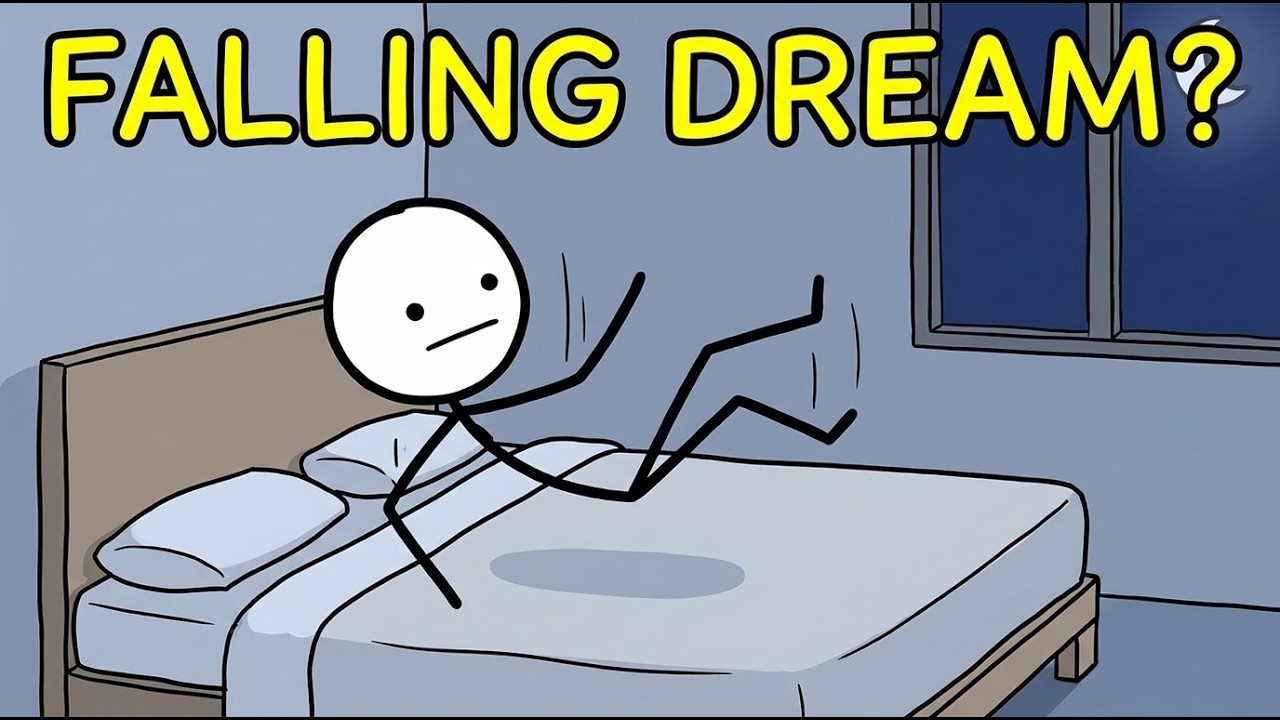
As the body begins to relax into sleep, muscle tone drops and the vestibular system—which governs balance and spatial orientation—receives signals that resemble what would occur during a loss of support. The brain interprets these genuine sensory inputs and constructs a narrative: falling. The jerk that wakes you is the motor system responding to that narrative. It is a reflex attempt to catch yourself, to regain support that the brain believes has been lost.
Because the sensory signals are real—the muscles genuinely are relaxing—the experience feels far more vivid and grounded than typical dream content, which is usually built from stored memories and imagination. One of the leading explanations for why this reflex exists is the tree-sleeping hypothesis. Our pre-hominin ancestors likely slept in trees, where complete muscle relaxation during sleep would have caused them to fall. Over time, the brain evolved a monitoring system that fires a motor discharge if muscles relax too fully at sleep onset, restoring tone and preventing a dangerous drop.
In a modern bed, that system still fires under the same conditions—even though there is no tree and no actual risk of falling. The result is the body catching you from a fall that does not exist. Certain habits make hypnic jerks more frequent and intense. Caffeine is a major contributor, as it blocks adenosine receptors and creates a more conflicted state during sleep onset.
Physical exhaustion leads to more abrupt transitions into sleep, which can trigger the reflex. Stress and anxiety keep arousal systems elevated, making the transition to sleep less smooth. Even the timing of exercise matters: working out close to bedtime raises core body temperature and sympathetic nervous system activity, both of which interfere with the gradual relaxation needed for seamless sleep onset. Falling dreams that occur later, during REM sleep, work through a different mechanism.
During REM, the brain is highly active while the body is paralyzed by a process called REM atonia. The vestibular system is operating without confirming movement signals, and this mismatch can produce sensations of displacement. The dreaming brain, which is actively building narratives at high speed, incorporates these signals into its story. If the dream involves a tall building, the disturbance becomes a fall from it; if it involves flying, it becomes a loss of altitude.
The emotional intensity of falling dreams is amplified by the amygdala, which is highly active during REM sleep. Because falling is intrinsically threatening, the amygdala processes the narrative as a genuine danger signal. This triggers real physiological responses—adrenaline release, increased heart rate, changes in breathing—which then become sensory inputs that reinforce the sense that the experience is real. This feedback loop is why a falling dream can feel more visceral than almost any other dream content.
Waking up before impact is not a protective mechanism that stops the dream before a frightening conclusion. The physiological arousal generated by the fall simply crosses a threshold that ends the sleep state. The dream does not self-censor; it ends because the emotional intensity of the experience wakes you. Falling dreams have been documented across cultures and centuries, appearing in Mesopotamian dream interpretation texts, the writings of ancient Greek and Roman authors, and traditional dream systems from Asia, Africa, and the Americas.
This universality suggests the experience is not culturally constructed but is produced by a shared human neurology encountering sleep onset in a consistent way. At a deeper level, the falling dream illustrates something fundamental about consciousness. Human perception is not a passive recording of reality; it is an active construction built from sensory inputs, expectations, and narrative frameworks. The feeling of reality is not proof of actual reality—it is simply a feature of the brain’s model.
A falling dream feels real because it is built from genuine sensory signals, and the brain constructs felt reality in the same way whether the source of those signals is external or internal. The next time a falling dream snaps you awake, you can trace the experience to a chain of real events: the caffeine from the afternoon, the stress you are carrying, the abrupt physical transition into sleep, and the ancient circuitry your brain inherited from tree-dwelling ancestors. The ceiling you stare at afterward is the real world reasserting itself, but for the duration of the fall, your brain was doing exactly what it always does—building the most coherent experience it can from the signals it had.