In the Beqaa Valley of modern Lebanon, three limestone blocks sit stacked inside a wall that has stood for nearly 2,000 years. Each weighs about 800 tons, heavier than a fully loaded jumbo jet, heavier than a blue whale, heavier than 130 adult elephants standing nose to tail. A few hundred meters away in the same quarry, a fourth block was cut and then abandoned. Engineers estimate its weight at around 1,650 tons, making it the heaviest single block of stone any human society has ever attempted to shape.
Nobody today has a crane rated to lift that block in one piece. Yet the people who cut it did so with hand tools roughly 2,000 years ago. This pattern repeats across every inhabited continent except Antarctica. Egyptians on the Nile, Neolithic farmers in Britain, Polynesian voyagers on a Pacific island, Roman engineers in the Levant, and Inca stonemasons in the Andes all independently arrived at the same idea: cut stone into enormous blocks, move it an unreasonable distance, and stack it so precisely that it outlasts empires.
The question of how they did it has produced everything from careful engineering studies to television specials about ancient astronauts. What actually happened is documented in quarry marks, tomb paintings, shipping logs written on papyrus, and in the stones themselves, which still carry the scars of the tools that shaped them. None of it involves lost technology. All of it involves physics that a high school student could follow, applied with a level of patience and organization that modern society rarely attempts anymore.
The people who quarried, hauled, and stacked these stones were surveyors who could lay out a base the size of several football fields and get it level to within about a centimeter and a half. They were metallurgists who understood exactly how copper behaves against limestone and how quartz sand behaves against granite. They were foremen who could keep several thousand people fed, housed, and organized into rotating shifts for years at a stretch. What they lacked was diesel engines and structural steel.
What they had instead was an extremely refined understanding of leverage, friction, and geometry—and perhaps most underrated, how to get large groups of humans to pull in exactly the same direction at exactly the same moment. They didn’t lack intelligence. They lacked machines. The technical word for these structures is megalith, from Greek roots meaning simply “big stone.
” It covers burial tombs built from stacked slabs, standing stone circles used for ritual or astronomical purposes, temple platforms like the one at Baalbek, retaining walls built from interlocking blocks, and free-standing statues like the moai of Rapa Nui. This wasn’t one civilization’s trick that spread around the globe through contact or trade. Egypt’s pyramid builders never met the people who built Stonehenge. Neither of them had any contact with the Rapa Nui islanders who carved the moai centuries later, or the Inca stonemasons fitting granite blocks together in the Andes without mortar.
These are separate inventions arrived at independently by societies that shared nothing except a similar set of problems: how to move something extremely heavy, and how to convince a large number of people to help you do it. When completely unconnected cultures land on similar engineering solutions again and again, that’s usually a sign the solutions were being discovered through trial, error, and physics—not handed down from somewhere else. The scale involved is hard to hold in your head using ordinary experience. The average limestone block that makes up the body of the Great Pyramid weighs around 2.
5 tons, roughly the weight of one car repeated 2,300,000 times. The upright sarsen stones at Stonehenge average around 25 tons, roughly two city buses stacked end to end and then stood on end. The granite beams sealing the King’s Chamber inside the Great Pyramid weigh up to 80 tons each and were lifted more than 40 meters into the air. The trilithon blocks at Baalbek weigh around 800 tons apiece—more than five blue whales, each one cut, moved, and set into a wall 6 meters off the ground.
The answer to how they did it starts before any of the hauling happens. Long before a single stone was cut, surveyors walked quarry sites looking for bedrock with a clean, consistent grain, free of hidden cracks that could split a block apart mid-lift, or hidden weaknesses that could cause it to fail years later under the weight of everything stacked on top of it. Stone splits more easily along its natural bedding planes, the layers it originally formed in, the same way wood splits more easily along its grain than across it. Quarrymen would trace those planes, mark out a block along the lines the stone already wanted to break along, and only then start cutting.
Once a site was chosen, the method of separating stone from bedrock depended entirely on what kind of rock it was. Soft stone like limestone or sandstone could be worked with tools made of copper or bronze. Once a channel was carved down each side of a block, workers cut a row of slots along its base and drove dry wooden wedges into them. Then they soaked the wedges with water.
Wood swells as it absorbs moisture, and swelling wood generates enormous, steady pressure—enough to split a multi-ton block cleanly along the line the quarrymen had chosen, using nothing but water and patience. Granite and other hard igneous rock don’t respond to that trick because they’re too dense and don’t have the same kind of natural bedding planes. For those, Egyptian quarrymen at sites like Aswan pounded the stone into submission using hand-size balls of an even harder stone called dolerite, some weighing up to about 12 kilograms. Workers would drop them repeatedly onto the granite surface, pulverizing it a few grains at a time until a groove had been worn down deep enough to work with.
This was sometimes combined with fire-setting: piling burning brushwood against a rock face, letting it heat the stone, then dousing it with cold water. The sudden temperature change caused the outer layer to crack and flake away. None of this was fast, but it worked repeatedly at massive scale because it exploited real physical weaknesses in the rock rather than trying to overpower it. With the block finally free of the bedrock, the next problem was getting it to move.
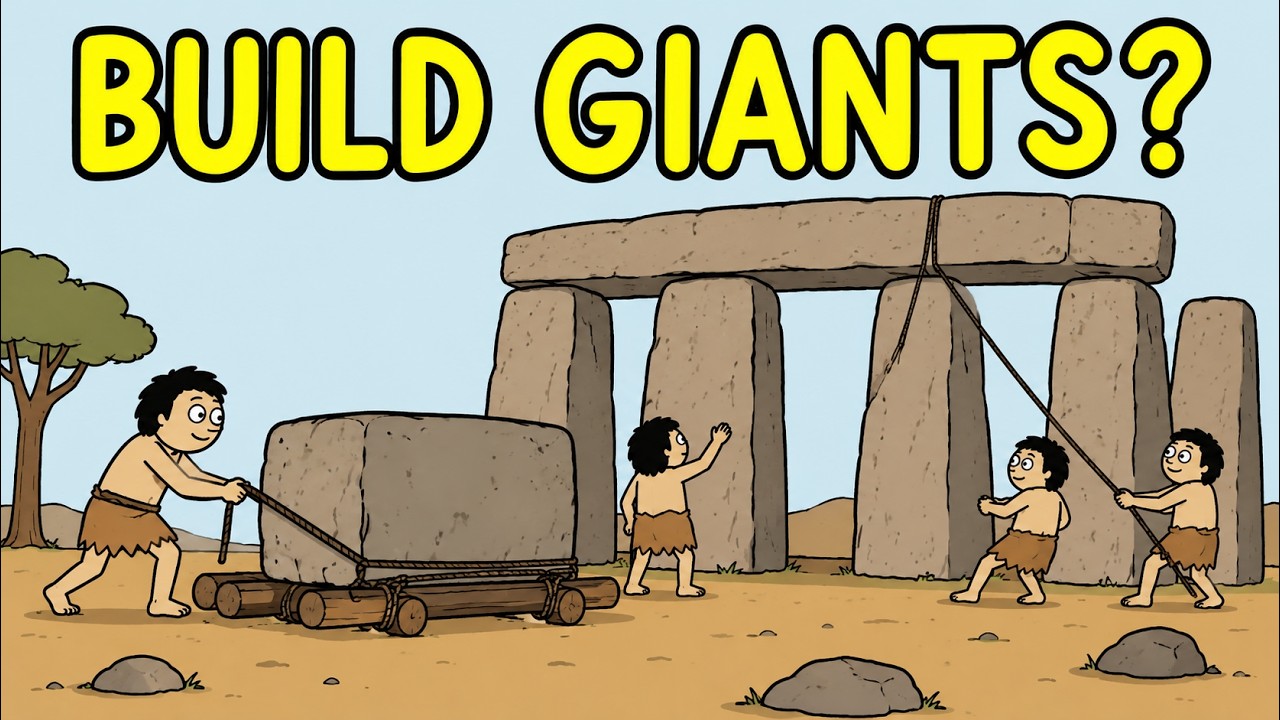
The wheel, which feels to modern eyes like the obvious answer, was often the wrong tool for the job. On loose desert sand or uneven rocky terrain, a wheel narrow enough to carry a multi-ton load concentrates all of that weight onto a tiny contact patch, and it simply sinks. What worked far better was a sledge, a flat wooden platform with long runners that spread the weight across a much wider area. Even with a sledge, dragging a heavy load across dry sand is brutally hard because the leading edge of the runners pushes sand into a mound in front of the load.
In 2014, a team of physicists at the University of Amsterdam, led by Daniel Bonn, took a closer look at a wall painting inside a nearly 4,000-year-old Egyptian tomb. The painting shows workers hauling an enormous statue on a sledge, with a single figure at the front pouring liquid onto the sand directly in the load’s path. The Amsterdam team decided to test it in a lab with real sand, real sledges, and real measurements of pulling force. They found that adding a small, carefully controlled amount of water to dry sand—somewhere around 2 to 5 percent of the sand’s volume—creates thin bridges of liquid between individual grains.
Those bridges pull the grains together through surface tension, and the sand stiffens dramatically, almost doubling in structural rigidity. A stiffer surface means the sledge’s runners stop sinking in, and the mound of sand that used to pile up in front of the load barely forms at all. In their tests, this single change cut the pulling force required nearly in half. Add too much water, on the other hand, and the sand turns to mud, the bridges collapse, and friction rises right back up.
Cutting the pulling force in half doesn’t sound like the most dramatic discovery in archaeology, but think about what it actually means on the ground. If a team needed to haul a 50-ton stone, halving the friction meant halving the number of people required to move it. Multiplied across every stone in a project involving millions of them, that could mean the difference between a monument that takes 20 years to build and one that takes 40. Water and sledges solved the friction problem, but they didn’t solve the strength problem.
No individual person can move an 800-ton stone, and ten people can’t either. The answer, every single time, was more people organized with real precision. A fit adult can sustain a pulling force of somewhere around 200 to 300 Newtons on a rope for an extended period. Do the arithmetic on a 50-ton block moving across a lubricated, prepared trackway, and the total force needed comes out to somewhere in the range of 200 to 300 people all pulling at once.
But raw headcount only gets you part of the way there, because 200 people pulling out of sync waste most of their own effort. What ancient work crews figured out, independently, in Egypt, in the Andes, on Rapa Nui, was that timing matters as much as raw numbers. Foremen stood on top of the load or walked alongside the ropes, using chants, clapping patterns, or drum beats to synchronize the exact instant every worker pulled hardest. That coordinated instant matters enormously in physics, because breaking a stationary object’s static friction takes more force than keeping it moving once it’s already sliding.
A perfectly timed group pull generates a sudden spike of force big enough to break that initial resistance. In effect, hundreds of individual bodies moving in time with each other behaved like a single machine. Moving stone across dozens or hundreds of kilometers overland day after day was slow and enormously labor-intensive, so wherever it was possible, builders used water instead. In ancient Egypt, this meant the Nile.
During the annual flood season, the river rose high enough that engineers could cut artificial canals and harbor basins right up to the edge of the Giza Plateau, letting heavily loaded barges sail almost to the construction site itself. In 2013, archaeologists found a set of papyrus logbooks at an ancient harbor on the Red Sea, written by a middle-ranking official named Merer roughly 4,500 years ago. Merer commanded a crew of around 200 workers, and his journal records, in day-by-day detail, his team’s job: loading blocks of fine white limestone onto boats at the quarries of Tura, sailing them across the Nile and up a purpose-built canal, and delivering them to the Great Pyramid construction site. A round trip he and his crew completed every 2 to 3 days.
Getting a stone to the base of a monument was one challenge. Getting it to the top was a completely different one, and it’s the part of the story where the least physical evidence survives, because the equipment used to do it was, almost by definition, temporary. The basic principle everyone agrees on is that builders converted the impossible problem of lifting straight up into the more manageable problem of hauling along a slope. A single straight ramp running directly from the ground to the top of the Great Pyramid would need to stretch well over a kilometer, and building it would have required more material than the pyramid itself.
That’s almost certainly ruled out as the sole method, at least for the upper portions. A zigzag ramp wrapped around the outside uses far less material but creates brutal bottlenecks at each corner. A third option, a ramp built into the structure’s own core and later filled in or hidden, leaves almost no trace for archaeologists to find. Alongside ramps, ancient engineers also used levers: long wooden poles wedged under the base of a stone using a fixed pivot point to multiply a worker’s effort.
Push down on the far end and the near end lifts the stone a few centimeters. Slide a wooden block into the gap, reset the lever, and repeat. A team can walk a multi-ton stone upward one small increment at a time. Nowhere is the full engineering picture clearer than at the Great Pyramid itself.
Before a single block was placed, surveyors leveled a base covering more than 5 hectares to within about a centimeter and a half across its entire perimeter and aligned its four sides to true north with an error of only a few arc minutes. They achieved that with a plumb bob, a simple sighting tool, and shallow trenches filled with water, using the water’s naturally flat surface as a giant spirit level. Deep inside the structure, above the King’s Chamber, engineers placed nine granite beams weighing up to 80 tons each, stacked in five separate layers topped by a peaked stone gable. That design wasn’t decorative.
It was a load-bearing solution that redirects the crushing weight of millions of tons of stone outward and down into the surrounding masonry, protecting the empty space beneath. Stonehenge presents an entirely different kind of puzzle because its story isn’t primarily about height—it’s about distance. The large upright sarsens, averaging around 25 tons each, came from a source about 25 kilometers away. The smaller bluestones, weighing two to five tons apiece, came from quarry sites in the Preseli Hills of Wales, more than 200 kilometers from Salisbury Plain.
Geologists traced those bluestones back to their exact origin points by matching their mineral fingerprint to specific outcrops. Excavations at those quarry sites turned up stone wedges, hammerstones, and the remains of timber loading platforms dating to roughly 5,000 years ago. The extraction method mirrors what shows up at other sites: workers drove wedges into natural vertical cracks in the rock, split off long pillar-shaped blocks, lowered them onto wooden platforms, and began the long haul. Moving material that far, using nothing but human muscle and simple sledges, for a monument with no obvious practical use beyond ritual and observation, tells you how much the destination itself mattered to the people who built it.
Rapa Nui tells a story that for a long time nobody could agree on. The island’s nearly 1,000 moai statues, carved from volcanic rock at a single quarry between around 800 and 400 years ago, weigh anywhere from 10 to 80 tons, and many ended up on stone platforms kilometers from where they were cut across genuinely rough terrain. For decades, researchers assumed they’d been hauled flat on logs or sledges. But the islanders themselves had always said something different: that the statues walked.
In 2011, archaeologists Carl Lipo and Terry Hunt, working with Czech engineer Pavel Pavel, decided to test that claim directly using a replica statue. Moai abandoned along old transport roads have a distinctive shape: a rounded, forward-leaning base, quite different from the flat base seen on finished statues. That forward lean puts the statue’s center of gravity low and slightly ahead of its base. The team attached three ropes to a 5-ton replica moai and had a crew of just 18 people rock the statue side to side while pulling forward.
Because of that curved, off-center base, each rocking motion let the statue pivot and take a small forward step. The demonstration worked. The statue walked. That brings the story back to Baalbek and the 800-ton trilithon blocks.
Excavations beneath the site confirm a Roman build date roughly 2,000 years ago. The quarry sits slightly higher in elevation than the temple platform, which meant Roman engineers could build a graded downhill route between the two, with gravity working in their favor. The blocks were framed in heavy timber, set onto rollers, and moved along prepared wooden trackways using an array of capstans—large upright winches that a ring of workers pushed around and around. Mechanical historians who have modeled this setup estimate that around 16 capstans, each worked by roughly 32 men and geared down through compound pulley systems, could generate close to 78,000 kilograms of continuous pulling force—comfortably enough to overcome the rolling resistance of an 800-ton block on a well-prepared track.
This isn’t just a theoretical claim. In 1770, using nothing but capstans, wooden sledges, and bronze bearing tracks, Russian engineers moved a granite monolith weighing about 1,250 tons—one and a half times heavier than a single Baalbek trilithon block—across 6 kilometers of terrain into St. Petersburg. Moving and lifting stone is only half the story, though, because moving a rock into roughly the right place isn’t the same as fitting it precisely enough that a knife blade can’t slide into the seam.
In the Andean highlands at sites like Sacsayhuamán and Ollantaytambo, Inca stonemasons built walls from multi-ton, irregularly shaped blocks of diorite and granite stacked without any mortar at all, fitted together so tightly that the joints are barely visible. They got there through a slow iterative process. Lacking hard iron tools, workers pounded away high spots on each stone’s contact face using hammer stones made of even harder material, checking the fit repeatedly using flexible templates or soft clay pressed between the surfaces to reveal exactly where contact was too tight. Set the stone, check, remove it, pound down the high points, set it again.
Irregular interlocking polygonal joints turn out to be excellent at surviving earthquakes. A rigid wall with straight mortar joints builds up stress under seismic shaking and cracks in straight catastrophic lines. A polygonal mortarless wall can flex, letting individual stones shift slightly against each other, bleeding off the earthquake’s energy as friction instead of concentrating it into one fatal crack. None of this—the leveling, the right angles, the long-distance alignment to true north—required anything close to modern mathematics.
A plumb bob gives you true vertical anywhere on Earth for free, using gravity itself as the measuring instrument. A basic sighting rod lets you extend a straight line across a large open site. A length of rope knotted at regular intervals gives you a reliable unit of measurement. Stretch a looped rope into a triangle with sides of three, four, and five equally spaced knots, and the corner opposite the longest side will always come out to exactly 90 degrees.
A shallow trench filled with still water gives you a level line across a huge area because water always finds its own flat surface. Four humble tools applied with patience produced pyramids level to a centimeter and temples aligned to the compass points with an accuracy some modern buildings still can’t beat. But even with perfect stone cutting and perfect geometry, none of these projects happen without solving a problem that has nothing to do with physics at all: keeping several thousand people fed, housed, healthy, and organized for years or decades at a stretch. The old image of pyramid building—hundreds of thousands of people driven by the whip—doesn’t hold up against the archaeological record.
Excavations at a settlement near Giza known as the lost city of the pyramid builders, led by archaeologist Mark Lehner, uncovered a permanent town with bakeries, breweries, housing for skilled stonemasons and architects, alongside barracks for workers serving on rotating terms of labor—closer to a national civic duty than slavery in the way people usually picture it. Tax and ration records recovered from the site show these workers eating well—bread, beer, and meat from cattle, sheep, and goats—and skeletal remains show evidence that injuries were treated rather than simply left to fester. Somewhere behind every stone at Giza sits a supply chain: farmers producing a grain surplus, tax collectors gathering it, administrators distributing it to feed thousands of workers who never grew a single stalk of wheat themselves. Researchers have gone out and actually tested these methods under real conditions, an approach known as experimental archaeology.
Archaeologist Denys Stocks reconstructed ancient Egyptian copper saws and bow drills and demonstrated that a soft copper blade really can cut through hard granite—not because the copper itself is sharp enough, but because it carries an abrasive slurry of quartz sand, which does the actual cutting. Teams led by Mark Lehner and others have shown that crews of 20 to 50 workers using period-accurate sledges, levers, and lubricated trackways can reliably move 10- to 15-ton blocks across flat ground. Given all of that evidence, why do theories involving aliens or a lost advanced civilization remain so popular? Part of it is a kind of quiet, unintentional condescension: an assumption that because a modern viewer can’t picture how to move an 800-ton stone without a crane, nobody in the past could have figured it out either.
Part of it is a failure to update the old, inaccurate image of ancient people as primitive. And part of it is simply that the real explanation, spread across quarry marks, shipping logs, and friction coefficients, is less immediately dramatic on a screen than a single tidy answer involving visitors from another planet. The honest version of the story doesn’t need aliens to be remarkable. It’s remarkable because it was done by ordinary human beings using tools any of us could hold in our hands.
That doesn’t mean every question has a tidy answer. The precise shape of the ramps used on the upper levels of the Great Pyramid remains a live debate. Estimates for the total workforce at Giza still range fairly widely, somewhere between 15,000 and 40,000 people. Nobody has a precise figure for how much timber a project like Stonehenge or the pyramids consumed.
And the precise rope and rigging arrangements used to move something as extreme as an 800-ton Baalbek trilithon block are still being refined through engineering models. What’s genuinely striking is how much of this ancient knowledge is now looping back into modern engineering. Researchers studying how to move bulk industrial materials have drawn directly on the work about how moisture changes the friction of granular material. Structural engineers looking for lower-carbon alternatives to reinforced concrete have taken a fresh look at unreinforced stone masonry as a durable, low-impact building method.
And engineers working in earthquake-prone regions have studied Inca-style interlocking stonework as a model for seismic isolation systems. Modern reinforced concrete structures are typically designed with a working lifespan of somewhere between 50 and 100 years, after which water eventually finds its way in, corrodes the steel reinforcement inside, and the whole structure begins to crack from within. These stone monuments have already outlasted that by a factor of 40 or 50. Dense stone like granite or sarsen barely reacts chemically with its environment at all.
The builders designed almost entirely for compression, avoiding the internal tension and metal reinforcement that eventually doom modern concrete. Mortarless joints let rain drain straight through instead of pooling and freezing. Step back from the mechanics of levers and ramps and friction coefficients for a moment, and the more interesting achievement isn’t the stone at all. It’s everything that had to happen around the stone: generations of farmers growing enough surplus grain to free up thousands of workers for construction rather than agriculture; administrators tracking rations and rotations well enough to keep those workers fed and organized for decades; craftsmen passing specialized quarrying and masonry knowledge down through multiple generations of apprentices.
When you put it all together, there’s no missing piece, no forgotten technology, and no need to look off planet for an explanation. What these builders had was time, projects measured in decades, skill refined over generations of trial and error, careful planning, a working practical mathematics built from rope, water, and a plumb bob, teamwork precise enough to turn hundreds of individual bodies into something that functioned like a single machine, and engineering grounded in leverage, friction, and geometry. When you look at these monuments today, you’re not looking at something impossible.
You’re looking at what ordinary humans are capable of when thousands of them commit to one extraordinary goal, generation after generation, stone after stone.


