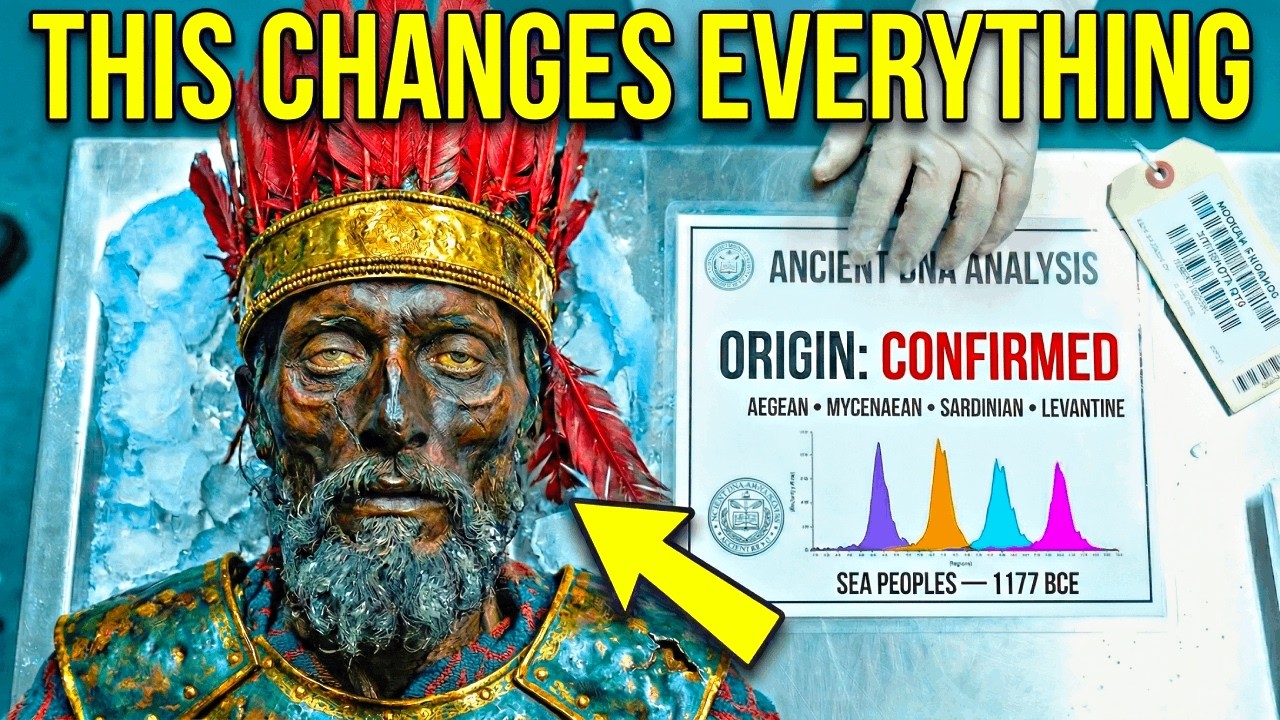
New groundbreaking DNA analysis reveals the Sea Peoples, infamous for wreaking havoc on the Bronze Age civilizations over 3,200 years ago, were not mysterious invaders from beyond but complex, interconnected groups with European ancestry who settled and integrated into the Levantine world, reshaping history’s narrative. This scientific breakthrough undercuts prior assumptions and radically redefines their origins.
Three millennia ago, an unprecedented collapse shattered the most sophisticated civilizations of the late Bronze Age. Palatial centers like Mycenaean Greece were razed, the Hittite Empire vanished, and Ugarit was reduced to ash. This catastrophe, long attributed to the enigmatic Sea Peoples, left historians grappling for answers about the true identity and fate of these marauding groups.
Until recently, the Sea Peoples remained a shadowy coalition only known through Egyptian inscriptions celebrating Pharaoh Ramesses III’s claimed victories. Yet these records were steeped in triumphalist propaganda, obscuring the reality of a multifaceted and prolonged crisis. Archaeologists lacked the biological evidence needed to untangle their origins and movements.
The breakthrough came with ancient DNA extraction from archaeological sites tied to the Sea Peoples’ descendants, particularly in Ashkelon, one of the Philistine Pentapolis cities. The genetic data revealed unmistakable European ancestry within early Philistine burials, confirming long-suspected connections to Southern Europe and the Aegean world, transforming speculation into hard scientific proof.
This European genetic imprint sharply differentiates the incoming Philistine settlers from the preceding Canaanite population, signaling a real migration rather than a mere cultural shift or diffusion. The DNA validates archaeological findings of distinctive pottery styles, dietary changes, and architecture linked to the Aegean, painting a clearer picture of the Sea Peoples’ actual identity.
However, this European lineage was fleeting. Within just two to three generations, the distinct genetic markers blended into the surrounding Levantine population, reflecting rapid integration rather than isolated separatism. The Sea Peoples arrived, settled, and became an indistinguishable part of the local genetic tapestry, their unique origin fading biologically yet enduring culturally.
The genetic studies further clarify that the Sea Peoples were not a single homogenized group but a coalition of diverse peoples including the Sherden, Lukka, Eqwesh, and others. No unified biological profile emerges, confirming ancient Egyptian accounts portraying them as a confederation of varied ethnic groups rather than one unified nation.
Notably, genetic analysis of the Nuragic culture from Bronze Age Sardinia corroborates archaeological claims about the Sherden warriors, affirming their European Mediterranean heritage and longstanding maritime traditions. Sardinia emerges as a key locus in this complex web of peoples, trade, and warfare spanning the late Bronze Age.
This genetic evidence dovetails with broader archaeological and climatological data outlining a perfect storm that precipitated the collapse: prolonged droughts, devastating earthquakes, disrupted trade routes—especially for tin—and internal social upheavals. The Sea Peoples exploited this systemic failure, appearing as both agents and symptoms of a world unraveling.
Egypt’s role was pivotal yet ultimately insufficient to withstand the tempest. While Pharaoh Ramesses III repelled invasions at the Nile, his victory was pyrrhic, as the empire was already weakened by external pressures and internal decay. Notably, some Sea Peoples were resettled in Egyptian territories as vassals, illustrating the complexity beyond simple conquest and destruction.
The Philistine settlements established on the southern Levantine coast under Egyptian suzerainty became a cultural melting pot. Their distinctive material culture, food customs, and urban forms epitomize the fusion of European migrant origins with Levantine traditions, creating a legacy that echoes through biblical texts and remains archaeologically visible today.
This reconfiguration challenges prior misconceptions portraying the Sea Peoples as alien invaders tearing apart a stable world. Instead, they were interconnected Mediterranean peoples, displaced and transformed by climate, conflict, and economic collapse, who adapted by migration and assimilation into new socio-political landscapes.
The study’s findings carry profound implications for understanding ancient history as a dynamic interplay of migrations, collapse, and resilience. They affirm that cultural identities can persist while biological ones blend and that humanity’s ancient interconnectedness shaped both destruction and renewal in profound ways.
For the first time, ancient DNA gives voice to people who had been silent for three millennia, transforming shadowy figures into complex human groups with tangible links to modern populations in the Levant. These revelations humanize the Sea Peoples and redefine how the Bronze Age collapse is interpreted.
In summary, the Sea Peoples were not an enigmatic external threat but an integral part of Late Bronze Age Mediterranean society unraveling under climatic and geopolitical pressures. Their biological legacy endures within the gene pool of the Levant, testament to survival, adaptation, and the enduring complexity of human history.