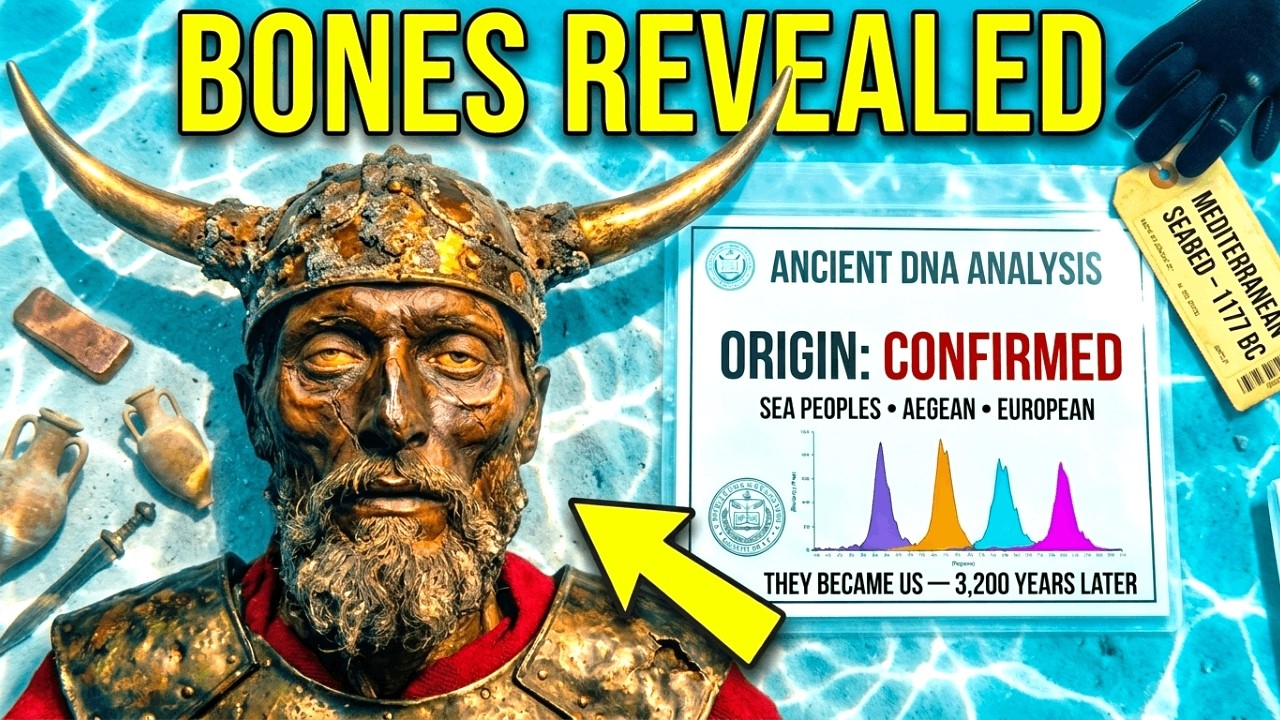
New groundbreaking DNA research shatters centuries-old assumptions about the elusive Sea Peoples, revealing they were not mysterious invaders but diverse groups rooted within the Bronze Age Mediterranean world itself. This revelation recasts a pivotal ancient crisis and reshapes our understanding of civilization’s collapse over 3,000 years ago.
For decades, the Sea Peoples were a historical enigma blamed for the catastrophic downfall of multiple great Bronze Age civilizations. Palatial complexes burned, empires vanished, and thriving coastal cities were reduced to ash. All that endured was the sparse Egyptian record, describing these warriors as foreign invaders streaming down the Nile, clad in distinctive armor and weaponry.
Yet this single-narrative perspective hinged on Egyptian propaganda, designed to show Pharaoh Ramesses III’s triumph. The reality was far more complex. The so-called Sea Peoples were not a singular army but a coalition of diverse populations 𝒄𝒂𝓊𝓰𝒉𝓉 in an unprecedented regional collapse marked by famine, earthquakes, and supply chain failures.
Ancient DNA analysis, extracted from the remains of individuals buried at early Philistine sites like Ashkelon, delivers the crucial missing piece. Researchers identified unmistakable European genetic signatures interwoven with the native Levantine populations during the transition from the Bronze to Iron Age, confirming migration from southern Europe and the Aegean.
This genetic evidence dismantles the myth of the Sea Peoples as alien conquerors. Instead, it proves they were displaced groups fleeing widespread environmental and socio-political disruptions within the very trade networks and empires they once participated in. Their arrival accelerated existing systemic failures rather than initiated them.
Further DNA studies show the genetic imprint of these migrant populations faded within a few generations, blending seamlessly with indigenous peoples. The Sea Peoples’ biological identity dissolved, replaced by integrated cultures retaining only faint memories of their origins. Their legacy survives instead in archaeological artifacts and ancient texts, like the Philistines of the Old Testament.
Intriguingly, no uniform genetic signature links all Sea Peoples groups, illustrating they were multiple peoples unified by circumstance, not biology. The famed Sherden were connected to Sardinia, Peleset to the Philistines of Canaan, and the Lukka originated from southwestern Anatolia. This diversity highlights a far-reaching maritime network fraying under immense pressure.
Environmental crises fueled the collapse. Prolonged droughts devastated agriculture while a flurry of earthquakes shattered cities from Greece to the Levant. Critical resource disruptions, especially tin from Afghanistan, crippled bronze production, the cornerstone of military and economic power. These combined stresses rendered empires fragile and susceptible to upheaval.
Archaeological evidence of selective palace destructions alongside surviving settlements implies internal strife and targeted attacks rather than indiscriminate invasion. The Sea Peoples capitalized on this weakness, sometimes as refugees seeking new homelands, other times as mercenaries woven into collapsing state armies—complex roles far beyond merciless marauders.
Egypt’s survival emerged as an anomaly, thanks in part to its isolation from seismic zones and strategic use of resettled Sea Peoples as vassals along its borders. Ramesses III’s inscriptions, long viewed as triumphalist propaganda, also suggest pragmatic accommodation of these groups, transforming former enemies into guardians of the empire’s frontiers.
The Uluburun shipwreck vividly symbolizes the interconnected and cosmopolitan Bronze Age world lost to this turmoil. Its cargo—from Cypriot copper to Baltic amber to Aegean pottery—testifies to a sophisticated trade system dismantled abruptly, as systems collapsed simultaneously rather than succumbing to a single external blow.
This breakthrough in ancient DNA analysis does not only solve a historical mystery but profoundly humanizes the Sea Peoples. It reveals a shared story of upheaval, adaptation, and survival, reminding us that the forces behind civilization’s collapse were born of the same humanity that constructed the ancient world’s greatest achievements.
In the end, the Sea Peoples did not vanish into oblivion. Their descendants continue quietly across the Mediterranean, their identities transformed but enduring. The Bronze Age collapse was not an invasion by unknown others but a cataclysm within humanity itself—devastating, transformative, and fundamentally familiar.
As archaeology and science converge, this urgent revelation forces a rewrite of ancient history’s darkest chapter. The Sea Peoples are no longer distant specters but real peoples shaped by—and shaping—the immense dramas of their age. Their story is, quite literally, part of our story today.